Other recent blogs


Most modernization programs stall not because of technology, but because of a bad first decision. Teams pick a strategy before understanding what they actually have. Legacy applications vary wildly in business value, technical debt, and cloud readiness. A lift-and-shift works for one system and destroys ROI for another. This blog cuts through that confusion. It maps out what application modernization is, why it matters in 2026, and how the 7 Rs framework gives CIOs a structured, defensible way to match every application to the right modernization path.
This post covers the definition and application modernization benefits, walks through each of the 7 Rs of application modernization, explains how to sequence them into a practical application modernization roadmap, and closes with common decision-making questions answered directly.
What is application modernization?
Application modernization is the process of updating legacy software systems to align with current business requirements, technology standards, and cloud-based infrastructure. It is not a single action. It is a portfolio-level discipline that involves evaluating each application and deciding whether and how to evolve it.
Legacy systems are not just old code. They are systems that have become expensive to maintain, difficult to integrate, and risky to change. In a survey by Gartner CIO survey, it was found that 46% of organizations planned to increase spending on application modernization, ranking it among the top four technology investment areas. That number reflects a market reality: organizations cannot pursue AI, real-time data, or scalable digital products while running on fragile monolithic backends.
The application services market was valued at $526 billion in 2024 and is projected to reach $793 billion by 2028, driven largely by modernization demand. Ignoring legacy debt is no longer a neutral choice. It carries compounding cost and competitive risk.
What are the key application modernization benefits?
The business case for modernization is not abstract. The application modernization benefits are measurable and direct.
Reduced total cost of ownership is the most immediate driver. Legacy systems require expensive specialized skills, proprietary licenses, and high maintenance effort. Modernized applications running on cloud-native infrastructure typically reduce infrastructure costs and allow operational teams to focus on higher-value work.
Agility and speed of deployment improve significantly. Modern architectures, particularly microservices and containerized workloads, allow individual components to be updated, tested, and released independently. This directly accelerates time-to-market for product teams.
Security posture improves with modernization. Legacy applications frequently run on unsupported versions of databases, operating systems, and runtimes. Modernized systems benefit from cloud-native security controls, automated patching, and better compliance tooling.
Scalability becomes elastic. Cloud-native applications scale on demand, which is critical for organizations operating in markets with variable load, including retail, financial services, and healthcare.
Data and AI readiness improves. Organizations modernizing in 2024 are prioritizing core back-end applications at 41% and data and analytics applications at 35%, reflecting the direct link between modernization and AI readiness. You cannot build reliable AI pipelines on unreliable legacy data infrastructure.
Integration capability expands. Modern APIs, event streaming, and microservices make it far easier to connect applications across cloud, edge, and partner systems.
What is an application modernization strategy, and why does it require the 7 Rs framework?
An application modernization strategy is the documented approach an organization takes to evaluate, prioritize, and execute the transformation of its application portfolio. Without a structured strategy, organizations default to ad hoc decisions, typically modernizing the most visible applications first while ignoring systemic debt.
The 7 Rs of application modernization form a strategic framework, originally shaped by Gartner's migration research and expanded by AWS, that helps organizations assess, plan, and execute legacy application transformation at scale. Below is the breakdown of the 7 Rs of application modernization:
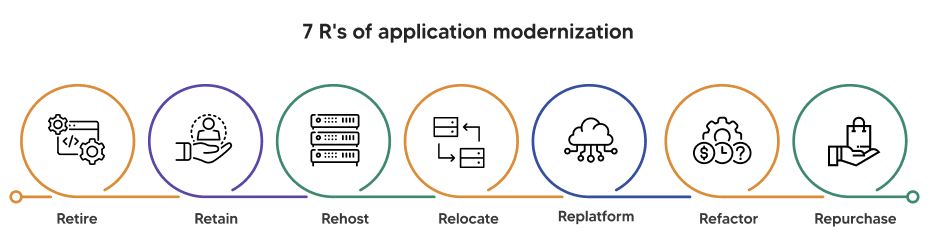
Retire
Retire means decommissioning applications that deliver no meaningful business value. These are systems that exist because no one has formally decided to shut them down, not because anyone actively uses them. Retiring applications reduces licensing costs, frees infrastructure, and lowers security exposure. Before any modernization program begins, a portfolio audit typically identifies 15 to 30 percent of applications as candidates for retirement. This is often the highest-ROI move in a modernization program because it eliminates cost with no migration complexity.
Retain
Retain means keeping an application in its current state, at least for a defined period. This applies to systems with strict compliance requirements, prohibitive migration complexity, or those scheduled for future replacement. Retain is not indefinite avoidance. It should come with a review date and clear criteria that would trigger re-evaluation. Treating retain as a permanent default is how technical debt accumulates.
Rehost
Rehost, often called lift-and-shift, moves an application to a new environment, typically a cloud platform, without changing its architecture or code. It is the fastest migration path and requires minimal cloud expertise. Rehost is appropriate when the organization needs to exit a data center quickly, when the application runs acceptably as-is, or when a broader refactor is planned for a future phase. The trade-off is clear: rehosting delivers none of the cloud-native benefits. Cost savings come primarily from infrastructure consolidation, not from optimized resource usage or modern scaling.
Relocate
Relocate is a variant of rehost that moves entire virtual machine instances from on-premises to a cloud-based hypervisor without changing the VM, operating system, or application. It is most relevant for VMware workloads moving to a managed cloud VMware environment. Relocate is faster and lower-risk than most other strategies but, like rehost, does not address underlying architectural limitations.
Replatform
Replatform, sometimes called lift-tinker-shift, keeps the application's core architecture intact but makes targeted changes to take advantage of cloud capabilities. Common examples include migrating from a self-managed database to a managed cloud database service, containerizing workloads, or adopting cloud-native logging and monitoring. Replatform delivers better ROI than rehost without the full complexity of refactoring. It is well-suited for core line-of-business applications that need improved performance and resilience but do not justify a full rearchitecture.
Refactor
Refactor, also called rearchitect, involves substantial changes to how the application is structured. The goal is to take full advantage of cloud-native capabilities. Common refactoring approaches include breaking a monolith into microservices, adopting serverless compute for specific functions, and rearchitecting data layers for streaming or real-time analytics. Refactoring is the most complex and expensive path. It is justified when an application has high business value, is central to competitive differentiation, and is constrained by its current architecture. Refactoring is best for complex and custom applications where the upfront investment is offset by long-term performance, agility, and scalability gains.
Repurchase
Repurchase replaces a legacy application with a commercial off-the-shelf or SaaS solution. This is the right call when a custom-built application duplicates functionality available in a mature market product, when the cost of maintaining the custom system exceeds the cost of licensing, or when the business process it supports is not a source of competitive differentiation. Repurchase decisions require careful change management because they often involve moving from a familiar custom interface to a standardized product workflow.
How does a practical application modernization roadmap work?
An application modernization roadmap translates the 7 Rs framework from a classification exercise into a sequenced delivery plan. It does not need to be a multi-year Gantt chart. It needs to be a living document that connects business priorities to migration decisions.
A credible roadmap has five phases.
- The first is portfolio discovery and assessment. Every application is inventoried with metadata covering business criticality, usage metrics, technology stack, integration dependencies, and estimated technical debt. This is where the 7 Rs assignment happens.
- The second is rationalization and prioritization. Applications assigned to Retire are decommissioned first. Applications assigned to Retain are formally parked with review dates. The remaining applications are sequenced based on business value, interdependency risk, and effort.
- The third is architecture planning. For applications being replatformed or refactored, target architecture designs are produced. This is where cloud-native patterns, API contracts, and data migration strategies are defined.
- The fourth is phased execution. Modernization runs in waves, typically grouping applications by domain or dependency cluster. Quick wins, such as retirements and rehosting of low-complexity systems, deliver early cost savings and demonstrate momentum.
- The fifth is continuous governance. The portfolio is reassessed regularly, at minimum annually. New applications entering the portfolio are evaluated at intake against the same framework. Modernization is not a project that ends. It is a discipline that runs continuously.
A common failure in roadmap execution is treating the 7 Rs assignment as permanent. Business context changes. An application retained for compliance reasons may become eligible for replatforming when regulation shifts. A repurchase decision may reverse if a SaaS vendor is acquired or changes pricing. The roadmap must be revisited, not just executed.
How does Kellton help organizations execute their application modernization roadmap?
Kellton brings structured methodology and engineering depth to every phase of the modernization lifecycle. From portfolio assessment and 7 Rs classification to cloud-native architecture design and phased migration execution, Kellton helps CIOs make faster, lower-risk decisions on legacy application debt. With delivery experience across financial services, retail, and technology sectors, Kellton builds modernization roadmaps that are sequenced for business impact, not just technical convenience. Ready to assess your legacy portfolio? Connect with Kellton's modernization team to start.
Frequently Asked Question
Question: What is application modernization?
Answer: Application modernization is the process of updating legacy software to meet current business needs, performance standards, and infrastructure models, primarily through cloud migration, rearchitecting, or replacement of outdated systems.
Question: What are the 7 Rs of application modernization?
Answer: The 7 Rs are Retire, Retain, Rehost, Relocate, Replatform, Refactor, and Repurchase. Each represents a distinct strategy for handling a legacy application, ranging from decommissioning to full rearchitecture. The right R depends on business value and technical fit.
Question: What is the easiest application modernization strategy?
Answer: Rehosting (lift-and-shift) is the lowest-effort option. It moves an application to a new environment without changing code or architecture. It is fast and low-risk but does not deliver cloud-native performance or cost optimization benefits.
Question: What are the main application modernization benefits?
Answer: Key benefits include reduced infrastructure costs, improved security posture, faster deployment cycles, elastic scalability, and better readiness for data and AI workloads. The weight of each benefit varies by application type and business context.
Question: How long does an application modernization roadmap take?
Answer: It depends on portfolio size and complexity. A focused roadmap for 50 to 100 applications typically runs 18 to 36 months in phased waves. Governance and re-assessment continue beyond initial execution.
Question: What is the difference between replatforming and refactoring?
Answer: Replatforming makes targeted infrastructure-level changes while preserving application architecture. Refactoring restructures the application itself to adopt cloud-native design patterns such as microservices or serverless. Refactoring costs more and takes longer but delivers deeper architectural benefits.
Question: When should an organization use the repurchase strategy?
Answer: When a custom application replicates functionality available in a mature SaaS product, and when maintaining the custom system costs more than licensing the SaaS alternative. The decision also depends on how differentiated the business process the application supports actually is.