Other recent blogs


In 2026, the digital divide is no longer between those who have an app and those who don’t; it’s between those whose systems are agile, AI-ready assets and those whose software acts as a digital anchor. If your organization is spending the majority of its IT budget on maintaining stagnant code, you aren’t just losing money; you are losing your ability to compete in a market driven by real-time intelligence. Recent data indicate that the global application modernization market is projected to grow from $30 billion in 2026 to $92 billion by 2034, reflecting a massive shift toward cloud-native and AI-augmented engineering. Furthermore, enterprises that prioritize legacy app modernization report 30–50% faster release cycles and up to a 75% reduction in IT infrastructure costs, demonstrating that the cost of doing nothing now poses the highest risk of all.
The Hidden Architectures of Risk: 2026 Challenges of Legacy Apps
While many executives once viewed legacy software as a stable foundation, the reality in 2026 is that these systems act more like anchors than foundations. Legacy applications often lack the architectural flexibility required to operate efficiently across modern, distributed cloud ecosystems, creating a massive integration overhead that prevents total scalability. In an era where real-time data streaming and agentic AI are the bare minimum benchmarks for high-performance operations, these siloed environments prevent businesses from responding to market shifts with the necessary speed.
Beyond the technical constraints, there is a profound human challenge: the knowledge gaps surrounding these systems are widening as the experts who built them are now on the verge of retiring. Without proper documentation or a modern codebase, making even minor updates feels like defusing a bomb, where one small change might trigger a total system collapse or catastrophic security breach. Here are the primary challenges of legacy apps that define the 2026 landscape:
- The Technical Debt Interest Rate: Maintaining systems built on COBOL, outdated Java, or old .NET versions is no longer just a budget line item; it is a drain that consumes up to 70% of total IT spending for many enterprises. This technical debt effectively subsidizes the past at the expense of the future, preventing organizations from investing in high-value initiatives like predictive analytics or automated supply chain orchestration.
- Antiquated Security Frameworks: Most legacy apps were built in an era of perimeter-based security, which is insufficient to confront the sophisticated AI-driven cyber threats of today. These systems typically lack native support for encryption, multi-factor authentication (MFA), and zero trust principles, making them easy targets for data breaches that now carry devastating financial and reputational consequences.
- Data Fragmentation and Silos: Legacy applications often house data in proprietary, unstructured formats that are almost impossible for modern AI tools to analyze in real-time. This fragmentation forces teams into manual data processing and creates "dark data" repositories, where valuable business insights remain trapped and unusable for strategic decision-making.
- The Talent Scarcity Crisis: In 2026, questing for developers who can work on two-decade-old codebases is a significant operational risk that will one day pave the way to total project stagnation. Modern engineering talent gravitates toward cloud-native stacks and AI-assisted workflows, leaving companies with legacy systems reliant on a shrinking, increasingly expensive pool of specialized contractors who charge a premium for their niche knowledge.
Strategic Framework: The 7 Rs of Application Modernization
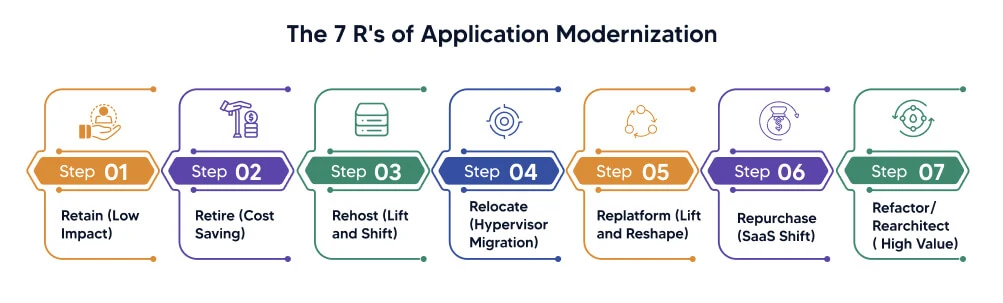
Selecting the right strategy is the most critical decision in any transformational journey, as it dictates the cost, risks, and the ultimate business benefit of the effort. Organizations in 2026 are moving away from risky "all-or-nothing" migrations in favor of modular application modernization approaches that prioritize business continuity. The “7 Rs” framework provides a structured menu of pathways, allowing leaders to tailor their approach based on the specific needs and risks of each workload in their portfolio. To succeed, enterprises must integrate comprehensive legacy application modernization strategies that look beyond simple code updates and focus on long-term scalability.
- Retain (Low Impact): This involves keeping the application in its current environment without making changes for now, often because the app is stable or slated for future decommissioning. It is a valid choice for systems that still provide high ROI but don’t yet require the agility of the cloud, allowing budgets to be focused on higher-priority legacy app modernization targets.
- Retire (Cost Saving): This is the strategic decommissioning of applications that no longer serve a business purpose, or rather provide redundant functionality. By identifying and shutting down these zombie apps, organizations can immediately reduce licensing fees and maintenance overhead, freeing up resources for more innovative, dynamic digital transformation projects.
- Rehost (Lift and Shift): This approach moves an application to the cloud “as-is” without changing the underlying code, offering the fastest route to reducing data center costs. While it doesn’t solve architectural issues, it provides immediate infrastructure benefits and serves as a foundational step for future, more granular application modernization approaches.
- Relocate (Hypervisor Migration): This involves moving virtual machines directly from an on-premise server to cloud environments with zero changes to the application or its configuration. It is an ideal strategy for massive data center exits where consistency and speed are prioritized over immediate architectural improvements, often utilizing tools like VMware Cloud on AWS.
- Replatform (Lift and Reshape): The strategy moves the applications to the cloud while making minor optimizations to leverage specific managed services, such as switching from a self-managed database to Amazon RDS. It offers a balanced middle ground, providing improved performance and reduced operational toil without the high cost and timeline of a full code rewrite.
- Repurchase (SaaS Shift): When a custom-built legacy system no longer offers a competitive advantage, organizations often choose to drop-and-shop by moving to a cloud-native SaaS alternative. This replaces the burden of maintenance with a subscription model, ensuring the business always has access to the latest features and security updates from the industry leaders.
- Refactor/Rearchitect ( High Value): This is the most transformative approach, involving a fundamental redesign of the application’s core structure into microservices or serverless architecture. By untangling a monolithic giant, companies gain the ability to scale components independently and integrate seamlessly with 2026’s advanced AI and real-time data streaming services. This path is frequently cited in effective legacy application modernization strategies for core business systems.
Rearchitecting a legacy system is the ideal time to pivot to a stack that supports AI and high-concurrency. Most modern transformations we lead at Kellton involve moving to Go or FastAPI to reduce cloud costs and improve response times. See how these compare in our 2026 Guide to Best Backend Frameworks.
Transforming Operations: Application Modernization Use Cases
Modernizing is no longer a generic IT task; it is a vertical-specific growth strategy that enables new business models and customer experiences. From banking to healthcare, the transition away from rigid systems is unlocking real-time capabilities that were previously impossible for legacy-bound firms. These application modernization use cases demonstrate how technical upgrades translate directly into market-leading advantages in 2026. This evolution ensures that legacy data is no longer a static archive but a dynamic fuel for modern business intelligence and customer engagement. To understand this impact in action, we must look at how different industries are specifically leveraging these technologies to solve long-standing operational bottlenecks. We will now see some key application modernization use-cases.
- Financial Services (BFSI): Global banks are using a strangler pattern to incrementally migrate Mainframe ledger functions to cloud-native microservices to support instant, 24/7 cross-border payments. This legacy app modernization allows them to integrate real-time fraud detection AI directly into the transaction stream, reducing losses while providing a seamless, secure mobile banking experience for their customers. By decoupling these services, banks can also roll out new fintech features in days rather than months, staying ahead of digital-only competitors.
- Healthcare and Lifesciences: Providers are modernizing legacy electronic health record (EHR) systems to support FHIR data standards, enabling seamless interoperability between hospitals and wearable devices. This shift facilitates predictive patient care, where AI models analyze a patient’s historical data and real-time updates to alert doctors hours before a medical emergency occurs, significantly improving patient outcomes. This interconnected system also reduces administrative burnout by automating data entry and compliance reporting across disparate medical networks, showcasing one of the most impactful application modernization use cases of the decade.
- Manufacturing and Industry 4.0: Manufacturers are using API-first legacy application modernization strategies to connect decades-old factory floor machinery with modern AI-driven supply chain platforms. By "wrapping" legacy protocols in modern interfaces, they achieve a digital twin of their operations, allowing for predictive maintenance that reduces unplanned downtime by as much as 30% annually. This integration also allows for real-time inventory adjustments based on global market fluctuations, ensuring lean operations even during supply chain volatility.
Leading the Modernization Wave
In 2026, the legacy app modernization has transitioned from a back-office IT project to a front-line competitive strategy. The path forward requires a systematic approach to untangling technical debt and aligning your technology stack with your business outcomes. Future-proofing your enterprise requires more than just moving code to the cloud; it requires a cultural shift towards continuous evolution and architectural flexibility. Whether you choose to rehost for speed or rearchitect for innovation, the key is to begin the journey now before the gap between your legacy systems and the modern market becomes an unbridgeable chasm. Adopting diverse application modernization approaches tailored to your specific needs ensures your organization remains resilient, scalable, and ready to lead in an increasingly AI-driven world. Enterprises must continuously refine their legacy modernization strategies to adapt to the rapid advancements in cloud-native technologies.
Frequently Asked Questions (FAQs)
Q1: How do we determine if an app should be modernized or retired?
Answer: Organizations use an effort vs value matrix; if the cost of maintenance exceeds the value provided and the app lacks a competitive edge, it is a candidate for retirement. However, if the app contains unique business logic that cannot be found in off-the-shelf software, modernization is the necessary path.
Q2. Can AI help speed up the modernization process in 2026?
Answer: Yes, the AI-augmented engineering is now a standard, with LLMs capable of analyzing 80000 lines of code in under an hour to summarize dependencies or even translate legacy languages like COBOL into modern Java or Python. This reduces discovery and refactoring timelines by up to 40%.
Q3: What is the biggest risk during a modernization project?
Answer: The primary risk is business disruption caused by data complexity or unforeseen dependencies that break critical workflows during migration. This is why 2026 best practices emphasize a phased, incremental approach rather than a Big Bang transition, ensuring systems remain operational throughout.
Q4: How long does a typical modernization project take?
Answer: Timelines vary significantly: a simple "Rehost" might take 3 months, while a full "Rearchitecting" of a core enterprise system can span 12 to 24 months. Most successful firms break these long timelines into 3-month sprints to deliver measurable business value and ROI at every stage.