Other recent blogs


Enterprise AI is on the verge of failing, and surprisingly, it is not because of the weak models. The real culprit behind the failure is the presence of obsolete enterprise data platforms that are fragmented, under-governed, and misaligned with real-time decision requirements. In the AI-centered landscape, CIOs are rebuilding digital transformation on cloud-native and AI-ready data foundations. This makes Microsoft Azure the preferred platform for organizations focused on AI-driven growth, regulatory compliance, and scalable data operations.
Azure leads as an enterprise data platform due to its architectural alignment with AI. Furthermore, the data architecture, integration, governance, hybrid flexibility, and embedded AI services are designed to function as a unified platform. This blog outlines why Azure is the platform of choice for enterprise data modernization, how its benefits drive measurable business outcomes, and how organizations are rebuilding core data estates on Azure to support AI, analytics, and operational intelligence at scale.
How is Microsoft Azure changing the game for enterprise data modernization?
Most enterprise data stacks were not designed for current demands. The data volume, velocity, and variety in 2026 have surpassed the capabilities of architectures built for earlier challenges. AI workloads now require real-time, governed, and unified data access at a scale that legacy platforms cannot provide.
This gap is already resulting in project delays, cost overruns, and competitive disadvantages. Microsoft Azure has become the preferred platform for enterprises seeking to address these challenges. Azure offers an integrated data and AI ecosystem that combines storage, processing, governance, analytics, and AI services under a unified security and identity model.
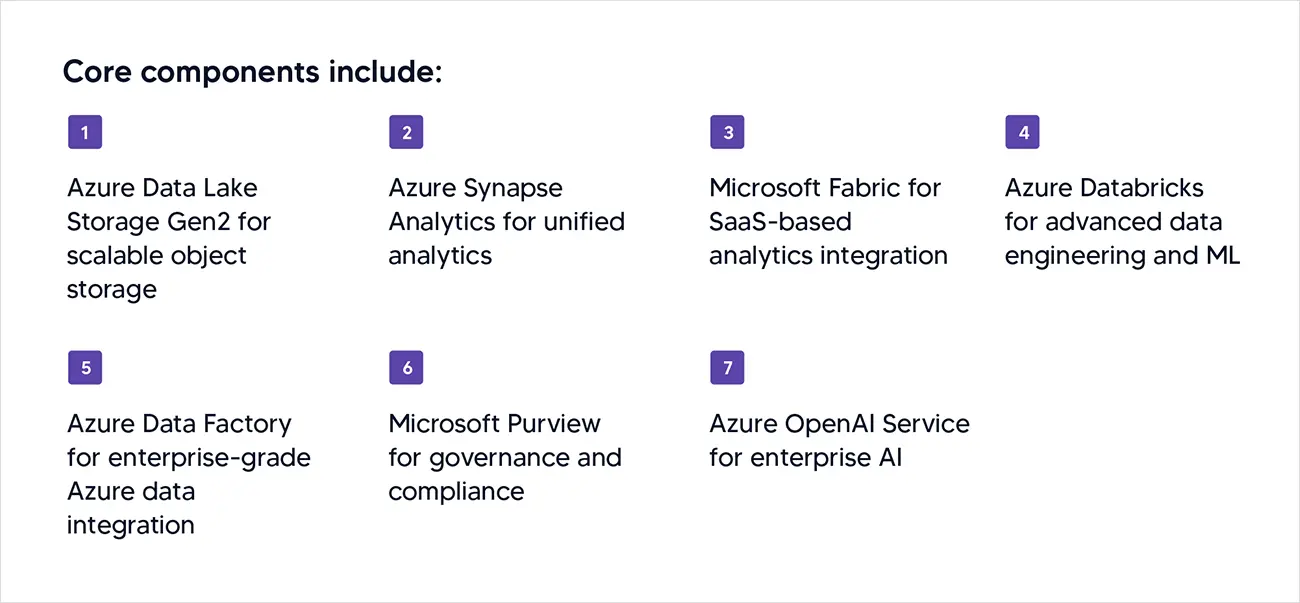
- Azure Data Lake Storage Gen2 for scalable object storage
- Azure Synapse Analytics for unified analytics
- Microsoft Fabric for SaaS-based analytics integration
- Azure Databricks for advanced data engineering and ML
- Azure Data Factory for enterprise-grade Azure data integration
- Microsoft Purview for governance and compliance
- Azure OpenAI Service for enterprise AI
This shift is structural. While traditional data warehouses were siloed, modern Azure data architecture integrates transactional systems, IoT feeds, SaaS applications, and AI pipelines within a governed lakehouse model. This integration is essential for AI initiatives that require clean, unified, policy-driven data. Azure brings infrastructure, data engineering, governance, and AI together under a single control plane, offering a level of enterprise coherence across hybrid environments that few competitors match.
According to Microsoft's FY2025 earnings data, Azure revenue grew 35% year over year in Q2 2025, with a significant portion attributed to data and AI workloads. Gartner's 2025 Magic Quadrant for Cloud Database Management Systems placed Microsoft as a Leader for the fourth consecutive year. These are not vanity metrics. They reflect enterprise spending decisions made by organizations that evaluated alternatives and committed capital.
What are the top reasons enterprises choose Microsoft Azure for AI-driven transformation?
Enterprises migrate to Azure not for a list of features, but because the platform addresses critical barriers to growth. The following are five key reasons driving enterprise adoption.
1. Unified data and AI architecture: the Microsoft Fabric shift
Microsoft Fabric represents the most significant architectural consolidation in enterprise analytics since the data warehouse era. It combines Azure Data Factory, Azure Synapse Analytics, Power BI, and Azure Data Lake Storage into a single SaaS platform underpinned by OneLake, a single logical data lake for the entire organization.
This consolidation allows data engineers, data scientists, and business analysts to work with the same data within a unified governance framework, eliminating the need to copy data between systems. As a result, organizations reduce costs and inconsistencies caused by data duplication across siloed tools.
2. AI-first foundation with Azure OpenAI
Azure OpenAI Service gives enterprises access to OpenAI's GPT-4o, o1, and o3 model families through Azure's enterprise API infrastructure, meaning the same security, compliance, and network controls that govern the rest of the Azure environment apply to AI workloads.
This matters because the alternative, calling the OpenAI API directly from production enterprise systems, introduces data residency, logging, and compliance risks that most regulated industries cannot accept. Azure OpenAI keeps data within the enterprise's Azure tenant, supports private endpoints, and integrates with Microsoft Entra ID for identity governance.
Azure AI Foundry, which reached general availability in 2025, provides a unified studio for building, evaluating, and deploying AI applications using both Microsoft-hosted and open-source models. Azure AI Search adds vector search and retrieval-augmented generation (RAG) capabilities that connect enterprise data to AI models without retraining. For enterprises building AI-driven products or internal tools, this integration removes the need to manage separate AI infrastructure. The data lives in OneLake. The AI services run in the same Azure region. The governance policies apply consistently.
3. Unmatched hybrid and multicloud mastery
Few enterprises operate solely in one cloud. Azure stands out due to Azure Arc, which extends Azure management, governance, and services to on-premises servers, other clouds, and edge locations.
Azure Arc enables enterprises to apply Azure Policy, Microsoft Defender for Cloud, and Azure Monitor to resources on AWS, Google Cloud, or private data centers. For CIOs managing hybrid environments, this provides a single control plane for compliance, security monitoring, and cost management across diverse infrastructure.
For multicloud data integration, Azure Data Factory supports over 100 connectors, including native options for AWS S3, Google BigQuery, Snowflake, and Salesforce. Enterprises can build Azure-centric analytics platforms without moving all data to Azure by federating queries across sources using Microsoft Fabric's shortcut feature, which creates virtual links to external data.
4. Embedded security and governance
Microsoft Purview serves as the unified governance layer across the Azure data estate. It provides automated data discovery and classification, sensitivity labeling that follows data as it moves between services, access policy management, and data lineage tracking from source to report. For organizations subject to GDPR, HIPAA, SOC 2, or industry-specific regulations, Purview reduces the manual effort of compliance reporting significantly.
Microsoft Entra ID handles identity and access management with conditional access policies, privileged identity management, and integration with over 3,000 third-party SaaS applications. Column-level and row-level security in Azure Synapse and Fabric can be tied directly to Entra ID group membership, removing the need to manage data permissions in a separate system. Microsoft Defender for Cloud provides continuous security posture assessment and threat detection across Azure workloads, with specific protections for Azure SQL, Azure Cosmos DB, Azure Storage, and Azure Kubernetes Service.
5. Performance, scale, and reliability
Azure operates 60-plus regions globally as of 2025, more than any other cloud provider. For enterprises with data residency requirements, this geographic coverage is a practical necessity.
Azure Synapse Analytics and Microsoft Fabric both use distributed query execution engines that scale compute independently of storage. This means an enterprise can run complex queries against petabytes of data without pre-provisioning compute capacity. Autoscaling handles burst workloads, and pause-resume capabilities eliminate compute costs during idle periods.
Azure Cosmos DB offers single-digit millisecond read and write latency at any scale, with 99.999 percent availability SLAs for multi-region configurations. Azure's 99.9 to 99.99 percent SLAs across compute, storage, and database services are backed by financial credits.
Where do traditional cloud and infrastructure approaches hit limits for enterprise data?
Legacy enterprise data architecture, built on on-premises data warehouses, ETL batch pipelines, and siloed departmental analytics tools, was designed for a world where data volume grew slowly, AI was not a production workload, and real-time analytics was a niche requirement.
These limitations are evident in areas such as batch pipelines, which introduce latency between events and insights. For example, a supply chain disruption at 2:00 AM may not appear in dashboards until the next business day if pipelines run nightly. Siloed data architectures also create inconsistent metrics, requiring significant effort to reconcile data across departments.
In 2026, traditional architectures are not equipped to support AI models. Machine learning requires governed access to large historical datasets, low-latency feature retrieval for real-time inference, and integration with model management systems. Most legacy platforms require extensive rearchitecting to support even basic machine learning workflows.
Cloud-native migrations that replicate on-premises system structures often inherit existing issues. While moving an on-premises SQL Server data warehouse to Azure SQL Managed Instance is faster than rebuilding, it does not resolve the underlying architectural limitations.
How are modern enterprises rebuilding their data foundations on Microsoft Azure?
Successful Azure modernization typically follows a phased approach, delivering value at each stage rather than deferring benefits until the end of a multi-year program.
- Phase one focuses on establishing the foundation: setting up the landing zone, implementing data governance with Purview, integrating identity with Entra ID, and migrating high-value data sources to OneLake. This phase usually takes three to six months and immediately reduces compliance burdens for data teams.
- Phase two is unification: migrating analytics workloads to Microsoft Fabric, retiring redundant ETL tools, and establishing a single semantic model for both operational reporting and ad hoc analysis. Organizations completing this phase report a 30 to 60 percent reduction in time-to-insight for standard analytics requests.
- Phase three is AI enablement: integrating Azure OpenAI Service with enterprise data, developing RAG-based applications for natural language queries, and establishing MLOps workflows with Azure Machine Learning. This phase delivers compelling ROI for executive sponsors. Governance is critical at every stage; organizations that neglect early Purview-based classification and access policies often encounter costly regulatory challenges later.
How can Kellton help enterprises accelerate their Azure data platform journey?
We are a Microsoft Certified Solutions Partner with deep expertise across Azure migration and modernization, data and AI integration, cloudOps, DevSecOps, IoT and edge intelligence, site reliability engineering, and more. Our delivery model aligns with the phased modernization approach, and we at Kellton deliver purpose-built SaaS offerings on Microsoft Azure to improve operational visibility and predictive intelligence.
For organizations at the start of their Azure journey, Kellton offers a structured assessment that produces a prioritized modernization roadmap, complete with architecture recommendations, cost projections, and delivery timelines. This way, we help enterprises modernize, optimize, and accelerate faster. In every engagement, our starting point is your current state, not a fixed methodology. The goal is to make your Azure investment deliver measurable business value faster.
FAQS
Q: Why do enterprises select Microsoft Azure instead of other cloud providers?
Ans: Enterprises choose Azure when they need an integrated ecosystem rather than isolated cloud services. Azure connects compute, storage, Azure data platform services, AI capabilities, governance frameworks, identity management, and productivity tools into a single enterprise-grade architecture. For organizations already operating within the Microsoft ecosystem, this integration reduces complexity, lowers integration risk, and accelerates transformation.
Q: Is Azure secure enough for large-scale enterprise workloads?
Ans: Yes. Azure is built on Microsoft’s global cybersecurity investments and follows a Zero Trust security model by default. It supports advanced threat protection, continuous compliance monitoring, identity-centric access control, and one of the broadest regulatory compliance portfolios among cloud providers. Security and governance are embedded at the platform level, not added as an afterthought.
Q: How does Azure enable enterprise AI adoption?
Ans: Azure supports AI initiatives through OpenAI Service, Machine Learning, Microsoft Fabric, and AI Studio. These services allow enterprises to seamlessly develop, train, deploy, and govern AI models within a secure cloud boundary. Also, Azure data integration pipelines ensures AI models operate on trusted and governed enterprise data rather than disconnected datasets.
Q: Which workloads are best suited for Azure?
Ans: Azure is well-suited for modern cloud-native applications, large-scale analytics platforms, hybrid and multicloud environments, mission-critical enterprise systems, AI and Machine Learning pipelines, and enterprise data modernization programs.