Other recent blogs


In 2026, enterprises are at the verge of a critical challenge: balancing the competitive imperative to adopt custom AI with unpredictable software development costs ranging from $50,000 to over $2 million. The problem extends beyond initial budgeting, and organizations struggle to account for hidden infrastructure costs, ongoing maintenance, and the reality that 60% of AI projects exceed their original cost estimates by 30 to 50%.
Custom AI development — building AI systems designed specifically around a business's own data, workflows, and constraints, rather than adapting to an off-the-shelf tool — has become a default consideration for enterprises rather than an experimental one. Understanding what that investment actually costs, and why, is the focus of this guide.
Project scope and complexity form the foundation, where simple rule-based automation differs dramatically from deep learning systems requiring extensive data engineering.
Team composition directly impacts budgets, with AI specialists commanding $150,000 to $300,000 annually in competitive markets. Infrastructure requirements vary significantly—cloud-based solutions offer flexibility, while on-premises deployments demand a substantial upfront investment. Data preparation typically consumes 40 to 60% of project timelines, translating to substantial labor costs. Integration complexity with existing enterprise systems, regulatory compliance requirements, and post-deployment support commitments round out the cost equation.
This comprehensive guide examines the cost of custom AI development for enterprises in 2026, providing decision-makers with actionable cost breakdown frameworks. In this blog, we will delve deeper into detailed pricing models for different AI solution types, hidden costs often overlooked, and quick strategies to optimize custom AI development budgets.
What Factors influence Custom AI Development costs?
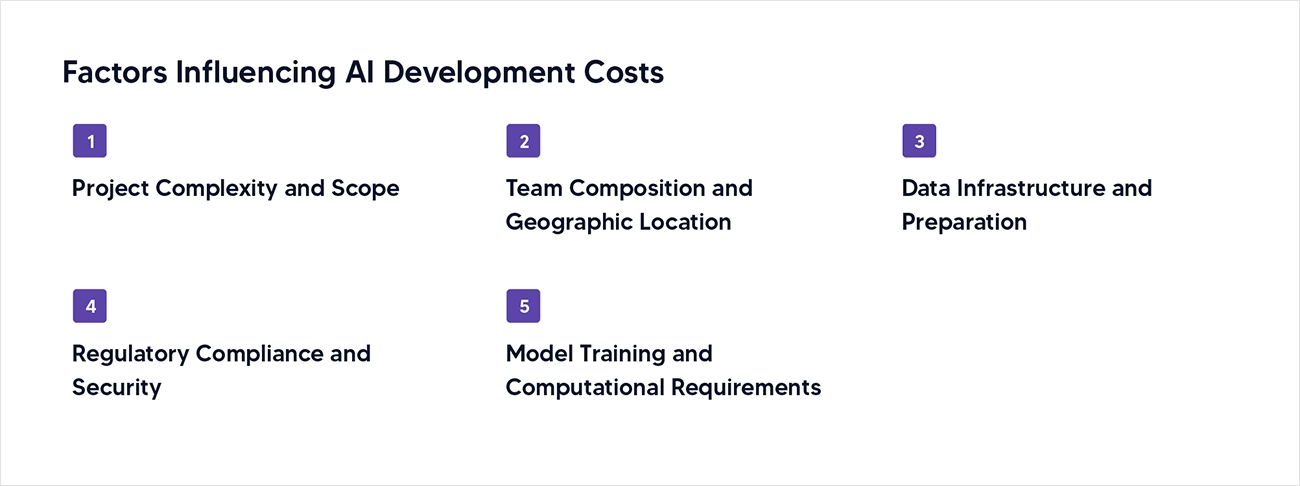
Project complexity and scope
The cost of developing AI solutions correlates directly with technical complexity. Simple AI implementations, such as chatbots handling predefined workflows or basic classification models, typically range from $50,000 to $150,000. These projects leverage existing frameworks and require minimal custom architecture. Mid-complexity solutions involving predictive analytics, recommendation systems, or computer vision applications cost between $150,000 and $500,000 and require custom model development and significant data engineering. Enterprise-grade AI systems incorporating multiple models, real-time processing, and advanced neural networks exceed $500,000, often reaching $2 million or more.
Scope definition significantly impacts the cost of AI software development. Projects requiring multi-modal AI capabilities—combining vision, language, and structured data processing—multiply development effort. Integration with multiple enterprise systems adds layers of complexity, each requiring custom API development, data mapping, and testing protocols.
Team composition and geographic location
Talent costs represent the largest component of custom AI development budgets. A typical AI development team comprises data scientists ($130,000 to $250,000 annually), machine learning engineers ($140,000 to $280,000), data engineers ($120,000 to $200,000), AI architects ($160,000 to $300,000), and DevOps specialists ($110,000 to $180,000). Projects requiring 6-12 months of development with a team of 5-8 specialists easily accumulate $500,000 to $1.5 million in labor costs.
Geographic arbitrage offers cost optimization opportunities. North American AI talent commands premium rates, while Eastern European developers provide 40-50% cost savings with comparable expertise. Asian markets offer 50-60% reductions, though time zone differences may impact collaboration efficiency. However, the cost of AI development considerations must balance labor savings against communication overhead and quality assurance requirements.
Data infrastructure and preparation
Data readiness fundamentally determines AI development cost. Organizations with mature data infrastructure—centralized data lakes, established governance frameworks, and clean datasets—reduce development timelines by 30-40%. Conversely, enterprises that require extensive data collection, cleaning, and labeling incur substantial additional costs.
Data preparation typically consumes $50,000 to $300,000 of project budgets. Annotation costs for supervised learning range from $0.10 to $5 per data point, depending on complexity. A computer vision project requiring 100,000 labeled images at $1 per image adds $100,000 to the cost before model development begins. Text annotation for NLP projects costs $20 to $100 per hour, with complex legal or medical domain requirements at the higher end.
Infrastructure costs vary based on deployment architecture. Cloud-based solutions using AWS SageMaker, Google Cloud AI Platform, or Azure Machine Learning incur ongoing operational expenses ranging from $5,000 to $50,000 per month, depending on model complexity and inference volume. On-premise infrastructure requires upfront GPU server investments ($20,000 to $100,000 per server) plus maintenance overhead.
Regulatory compliance and security
Industries facing stringent regulatory requirements—healthcare (HIPAA), finance (SOC 2, PCI-DSS), and government (FedRAMP)—experience 20-35% cost increases. Compliance requires enhanced security protocols, audit trails, explainability features, and bias-mitigation frameworks.
The cost of AI software development increases significantly when implementing privacy-preserving techniques. Federated learning, differential privacy, and homomorphic encryption add architectural complexity, extending timelines by 2-4 months and increasing costs by $100,000 to $300,000.
Model training and computational requirements
Training costs scale with model sophistication. Simple models using traditional ML algorithms (random forests, gradient boosting) require minimal computational resources—often costing less than $1,000 to train. Deep learning models demand substantial GPU resources. Training a moderately complex neural network costs $5,000 to $20,000 in cloud compute. Large language models or complex vision transformers can exceed $100,000 in training costs alone.
Hyperparameter optimization and model experimentation multiply these costs. Enterprise projects typically iterate through 20-100 model variations before deployment, requiring substantial computational budgets. Organizations should allocate 15-25% of total project budgets to computational resources.
What’s different about AI Development costs in 2026?
AI development costs in 2026 reflect a fundamental shift from model building to system engineering. Foundation models from leading vendors and open-source ecosystems have commoditized core intelligence, reducing baseline model development costs by 40–60% compared to 2023 and enabling API-driven experimentation at low cost.
In effect, the cost has shifted from building the brain to building the nervous system—the integrations, data pipelines, guardrails, and orchestration layers that allow AI to operate safely and reliably in production. Competitive advantage now emerges from advanced customization through fine-tuning, retrieval-augmented generation (RAG), and domain-specific adaptations, each introducing new cost layers tied to data engineering, evaluation, and long-term operational resilience.
The rise of agentic AI has further reshaped budgets. Autonomous systems that plan, reason, and execute multi-step workflows introduce persistent cost multipliers—reasoning loops, high token consumption during multi-step planning, and repeated tool calls that must be monitored and constrained. Beyond orchestration frameworks and tool integrations, teams now invest heavily in guardrails, safety controls, and continuous validation to prevent drift and runaway execution. Infrastructure spend has expanded in parallel, with vector databases, embedding generation, long-context storage, and continuous data ingestion becoming baseline operational expenses rather than optional optimizations.
Finally, regulatory pressure has made AI governance unavoidable. With the EU AI Act and parallel global regulations now fully in force, AI teams are budgeting for formal AI Act compliance audits, continuous bias monitoring, explainability documentation, and model traceability by default. These requirements now add 20 to 35% to total AI development costs—often translating to $100k to $300k per system—turning compliance from a late-stage checkbox into a permanent, board-visible budget line.
Cost breakdown for different types of custom AI Software Development
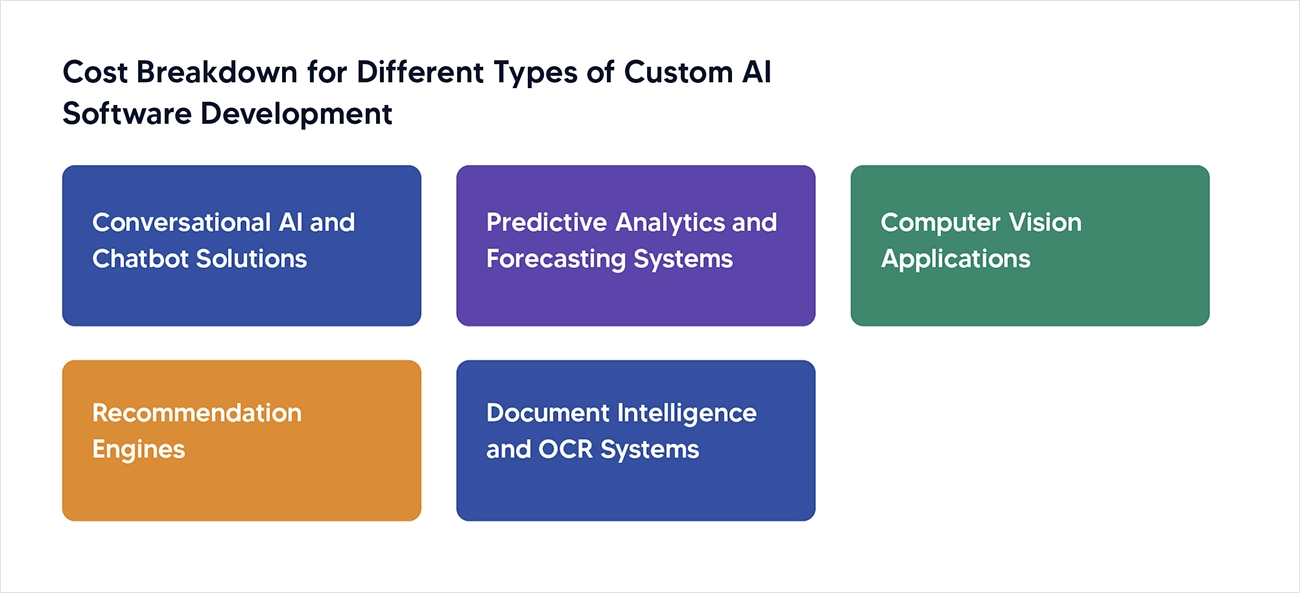
Conversational AI and Chatbot solutions
Basic rule-based chatbots handling 50 to 100 predefined intents cost $30,000 to $80,000. These solutions utilize platforms like Dialogflow or Amazon Lex with minimal customization. Development timelines span 2 to 3 months with teams of 2 to 3 developers.
Advanced NLP-powered conversational AI supporting context awareness, sentiment analysis, and multi-turn dialogues ranges from $100,000 to $300,000. These implementations require custom NLP model development, integration with knowledge bases, and sophisticated dialogue management. Development extends 4-6 months with teams including NLP specialists, backend engineers, and UX designers.
Enterprise conversational AI platforms supporting multiple languages, voice integration, and omnichannel deployment exceed $300,000, often reaching $800,000. Voice-enabled AI assistants add $50,000 to $150,000 for speech recognition and synthesis capabilities.
Predictive analytics and forecasting systems
Basic predictive models for demand forecasting, customer churn prediction, or sales forecasting cost $80,000 to $200,000. These projects leverage established algorithms and standard feature engineering, requiring 3-5 months for development and validation.
Advanced predictive systems incorporating real-time data streams, ensemble modeling, and automated retraining capabilities range from $200,000 to $500,000. Financial forecasting models that require high accuracy and explainability, particularly in regulated industries, command premium pricing due to the extensive validation requirements.
Enterprise-grade predictive platforms with multi-model orchestration, what-if scenario analysis, and automated feature engineering exceed $500,000. Development timelines range from 6 to 12 months, requiring data science teams, platform engineers, and domain experts.
Computer vision applications
Basic image classification systems identifying 10-50 categories cost $100,000 to $250,000. These projects leverage transfer learning from pre-trained models such as ResNet or EfficientNet, which require custom fine-tuning and deployment infrastructure.
Object detection and segmentation applications for manufacturing quality control or retail analytics range from $250,000 to $600,000. These solutions demand custom dataset creation, model architecture development, and edge deployment capabilities for real-time processing.
Advanced vision AI incorporating video analytics, multi-object tracking, and action recognition exceeds $600,000. Autonomous system vision stacks for robotics or autonomous vehicles range from $1 to $3 million and require extensive sensor fusion, real-time processing, and safety validation.
Recommendation engines
Collaborative filtering systems for e-commerce or content platforms cost $150,000 to $350,000. Development includes user-item interaction modeling, real-time recommendation serving, and A/B testing infrastructure.
Hybrid recommendation systems combining collaborative filtering, content-based approaches, and contextual bandits range from $350,000 to $700,000. These sophisticated engines require extensive experimentation infrastructure and continuous optimization capabilities.
Enterprise recommendation platforms supporting multiple business units, personalization at scale, and advanced explainability features exceed $700,000, often reaching $1.5 million for complex implementations.
Document intelligence and OCR systems
Basic document classification and data extraction systems cost $80,000 to $200,000. These solutions leverage cloud OCR services (AWS Textract, Google Document AI) with custom post-processing logic.
Advanced intelligent document processing, including handling unstructured documents, multi-language support, and complex table extraction, ranges from $200,000 to $500,000. These systems require custom model training, validation workflows, and exception handling mechanisms.
Enterprise document intelligence platforms with workflow automation, validation frameworks, and continuous learning capabilities exceed $500,000, often reaching $1 million for comprehensive implementations.
How Much Does Custom AI Development Cost for Small Businesses?
Not every custom AI project requires enterprise-scale investment. Small businesses and startups can get started with a scoped, single-use-case build — a customer-support chatbot, a lightweight document classifier, or an API-based integration into an existing tool — for $5,000 to $50,000, typically delivered in 2 to 6 weeks(Note: The cost presented here is for indicative purposes only; connect with the Kellton Team for exact offerings and price). These smaller builds skip the extensive data engineering, compliance overhead, and multi-system integration that drive enterprise costs up, while still delivering a production-ready solution tailored to a specific workflow.
The cost presented below is also for indicative purpose; the cost would change based on the requirements and the timeline also
| Tier | Range | What's Included | Typical Timeline |
|---|---|---|---|
| Starter / SMB | $5,000 – $50,000 | Off-the-shelf model + light customization (e.g. a scoped chatbot, single-workflow automation, API-based integration) | 2–6 weeks |
| Mid-Complexity | $50,000 – $150,000 | Custom model fine-tuning, predictive analytics, single-system integration | 2–4 months |
| Enterprise | e$150,000 – $500,000+ | Multi-model orchestration, deep integration, compliance requirements | 4–12 months |
| Enterprise-Grade / Regulated | $500,000 – $2M+ | Multi-modal AI, real-time processing, advanced neural networks, formal governance | 6–18 months |
Hidden and long-term cost breakdown for Custom AI Development in 2026
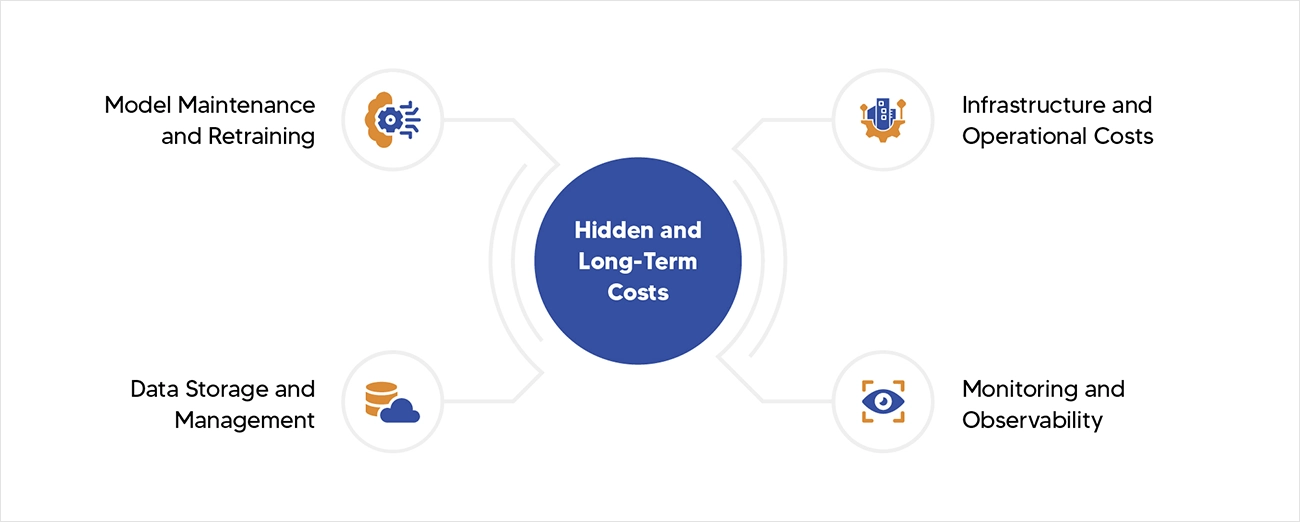
Model maintenance and retraining
AI models degrade over time as data distributions shift. Production systems require continuous monitoring and periodic retraining. Organizations should budget 20-30% of initial development costs annually for maintenance. A $500,000 initial project requires $100,000 to $150,000 annually for effective model lifecycle management.
Retraining frequency depends on the application domain. E-commerce recommendation engines may require monthly updates, while medical imaging models might retrain quarterly. Each retraining cycle costs $5,000 to $50,000 in computational resources and data scientist time.
Infrastructure and operational costs
Cloud inference costs scale with usage volume. A conversational AI serving 1 million monthly requests costs $5,000 to $15,000 monthly on major cloud platforms. High-volume applications serving 100 million requests can exceed $100,000 monthly.
On-premise infrastructure requires ongoing costs beyond initial hardware investment. GPU server maintenance, cooling, power consumption, and replacement cycles add 15-20% annually of hardware value. A $200,000 infrastructure investment requires $30,000 to $40,000 annual operational budget.
Data storage and management
Training data, model artifacts, and inference logs accumulate rapidly. A computer vision project generates terabytes of image data. Storage costs range from $0.023-$0.10 per GB monthly depending on storage tier and access patterns. Organizations with petabyte-scale AI data lakes incur monthly storage costs of $20,000 to $100,000.
Data governance and privacy compliance add overhead. Implementing data lineage tracking, access controls, and retention policies requires dedicated data governance frameworks and personnel, adding $50,000 to $200,000 annually to your operational budget.
Monitoring and observability
Production AI systems require sophisticated monitoring beyond traditional application metrics. Model performance tracking, data drift detection, and explainability dashboards necessitate specialized tooling. Commercial AI observability platforms cost $20,000 to $100,000 annually depending on model volume and feature complexity.
Custom monitoring infrastructure development adds $50,000 to $150,000 to initial projects, with ongoing maintenance costs of $20,000 to $50,000 annually.
Pricing model structures for Custom AI Development: A quick overview
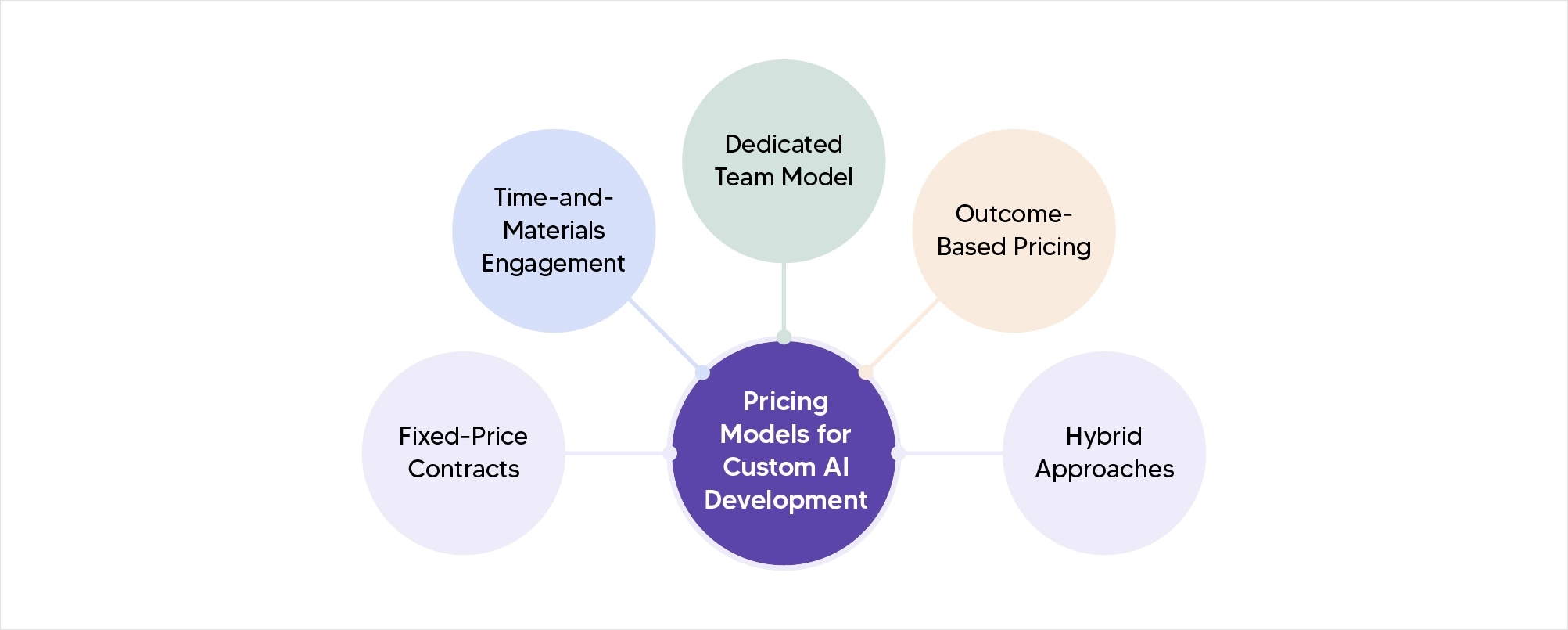
Fixed-price contracts
Fixed-price engagements suit well-defined projects with clear requirements and limited scope ambiguity. Typical for chatbot implementations, basic classification models, or predefined analytics dashboards. Projects under $200,000 with 3-4 month timelines work effectively under fixed-price structures.
Vendors add 20-30% risk premium to fixed-price quotes, accounting for requirement changes and technical uncertainties. This model provides budget certainty but reduces flexibility for iterative improvement based on interim findings.
Time-and-materials engagement
Time-and-materials pricing offers flexibility for exploratory AI projects where requirements evolve through experimentation. Organizations pay for actual hours worked, typically at $150 to $300 per hour for AI specialists depending on seniority and geography.
This model suits research-intensive projects, proof-of-concept developments, and complex enterprise AI where initial requirements cannot fully capture solution architecture. Monthly budgets of $50,000 to $200,000 allow dedicated team allocation while maintaining scope flexibility.
Dedicated team model
Long-term AI initiatives benefit from dedicated team arrangements, in which organizations secure full-time equivalent resources for extended periods. Monthly costs range from $40,000 for a small team (2-3 members) to $200,000+ for comprehensive teams including data scientists, ML engineers, and DevOps specialists.
This model provides continuity, deep domain knowledge development, and flexibility for managing multiple concurrent AI workstreams. Minimum commitments typically span 6-12 months, with optimal ROI achieved over 18-24 month engagements.
Outcome-based pricing
Performance-based models align vendor incentives with business outcomes. Compensation ties to measurable KPIs—accuracy improvements, cost reductions, or revenue generation. Common in predictive maintenance (payment based on downtime reduction) or fraud detection (compensation tied to fraud prevention).
These arrangements require sophisticated baseline measurement and attribution modeling. Vendors demand premium pricing (30-50% above time-and-materials) to compensate for outcome risk. Suitable for mature AI use cases with established value quantification frameworks.
Hybrid approaches
Many enterprise AI engagements use hybrid pricing, combining fixed-price initial phases with time-and-materials for iterative enhancements. Organizations might pay $150,000 fixed price for proof-of-concept, then transition to a dedicated team model ($80,000 monthly) for production development.
This approach balances budget predictability during requirements validation with flexibility for production-grade implementation. Phased payment structures align cash flow with project milestones and risk reduction.
Real-World Example: Custom AI ROI in Practice
When Kellton built a custom Generative AI platform for a business-advisory startup, the goal was to connect customers with specialized experts through both live calls and AI-powered Digital Clones, available 24/7. By combining Generative AI with human-led interaction, the platform gave customers always-on access to expert guidance and vendor connections — significantly reducing reliance on traditional consulting costs while helping the business make faster, more confident strategic decisions. It's a clear illustration of how a well-scoped custom AI build can deliver measurable operational value rather than an open-ended, expensive platform buildout.
Selecting the right AI Development Partner in 2026: Key Considerations
Choosing the right AI services partner in 2026 requires alignment across technology, domain expertise, and delivery maturity. Strong partners demonstrate multi-model fluency across leading foundation models, proven experience with agentic AI, and deep infrastructure capabilities spanning RAG, MLOps, and scalable deployment. Industry specialization and regulatory fluency are critical to avoid costly compliance gaps.
Equally important are agile delivery methods, transparent communication, and a clear commitment to knowledge transfer. Commercially, the best partners offer transparent pricing, flexible engagement models, and risk-sharing approaches. A synchronized balance of technical depth, cultural fit, and commercial clarity ensures long-term AI success.
Conclusion: Partner with Kellton for custom AI development excellence
Kellton delivers measurable AI impact through 200+ successful implementations across industries. Our proven accelerator frameworks reduce custom AI development cost while accelerating time-to-value. We've achieved 94% client satisfaction with average ROI exceeding 300% within 24 months.
Our flexible engagement models—from fixed-price PoCs to outcome-based partnerships—align with your risk profile and business objectives. With specialized expertise in agentic AI, multi-modal systems, and foundation model optimization, Kellton transforms AI investments into competitive advantages.
Ready to optimize your AI investment? Schedule a complimentary cost assessment with Kellton's AI strategists to receive a customized ROI analysis and implementation roadmap. Contact us today to start your AI transformation journey.
Frequently Asked Questions(FAQ)
Q1. How much does it cost to build an AI solution in 2026?
Answer: AI solutions in 2026 cost $50,000 to over $2 million based on complexity. Simple chatbots range from $50,000–$150,000, mid-level solutions $150,000–$500,000, and enterprise systems $500,000–$2 million. Total ownership over three years is typically 1.5–2x the initial build cost.
Q2. How much does enterprise custom AI development cost?
Answer: Enterprise AI development typically costs $300,000–$1.5 million upfront, with 20–30% annual maintenance costs. Security, compliance, scalability, and explainability add 25–40% to baseline budgets. Large, multi-unit enterprise platforms usually require total investments between $500,000 and $2 million.
Q3. What is the future of custom AI development in 2026?
Answer: Custom AI in 2026 focuses on domain-specific, production-ready solutions. Foundation models reduce costs by 40–50%, while edge AI and multimodal systems become standard. As tooling matures, costs stabilize, shifting focus from experimentation to scalable deployment, MLOps, governance, and responsible AI practices.
Q4. Why are enterprises investing in custom AI development?
Answer: Enterprises invest in custom AI to gain competitive advantage using proprietary data and tailored workflows. Custom models deliver 30–50% better performance than generic tools. Regulatory compliance, data sovereignty, and deep integration with legacy systems make off-the-shelf solutions insufficient for many industries.
Q5. What factors affect custom AI development cost?
Answer: Costs depend on model complexity, data readiness, team location, infrastructure, and compliance needs. Data preparation accounts for 40–60% of costs, integrations add 20–35%, and regulated industries increase budgets by 25–40%. Ongoing maintenance and retraining add 20–30% annually.
Q6. What are the realities of AI custom development costs in 2026?
Answer: Despite maturing technology, AI development remains expensive due to hidden costs like data, infrastructure, and talent. Budgets often overrun by 30–50%, with ROI taking 18–36 months. Success comes from focused use cases, incremental rollout, reusable components, and experienced implementation partners.