Other recent blogs


For many years, the requirements of IT leaders were very simple, which were the modernization of legacy applications. Migrate legacy applications, leverage APIs, and then aim to optimize for stability, scalability, and uptime. But what changed in 2025 is that stability is no longer enough; rather, there needs to be a bigger picture of viewing modernization from a bigger lens. Along with that, the real question has shifted from “How do we keep running our apps running?” to “How do we turn enterprise applications into engines of exponential growth?”
The answer lies in moving beyond simple legacy modernization and adopting AI-powered applications. It is not just adding a chatbot to your UI; it’s about revamping your core business logic into an Agentic ecosystem. The core benefit is that AI aims to act rather than just give suggestions.
The Shift: From Reactive Modernization to Proactive Intelligence
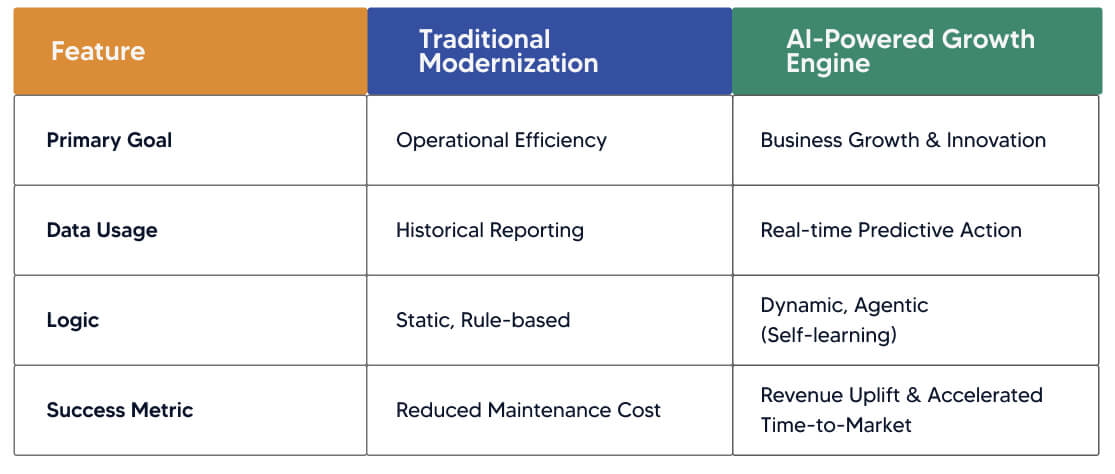
For decades, IT leaders viewed it as a necessary mission to keep the lights on and debt down. However, the emergence of the agentic ecosystem has turned this defensive posture into a powerful strategy. We are moving away from simply fixing what is broken towards building systems that can think, act, and make decisions on their own. This paradigm shift demands that we stop treating software as a static utility and commence treating it as a dynamic participant in business strategy. By embedding intelligence at the core, we ensure that modernization isn't just a technical milestone, but a permanent launchpad for scalable innovation. The following comparison highlights how the focus has moved from technical stability to autonomous business excellence.
Three Pillars of AI Integration in Enterprise Software
To transition from a static tool to a growth engine, enterprise application development must evolve. It is no longer about just writing code; it is about orchestrating intelligence. This evolution requires a fundamental rethink of how software perceives, processes, and acts upon information in a fragmented digital landscape. By moving beyond simple automation, organizations can create a resilient digital core that thrives on complexity rather than being slowed down by it. Successful AI integration rests on three foundational pillars:
- Contextual Awareness: Unlike legacy systems that treat every data point as an isolated event, AI-powered applications understand the “why” behind the data. By using vector databases and semantic search, the application can recall past interactions and apply them to current business challenges. This layer of intelligence ensures that the system doesn’t just provide a transaction, but understands the customer’s historical intent and future needs.
- Autonomous Reasoning: AI in modern applications uses LLM ( large language models) not just for text, but as reasoning engines. This allows the software to navigate complex workflows, such as supply chain disruptions and that too without waiting for human intervention. By empowering the application to weigh variables and simulate outcomes, you transform your software from a passive record-keeper into a strategic decision-maker.
- Feedback Loops: A true growth engine learns from its own performance. Through continuous machine learning integration, the application refines its decision-making logic every time a user interacts with it, ensuring the software becomes more valuable he longer it is used. These self-correcting loops create a compounding effect where the system grows smarter and more efficient with every byte of data it processes. This constant evolution ensures that the application remains aligned with shifting market dynamics without requiring constant manual code updates.
How to Integrate AI into an App: The 2026 Framework
Many leaders ask the practical question: How to integrate AI into an app that was originally built 15 years ago? The process requires a surgical approach to legacy application modernization, moving away from rip-and-replace strategies to incremental and high-impact intelligence strategies. Successful integration is less about a single software update and more about re-engineering the very DNA of how your application processes information.
- API-First Refactoring: By adding intelligence, you must unbundle the monolith. By exposing core functions via APIs, you create the hooks that an AI agent needs to interact with your data. This ensures that your legacy logic remains stable while allowing the AI to call specific functions as if it were a human operator.
- The Micro-Agent Approach: Instead of a single AI agent, build small, specialized agents for specific tasks, i.e, one for inventory forecasting, one for customer retention, and one for fraud detection. By distributing intelligence across these specific modules, you reduce the risk of a single point of failure and make the system much easier to debug and scale.
- Real-time Data Pipelines: Machine learning integration fails if the data is stale. Modernizing the data layer to support streaming data ensures the AI is acting on what is happening now, not what happened last week. In a high-velocity enterprise environment, a ten-minute delay in data synchronization can mean the difference between a proactive growth opportunity and a missed market shift.
Breaking the Data Debt Barrier
The biggest hurdle in enterprise application development is not the code but the data debt. Legacy systems often store data in unstructured or siloed formats that AI cannot easily digest. To move beyond modernization, enterprises must implement a Data-to-Intelligence pipeline.
This pipeline acts as a high-speed conduit that transforms raw, static records into dynamic assets ready for machine learning integration. By automating the extraction and enrichment of legacy data, organizations can eliminate the manual bottlenecks that typically stall AI-powered applications. Ultimately, this flow ensures that every piece of information within the enterprise application development lifecycle is purpose-built to drive predictive growth and real-time decision making.
This involves cleaning historical records and enriching them with metadata so that AI-powered applications can perform high-fidelity predictive modeling. When you solve the data problem, you shift from guessing what the customer wants to what they will need next.
Why Kellton? Turning Vision into Velocity
At Kellton, we put in efforts to make your AI presence. We understand that enterprise application development nowadays requires a mix of deep legacy infrastructure knowledge and advanced ML experience. Whether you are looking forward to refactoring a legacy ERP application or building a greenfield AI-powered application, we are focused on helping you out by creating growth engines that drive the bottom line. Let’s build your AI roadmap if you need strategy insight to move beyond basic modernization.
Our approach goes beyond simple code migration; we partner with you to align your technical architecture with your most ambitious business goals. BY leveraging our deep expertise in AI integration, we help you navigate the complexities of machine learning integration while maintaining the integrity of your core operations. Together, we can transform your legacy constraints into competitive advantages that define the next era of your industry leadership.
Frequently Asked Questions ( FAQs)
Q1. What is the difference between app modernization and AI transformation?
Ans. App modernization focuses on the container ( ie, moving to the cloud) to improve technical agility. AI transformation focuses on the intelligence within the container using machine learning integration to enable the application to make decisions and predict customer needs.
Q2. How can I justify the ROI of AI-driven modernization to the board?
Ans. The thing is that ROI shouldn’t be measured by saved server costs only rather the focus should be on Growth Metrics.
i.e,
- Time to value: How much faster can we launch a new product feature using AI-assisted development?
- Revenue expansion: Can the AI identify at-risk customers and trigger a retention offer automatically?
- Operational velocity: Can we handle five times the transaction value without increasing the headcount?
If these questions can be answered with ease, the ROI can be justified with ease.
Q3. Is it better to build custom AI or buy SAAS AI tools?
Ans. If you want generic productivity to remain intact, i.e, while working on Gmails and docs, then buy SAAS tools. On the other hand, if you want to build a competitive advantage ( i.e, your core business logic), you should aim to integrate AI into custom enterprise applications.
Q4. What are the biggest risks of legacy application modernization with AI?
Ans. The biggest risks are Data Privacy and Model Hallucination. Enterprises must implement a Private AI strategy where data is never used to train public models, and Deterministic Guardrails are placed on top of probabilistic AI outputs to ensure compliance with industry regulations.