
Other recent blogs


The enterprise landscape is evolving at an unprecedented pace, driven by artificial intelligence, real-time analytics, and intelligent automation. As organizations race toward 2027—when SAP ECC mainstream support officially ends—the question is no longer whether to migrate to SAP S/4HANA, but how to execute this transformation in a way that positions your business for an AI-first future.
The migration approach you choose today will determine your competitive advantage tomorrow. This comprehensive guide compares the Greenfield, Brownfield, and Bluefield S/4HANA migration options, providing CIOs and data leaders with the strategic framework needed to make informed decisions that align technology investments with long-term business objectives.
Understand why the 2027 deadline means your migration can’t wait.
Read BlogWhat are the three main approaches to SAP S/4HANA migration?
The journey to SAP S/4HANA presents organizations with three distinct pathways, each representing a different balance between innovation and continuity. The greenfield approach offers a clean slate implementation, building SAP S/4HANA from scratch without carrying forward legacy customizations or historical data constraints.
The brownfield approach focuses on system conversion, transforming existing SAP ERP systems while preserving investments in customizations, configurations, and business processes. The bluefield approach—sometimes called the selective data transition or hybrid method—combines elements of both strategies, allowing organizations to selectively migrate processes and data while redesigning others.
Understanding these fundamental differences is critical because each approach carries distinct implications for timeline, budget, risk profile, and long-term system flexibility. The choice between these methodologies fundamentally shapes how organizations will leverage emerging technologies like embedded AI, predictive analytics, and intelligent automation within their ERP ecosystem.
What is the greenfield approach to SAP S/4HANA migration?
The greenfield approach represents a complete reimplementation of SAP S/4HANA, starting from a blank canvas without inheriting any configurations, customizations, or legacy constraints from existing systems. This methodology treats the migration as an opportunity for fundamental business process reengineering rather than a technical upgrade.
Organizations implementing greenfield leverage SAP's standard best practices, modern data models, and out-of-the-box functionality to build an optimized ERP environment. The approach requires comprehensive business process analysis, stakeholder alignment, and significant change management investments. Rather than replicating existing workflows, greenfield implementations challenge organizations to adopt industry-leading practices and eliminate accumulated technical debt.
Greenfield is best suited for
- Greenfield implementations prove most effective for organizations experiencing significant business model transformations with heavily customized legacy systems that no longer serve strategic objectives.
- This approach particularly benefits organizations transitioning from non-SAP ERP systems, businesses undergoing mergers or acquisitions requiring system consolidation, and enterprises willing to invest substantial time and resources for long-term optimization.
- Companies with outdated, inefficient processes that hinder competitiveness find greenfield implementations provide the catalyst for comprehensive operational transformation.
- Organizations prioritizing innovation over continuity and those with sufficient budget, timeline flexibility, and executive commitment to transformation derive maximum value from this approach.
Greenfield implementations deliver unparalleled optimization potential by eliminating technical debt, streamlining data models, and enabling full utilization of S/4HANA's advanced capabilities including embedded analytics, intelligent automation, and AI-powered insights. Organizations gain simplified system architecture with reduced data redundancy, faster processing speeds through optimized HANA database utilization, and enhanced user experiences via modern SAP Fiori interfaces.
The clean core approach—SAP's strategy for minimizing customizations—aligns naturally with greenfield implementations, ensuring future upgrade paths remain straightforward and cost-effective. This methodology positions organizations to rapidly adopt emerging technologies, integrate IoT capabilities, and leverage predictive maintenance scenarios without legacy constraints.
New to S/4HANA? Start with our beginner’s guide to the S/4HANA implementation process.
Read BlogWhat is the brownfield approach to SAP S/4HANA migration?
The brownfield approach involves converting existing SAP ERP Central Component systems to S/4HANA while preserving historical data, custom code, configurations, and business processes. This system conversion methodology upgrades the technical foundation to the S/4HANA platform without fundamentally altering the application layer or requiring complete reimplementation.
Organizations retain their accumulated investments in customizations, maintain business continuity, and minimize disruption to daily operations. The brownfield conversion leverages automated migration tools, preserves organizational knowledge embedded in existing configurations, and enables faster time-to-value compared to reimplementation strategies. This approach focuses on technical transformation rather than business process reengineering, making it the path of least resistance for organizations prioritizing stability.
Brownfield approach best suited for
- Brownfield conversions prove optimal for organizations satisfied with current business processes, those with extensive customizations serving critical business requirements, and companies requiring minimal operational disruption during migration.
- It is beneficial for organizations with limited budgets or compressed timelines, businesses facing the 2027 ECC support deadline without bandwidth for comprehensive transformation, and enterprises with stable, well-functioning SAP landscapes.
- Businesses with recent ECC optimization investments seeking to preserve those improvements while gaining S/4HANA's technical advantages choose brownfield conversions.
Brownfield implementations significantly reduce migration risk by maintaining familiar processes, preserving institutional knowledge, and enabling continuity in business operations. Organizations experience faster implementation timelines compared to greenfield approaches, typically completing conversions in months rather than years.
The methodology preserves investments in custom developments, specialized functionality, and business-specific configurations accumulated over decades of SAP utilization. Lower upfront costs make brownfield attractive for budget-conscious organizations, as automated conversion tools handle substantial portions of technical migration work.
Users experience minimal disruption, reducing change management requirements and training investments. Historical data remains fully accessible without complex extraction and loading procedures, maintaining comprehensive audit trails and regulatory compliance.
What is the bluefield approach to SAP S/4HANA migration?
The bluefield approach represents a strategic hybrid methodology combining greenfield's transformational potential with brownfield's preservation of valuable legacy elements. This selective data transition strategy enables organizations to redesign and optimize specific business processes while maintaining others in their current state.
Bluefield implementations begin by creating a new S/4HANA system shell, then selectively migrating data, configurations, and customizations based on strategic value assessments. Organizations evaluate each business process, module, and custom development individually, determining whether to migrate as-is, redesign using standard SAP functionality, or rebuild from scratch.
Bluefield approach best suited for
- Bluefield implementations serve organizations seeking balanced transformation—those wanting S/4HANA's innovations without complete disruption of proven processes.
- This approach benefits large enterprises with complex SAP landscapes, diverse business units with varying modernization needs, and organizations requiring flexibility in transformation scope and pace.
- Companies with critical customizations worth preserving alongside outdated processes requiring redesign find bluefield optimal.
- Businesses facing budget constraints preventing full greenfield implementations but recognizing brownfield limitations choose this middle path.
Bluefield implementations deliver optimal flexibility, enabling organizations to customize transformation scope, pace, and intensity across different business areas. This approach reduces risk compared to full greenfield reimplementations while providing greater innovation potential than pure brownfield conversions.
Organizations achieve targeted optimization, focusing resources on high-impact processes while maintaining stable, well-functioning areas. The methodology enables gradual technical debt elimination, selectively addressing legacy code issues without complete system rewrites.
Bluefield supports clean core principles by redesigning extensions and customizations using modern development paradigms including SAP Business Technology Platform, side-by-side extensions, and API-based integrations.
How do you choose between greenfield, brownfield, and bluefield SAP S/4HANA implementation strategies?
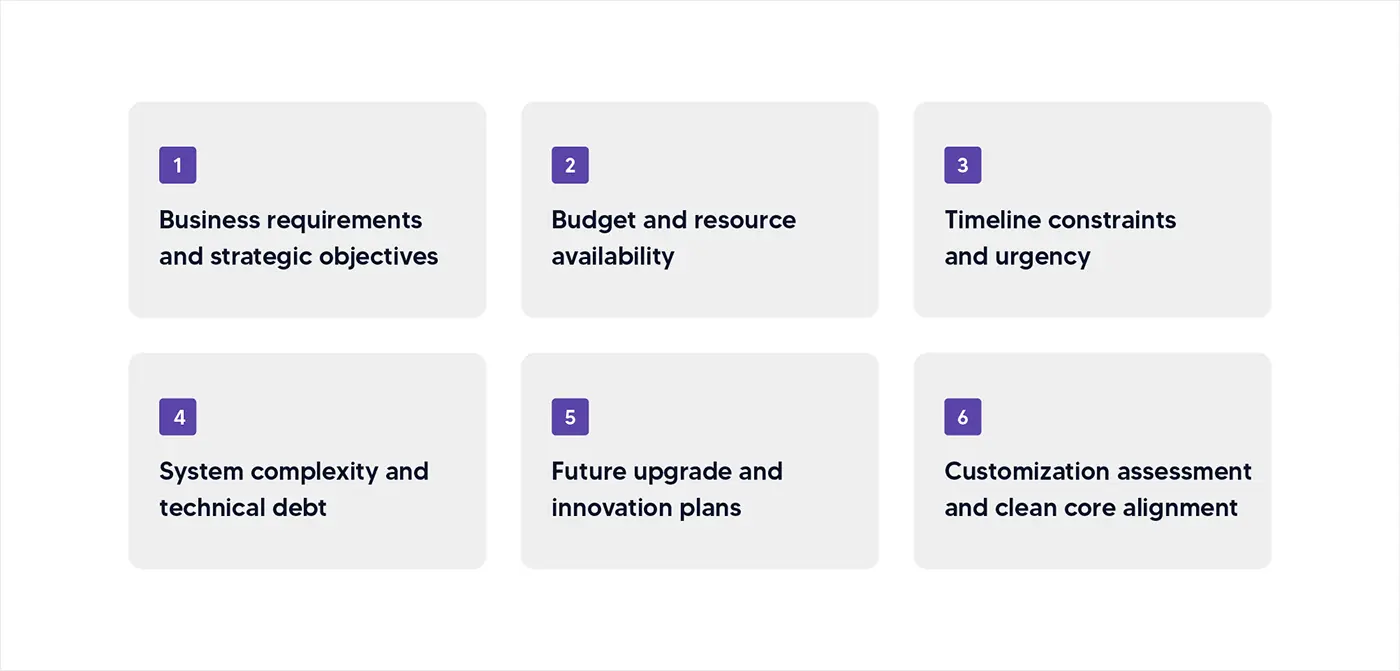
- Business requirements and strategic objectives
The foundation of any migration decision begins with comprehensive assessment of organizational strategy, competitive positioning, and transformation ambitions. Organizations must evaluate whether their primary objective involves technical upgrade, business process optimization, or comprehensive digital transformation.
Companies pursuing aggressive growth strategies, entering new markets, or fundamentally changing business models typically require greenfield's transformational potential. Businesses focused on operational stability, incremental improvement, or maintaining competitive parity often find brownfield sufficient. - Budget and resource availability
Financial considerations profoundly influence migration approach selection, with greenfield implementations typically requiring 150-300% of brownfield conversion costs due to comprehensive redesign, extended timelines, and intensive change management requirements.
Organizations must account for not only software licensing and implementation partner fees but also internal resource dedication, training investments, and opportunity costs from business disruption. Brownfield conversions minimize upfront expenditure through automated conversion tools and shorter timelines but may incur higher long-term costs through technical debt accumulation and limited optimization.
Bluefield implementations fall between these extremes, enabling phased investments spread across multiple budgetary cycles while delivering incremental value. Resource availability extends beyond financial capital to include skilled personnel, with greenfield requiring extensive business process expertise and brownfield demanding technical conversion knowledge. - Timeline constraints and urgency
With SAP ECC mainstream support ending in 2027, timeline pressures influence methodology selection significantly. Brownfield conversions typically complete in six to eighteen months, making them attractive for organizations facing imminent deadlines or requiring rapid S/4HANA adoption. Greenfield implementations extend over eighteen months to three years depending on complexity, making them viable only for organizations with sufficient runway before support termination.
Bluefield approaches offer variable timelines based on scope, enabling organizations to balance urgency with transformation ambitions through phased implementations. Organizations must consider not just migration completion but stabilization periods, with greenfield requiring extensive post-go-live optimization and user adoption initiatives.
The urgency calculation extends beyond the 2027 deadline to include competitive pressures, regulatory requirements, and business growth opportunities requiring modern ERP capabilities. Companies delaying decisions find options narrowing as timelines compress, potentially forcing suboptimal brownfield conversions when greenfield or bluefield would better serve strategic objectives. - System complexity and technical debt
Current landscape complexity significantly impacts migration approach viability, with heavily customized systems presenting distinct challenges across methodologies. Brownfield conversions carry forward existing technical debt—custom code, modifications, and workarounds accumulated over decades—potentially limiting S/4HANA's optimization potential.
Organizations with extensive custom developments must evaluate whether these customizations reflect genuine business requirements or legacy workarounds for outdated standard functionality. Greenfield implementations enable technical debt elimination but require rebuilding or replacing all custom functionality, demanding extensive effort for critical business-specific requirements. Bluefield approaches enable selective technical debt addressing, migrating valuable customizations while redesigning or eliminating problematic legacy code. - Future upgrade and innovation plans
Organizations must evaluate how migration approaches impact long-term agility, innovation capacity, and upgrade simplicity. Greenfield implementations aligned with clean core principles enable straightforward future upgrades, rapid adoption of new SAP functionality, and simplified integration of emerging technologies including embedded AI and intelligent automation.
Brownfield conversions carrying forward technical debt may complicate future upgrades, requiring extensive testing and remediation efforts with each release cycle. Bluefield implementations using modern extension frameworks position organizations for manageable future upgrades while selectively addressing legacy constraints.
The migration approach determines how readily organizations can adopt SAP's expanding Business AI capabilities, including Joule copilot, predictive analytics, and autonomous ERP features. - Customization assessment and clean core alignment
SAP's clean core strategy emphasizes minimizing core system customizations, instead leveraging side-by-side extensions, SAP Business Technology Platform capabilities, and standard configurations. Migration approach selection must consider customization philosophy, with greenfield naturally aligning with clean core principles through standard process adoption.
Brownfield migrations carry forward existing customizations, potentially conflicting with clean core objectives unless organizations commit to post-migration remediation.
Bluefield implementations enable selective customization addressing, redesigning critical custom functionality using modern extension frameworks while eliminating unnecessary modifications. Organizations must evaluate each customization's business value, technical viability in S/4HANA, and alignment with clean core principles.
The assessment determines whether customizations represent genuine competitive advantages requiring preservation or technical debt suitable for replacement with standard functionality. Companies embracing clean core philosophy for long-term upgrade simplicity and reduced total cost of ownership favor greenfield or bluefield approaches establishing clean foundations.
Whichever path you choose, prepare for the four major technical and organizational S/4HANA migration challenges.
Read BlogComparison matrix: Greenfield vs brownfield vs bluefield
| Decision Factor | Greenfield | Brownfield | Bluefield |
|---|---|---|---|
| Implementation Timeline | 18-36 months | 6-18 months | 12-24 months |
| Relative Cost | Highest (150-300% of brownfield) | Lowest (baseline) | Medium (120-180% of brownfield) |
| Business Disruption | High - complete process redesign | Low - minimal operational changes | Medium - selective transformation |
| Technical Debt | Eliminated - clean slate | Carried forward completely | Selectively addressed |
| Optimization Potential | Maximum - full redesign opportunity | Limited - incremental improvements | Moderate - targeted optimization |
| Risk Profile | Higher - extensive change | Lower - proven processes maintained | Balanced - controlled transformation |
| Clean Core Alignment | Excellent - natural fit | Poor - requires post-migration work | Good - selective modernization |
| Data Migration Complexity | High - complete ETL required | Low - system conversion | Medium - selective migration |
| Change Management | Extensive - user retraining | Minimal - familiar processes | Moderate - targeted training |
| Future Upgrade Simplicity | Excellent - standard configuration | Challenging - custom code testing | Good - modern extensions |
| Historical Data Retention | Selective - requires extraction | Complete - all data preserved | Flexible - selective migration |
| Customization Handling | Rebuild from scratch | Migrate as-is | Selective redesign |
| Innovation Enablement | Highest - latest capabilities | Limited - legacy constraints | Moderate - phased adoption |
| User Experience | New Fiori interface, full training | Familiar with enhancements | Mixed - gradual transition |
Transform your business with Kellton's proven SAP S/4HANA migration expertise
Navigating the complexities of SAP S/4HANA migration requires not just technical expertise but strategic partnership with organizations that understand the nuanced balance between innovation and business continuity. Kellton brings decades of SAP implementation experience, combining deep technical knowledge with industry-specific insights to guide your transformation journey.
Our approach begins with comprehensive landscape assessment, evaluating your current systems, business processes, and strategic objectives to recommend the optimal migration methodology—whether greenfield, brownfield, or bluefield—aligned with your unique requirements.
We recognize that successful S/4HANA migrations extend far beyond technical implementation, encompassing change management, stakeholder engagement, and continuous optimization ensuring your organization realizes expected value. Kellton's multidisciplinary teams bring expertise across business process optimization, data migration and quality management, security and compliance frameworks, and emerging technology integration including AI and intelligent automation.
Partner with Kellton to ensure your S/4HANA migration becomes a catalyst for digital transformation rather than merely a technical upgrade.