Other recent blogs


SAP ECC, or its older versions, form the basis of functioning of most organizations. SAP will support ECC until 2027 under a standard contract, with the option of extending it up to 2030. But what next? It is time to make a switch to SAP S/4HANA, SAP’s latest ERP offering for large enterprises.
What are the Phases of SAP S/4HANA Implementation?
The implementation of SAP S/4HANA follows the SAP Activate Methodology, which consists of six distinct phases: Discover, Prepare, Explore, Realize, Deploy, and Run. This modular approach ensures a "Clean Core" strategy and is essential for businesses moving to RISE with SAP cloud environments.
Digital Transformation is inevitable for enterprises. However, while choosing to implement critical changes to the current system, certain factors must be considered, such as sustaining business continuity and optimal workflow. Along these lines, it is undoubtedly worth approaching the SAP S/4HANA Implementation by the book – following the SAP S/4HANA usage steps predictable with the SAP system. It is additionally critical to pose the accompanying inquiry: can such a change encourage advancement?
2026 Implementation Roadmap: Quick Facts
- Primary Methodology: SAP Activate (replaces legacy ASAP).
- Key Transition Paths: Greenfield (New), Brownfield (Conversion), or Selective Data Transition.
- Cloud Strategy: Focus on RISE with SAP for Private/Public cloud scalability.
- Average Timeline: 6–18 months depending on data complexity and migration path.
The 2026 Clean Core Strategy
In the current 2026 landscape, a successful S/4HANA implementation is defined by the Clean Core principle. Moving custom ECC code directly into S/4HANA (the "Lift and Shift" trap) creates technical debt that blocks future AI and automation upgrades.
Key Pillars of a Clean Core Implementation:
- Extensibility: Shift custom logic from the ERP core to the SAP Business Technology Platform (BTP) using side-by-side extensions.
- Integration: Adopt an API-first approach using standard OData or SOAP services from the SAP Business Accelerator Hub.
- Processes: Prioritize Fit-to-Standard during the Explore phase to minimize modifications to standard SAP code.
- Data: Execute rigorous data archiving to reduce the HANA memory footprint and improve system performance post-go-live.
Time Is of the Essence
We can stand by until the last second with the choice to make a switch over to SAP S/4HANA. But, this might not be the right decision. Why? The time cushion until 2027 may appear to be adequate. However, looking at it from the perspective of the time needed to assess an organization’s circumstances and its readiness to embrace S/4 HANA along with the time required for the actual implementation, we may wind up hazardously near the deadline. Delaying the S/4 HANA implementation by a few years will make it hard to line the works with SAP Implementation Services providers responsible for your company’s digital transformation. The critical question here is: can your organization afford to wait until the last moment to leverage the latest technologies, which your competitors are already using?
The first step to SAP S/4HANA Implementation
When following the SAP S/4HANA implementation guide, every organization running SAP systems and planning a transformation need to go through the first phase of the implementation – encountering the capabilities offered by S/4 HANA with its business processes.
Various solutions are available for such massive projects of implementing SAP systems. Our SAP S/4HANA execution guide empowers the profound examination and appropriate conveyance of this cycle over the long haul. Most importantly, our primary objective isn’t just to adjust the framework to the organization’s business cycles; but, to plan its capacities such as accomplishing business objectives substantially more viable.
Due to this reason, we treat the first phase of transformation to S/4HANA as a different offer, whose eventual outcome is a complete roadmap, outlining how a business should approach the conversion in tandem with the SAP S/4HANA implementation guide. This phase also includes gathering information such as S/4 HANA features, cost and time required.
4-Step SAP S/4HANA Implementation Project Plan
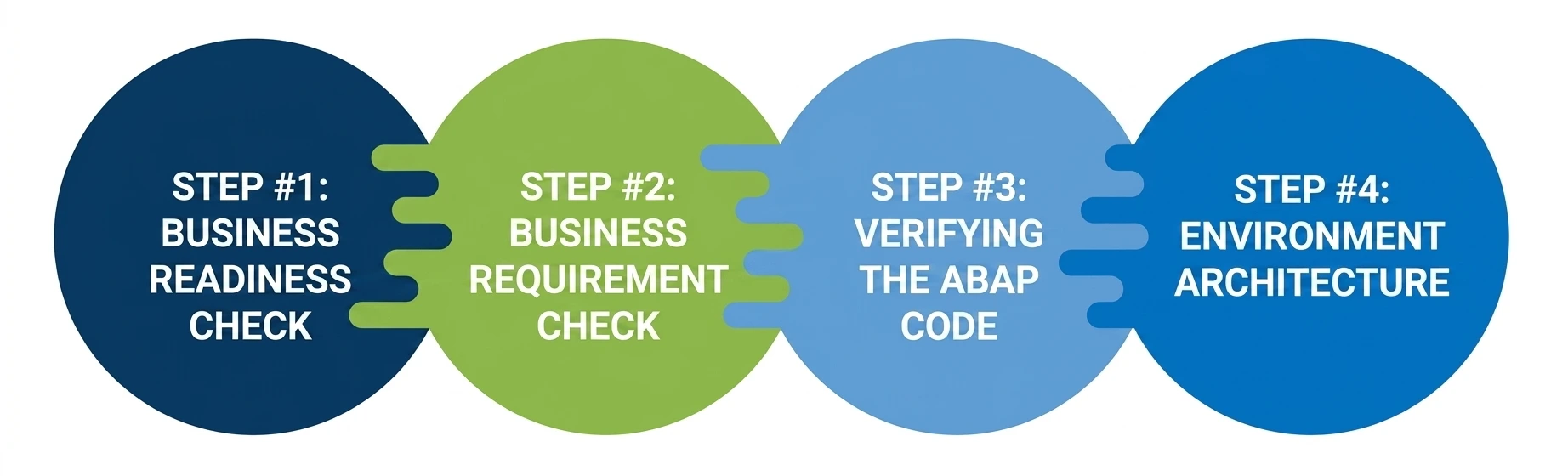 SAP S/4HANA Implementation Steps
Step #1: Process Discovery with SAP Signavio
Use process mining to identify bottlenecks in current ECC workflows. This "X-ray" of your business ensures you don't migrate inefficient manual processes into the new S/4HANA environment.
Step #2: SAP Readiness Check 2.0
Execute the cloud-based Readiness Check to identify Simplification Items, Recommended Fiori Apps, and Sizing Requirements. This report dictates the scope of your custom code remediation.
Step #3: ABAP Test Cockpit (ATC) Analysis
Run the ATC with the "S4HANA_READINESS" check variant. This identifies SAP HANA-incompatible SQL statements and obsolete functional calls that must be fixed before the Realize phase.
In 2026, ABAP verification is centered on the Clean Core principle. This involves using the SAP Fiori paradigm and side-by-side extensibility via the SAP Business Technology Platform (BTP) to ensure your S/4HANA system remains upgrade-ready.
Step #4: Environment Architecture
Define your landing zone (Public Cloud vs. Private Cloud). For most 2026 migrations, RISE with SAP is the preferred model, offering a managed service that includes infrastructure, software, and technical managed services in a single contract.
Selecting Your Migration Path: 2026 Comparison
| Feature | Greenfield (New Start) | Brownfield (Conversion) | Selective Data Transition |
|---|---|---|---|
| Ideal For | High technical debt in ECC | Optimized ECC systems | Large-scale global rollouts |
| Data Strategy | Master data & Open items | Full historical migration | Selective history migration |
| Custom Code | 100% Clean Core / BTP | Remediation of Z-code | Partial remediation |
| Project Risk | High (Process change) | Medium (Technical complexity) | High (Data mapping) |
| Timeline | 12–18 Months | 6–10 Months | 10–14 Months |
After equating the S/4 HANA capabilities with the organization’s requirements, it’s time to pick a real-world transformation scenario. SAP offers two basic options for S/4 HANA implementation: Brownfield and Greenfield. Both depend, from the viewpoint of monetary abilities, budget limit, and confirmation of long haul strategies and, on the other, on the business’s current SAP ECC framework.
Brownfield Implementation
A typical brownfield SAP S/4HANA implementation is a minimalistic approach requiring little redesign of the business processes.
The Benefits of Brownfield Implementation Include:
- Reduction in implementation time
- Reduced costs
- Business processes remain unchanged
- Access to new features of S/4 HANA: SAP Fiori, HANA database, and Embedded Analytics
Greenfield Implementation
A typical greenfield SAP S/4HANA implementation primarily focuses on a long haul approach taking into account the new offerings from SAP S/4HANA to achieve a competitive advantage.
The Benefits of Greenfield Implementation Include:
- Redesigned business processes
- Enhanced system capabilities
- Increased competitive advantage
- Complete Digital Transformation of the business
SAP Activate Methodology: The Full Implementation Phases
Prepare — initial planning, project governance, readiness
Explore — fit-to-standard workshops, gap analysis
Realize — build, configure, migrate, test
Deploy — cutover, go-live readiness
Run — hypercare, post-go-live optimization
S/4HANA Implementation KPIs to Track
To measure the success of your transformation beyond the "Go-Live" date, monitor these three technical metrics:
- Code Quality: Percentage of custom extensions residing outside the core (Target: >80% on BTP).
- User Adoption: Fiori app usage vs. traditional GUI transactions (Target: >90% for business users).
- Process Efficiency: Reduction in manual journal entries or "Days Sales Outstanding" (DSO) post-migration.
How Long Does SAP S/4HANA Implementation Take?
| Approach | Description | Typical Duration |
|---|---|---|
| Brownfield | Typically shorter — system conversion with minimal process redesign | e.g. 6-12 months (Depends on the project requirements) |
| Greenfield | Longer — full process redesign and reimplementation | e.g. 12-18+ months (Depends on the project requirements) |
| Key timeline drivers | Org size, number of business units/countries, data volume, degree of customization | - |
What Does SAP S/4HANA Implementation Cost?
SAP S/4HANA implementation costs vary widely — often more than businesses expect — because they depend on company size, deployment model, and how much customization is involved. As a starting point, here's what organizations typically budget in 2026.
| Company Size | Typical Investment Range | What It Usually Covers |
|---|---|---|
| Small business (up to ~50 users) | $75K – $300K(Indicative price, will change based on requirements) | Core implementation services, minimal customization |
| Mid-market (200–2,000 users) | $500K – $2M(Indicative price, will change based on requirements) | Licensing/subscription, implementation, integrations, training |
| Enterprise (1,000+ users, multi-country) | $2M – $6M+(Indicative price, will change based on requirements) | Full-scope implementation, complex data migration, multi-country rollout, change management |
These are directional industry ranges, not Kellton project quotes — your actual cost depends on scope.
What drives the cost up or down:
- Deployment model — Public cloud (GROW with SAP) implementations tend to run faster and cheaper (roughly $150K–$600K, 3–6 months) than private cloud or on-premise (RISE with SAP) projects, which run higher and take longer given the added infrastructure and customization work.
- Data migration complexity — Legacy systems with messy or fragmented data require more cleansing and validation work, which is one of the most commonly underestimated cost drivers.
- Customization depth — Heavily customized processes cost more to rebuild and test than standardized ones.
- Number of business units/countries — Multi-country rollouts add localization, compliance, and integration cost.
- Training and change management — Often under-budgeted, but essential to avoid post-go-live productivity dips.
Not sure what your SAP S/4HANA implementation will cost or how long it will take?
Why choose a SAP S/4HANA Implementation now?
- Your competitors currently on SAP ECC either already have transitioned to or are in the process of transitioning to SAP S/4HANA. It makes perfect sense to jump the bandwagon now.
- With ample time on your hands, you have the opportunity to assess as to which scenario will best fit your business use case within the proposed budget. Your new S/4 HANA implementation must support your business processes for the coming few years.
- Among the top SAP implementation partners in the USA & UK, we help enterprises leverage the advanced capabilities of S/4 HANA by upgrading to the latest SAP systems.
Frequently Asked Questions: SAP S/4HANA Implementation
Q: How long does an SAP S/4HANA implementation take?
A: A standard implementation typically ranges from 6 to 12 months for Brownfield conversions and 12 to 18 months for complex Greenfield global rollouts.
Q: What is the SAP Activate methodology?
A: It is the modular framework used for S/4HANA implementations, consisting of six phases: Discover, Prepare, Explore, Realize, Deploy, and Run.
Q: Can I implement S/4HANA on-premise?
A: While on-premise is available, most 2026 implementations utilize RISE with SAP for a managed cloud experience, reducing infrastructure overhead.
Q: What is the deadline for migrating to SAP S/4HANA?
A: SAP will maintain mainstream support for Business Suite 7 (ECC 6.0) until the end of 2027, with an optional extended support period until 2030.
Q: Does S/4HANA require a complete redesign of business processes?
A: Not necessarily. A Brownfield conversion keeps existing processes, while a Greenfield implementation allows for a complete redesign to align with SAP Best Practices.
Q: How long does SAP S/4HANA implementation take?
A: Most SAP S/4HANA implementations take 6 to 18 months, depending on deployment model and scope. Public cloud (GROW with SAP) projects can go live in as little as 3–6 months, while private cloud or on-premise (RISE with SAP) implementations for larger, more complex organizations typically take 9–18 months. Brownfield conversions are generally faster than Greenfield reimplementations.
Q: What is involved in an SAP S/4HANA implementation?
A: An SAP S/4HANA implementation involves assessing your current systems, planning the project scope, migrating and cleaning your data, configuring the new system to your business processes, integrating it with other tools, testing, training your team, and go-live support. It follows SAP's Activate methodology, moving through defined phases from initial planning to post-launch stabilization.
Q: What are the stages of SAP implementation?
A: SAP implementations typically follow five stages under the SAP Activate methodology: Prepare (planning and governance), Explore (fit-to-standard workshops and gap analysis), Realize (system build, configuration, and data migration), Deploy (final testing and cutover to go-live), and Run (post-go-live support and optimization).
Q: How much does SAP S/4HANA implementation cost?
A: Costs typically range from $75K–$300K for small businesses, $500K–$2M for mid-market companies, and $2M–$6M+ for larger enterprises with multi-country or highly customized deployments. The biggest cost drivers are deployment model, data migration complexity, and the level of customization required. All the cost present here for indicative purpose only and should not be consider final.
Q: What's the difference between Brownfield and Greenfield implementation?
A: Brownfield is a system conversion — you carry over your existing SAP configuration, processes, and data, making it faster and typically lower-cost. Greenfield is a full reimplementation from scratch, giving you a clean slate to redesign processes, which takes longer and costs more but removes legacy technical debt.
Understand why the 2027 deadline means your migration can't wait.