Other recent blogs


2026 CRITICAL UPDATE: As we approach the December 31, 2027 deadline for SAP ECC Mainstream Maintenance, the window for a "standard" migration is closing. SAP has confirmed a 2% surcharge for extended maintenance through 2030, but resource scarcity for implementation partners is expected to peak in late 2026. This guide has been updated to include the latest RISE with SAP 2025-2026 enhancements and AI-driven migration paths.
In a landscape where disruption is unpredictable, staying ahead of the technological curve is paramount for intelligent enterprises. Upgrading the existing lower versions of SAP-centric S/4HANA systems with a new version is a way forward to
- Enhance operational efficiency
- Elevate user experiences
- Sustain relevance in a dynamic SAP landscape
- Unlock continuous transformation
- Seamless integration with evolving SAP ecosystems
SAP upgrade, as a strategic business imperative, reshapes the trajectory of technological progress by helping businesses embrace incremental leading-edge technical improvements and new capabilities faster.
Failing to adopt releases through a timely SAP S/4HANA upgrade will leave your SAP-centric ecosystem open to many vulnerabilities while dramatically hampering the current application's speed, agility, responsiveness, and operational prowess.
Let's delve deeper into this post and explore the top reasons why embracing the latest SAP S/4HANA version is paramount for seamless operations. Through the sections below, we will also walk through SAP upgrade guide approaches in more detail, including why we need to upgrade SAP and the benefits of upgrading the SAP S/4HANA version.
SAP S/4HANA upgrade - The What
SAP S/4HANA emerges as a beacon of innovation, bridging the technical and functional gaps. The SAP S/4HANA upgrade addresses challenges posed by disparate systems by quickly upgrading existing SAP systems already running a lower version of SAP S/4HANA on-premise, hyperscaler, or private cloud to a higher S/4HANA version.
Since its inception, SAP has released a new realm of possibilities for forward-thinking organizations via different intelligent ERP suite versions. However, the need to upgrade to newer versions of SAP S/4HANA becomes more and more prominent as technology marches forward.
Here’s an in-depth overview of each S/4HANA on-premise version released:

To many companies, upgrading to the newer SAP S/4HANA version from lower release always seems more than just an IT upgrade. Here’s why - as a strategic move, the SAP upgrade helps enterprises become more responsive and proactive towards future disruptions including
- End of mainstream maintenance: For each release (e.g., 1909 and 2020), SAP’s S/4HANA release strategy supports five years of mainstream maintenance. After this duration, customers who want to get continued product support have to endure an additional maintenance fee.
- Enhanced and new functionalities: Each new release of SAP S/4HANA unfolds a comprehensive set of new and improved functionalities. A roadmap to leverage these enhancements goes through a functional SAP upgrade, resulting in significant improvements the operational efficiency.
- Enhanced user experience: With a higher version of the SAP S/4HANA upgrade release, the benefits of a modern and intuitive user interface get unlocked. It is pivotal in simplifying complex processes and empowers an enterprise with real-time insights, and informed decision-making capabilities.
Optimizing Your Upgrade TCO: Implementation Phases
A successful 2026 upgrade is measured by its Total Cost of Ownership (TCO). We break this down into four critical phases:
- Phase 1: Discovery & Readiness (Weeks 1–4): Using SAP Readiness Check and ABAP Test Cockpit to identify "dead code" that doesn't need to be migrated.
- Phase 2: Preparation & Sandbox (Weeks 5–8): Setting up your cloud environment and performing the first technical conversion of your production data.
- Phase 3: Realization & Testing (Weeks 9–16): The longest phase, involving rigorous User Acceptance Testing (UAT) and custom code remediation.
- Phase 4: Go-Live & Support (Week 17+): Final cutover using Near-Zero Downtime (NZDT) tools to ensure business continuity.
What does each higher version of S/4HANA offer?
Depending on the source and target release, the potential benefits of upgrading to a higher version of SAP S/4HANA are multi-faceted. Here’s the core impact:
- Technology improvements - With every new release of S/4HANA, the traditional ERP capabilities get refined. The significant improvements in Data Management, Security, UI/UX, Database features, Integration features, and Automation possibilities with AI/ML are the key outcomes whenever a SAP-centric company executes the upgrade from lower SAP S/4HANA releases to higher SAP S/4HANA releases. Interestingly, these improvements help an enterprise achieve heightened system performance, improved data governance, and robust cybersecurity measures.
- Application improvements - To enhance the application capacity, SAP introduces new functionalities and features (with each upgrade) to align the existing application with evolving business requirements. Generally, the application enhancements span industries and business processes to provide tailored solutions catering to specific needs. The new version release primarily focuses on process improvements, enhancements, UX innovations, performance improvements, new functionalities, and additional modules.
The Journey through SAP S/4HANA Upgrade: Unveiling technical versus functional advancements
Till date, SAP S/4HANA has witnessed many version releases wherein each upgrade rests upon the foundation of the previous version. The core purpose of these version releases is to deliver progressive technological and functional improvements. Let’s delve deeper into a breakdown of the key differentiators below to understand the advancements meant to be unlocked with each higher version of the S/4HANA upgrade.
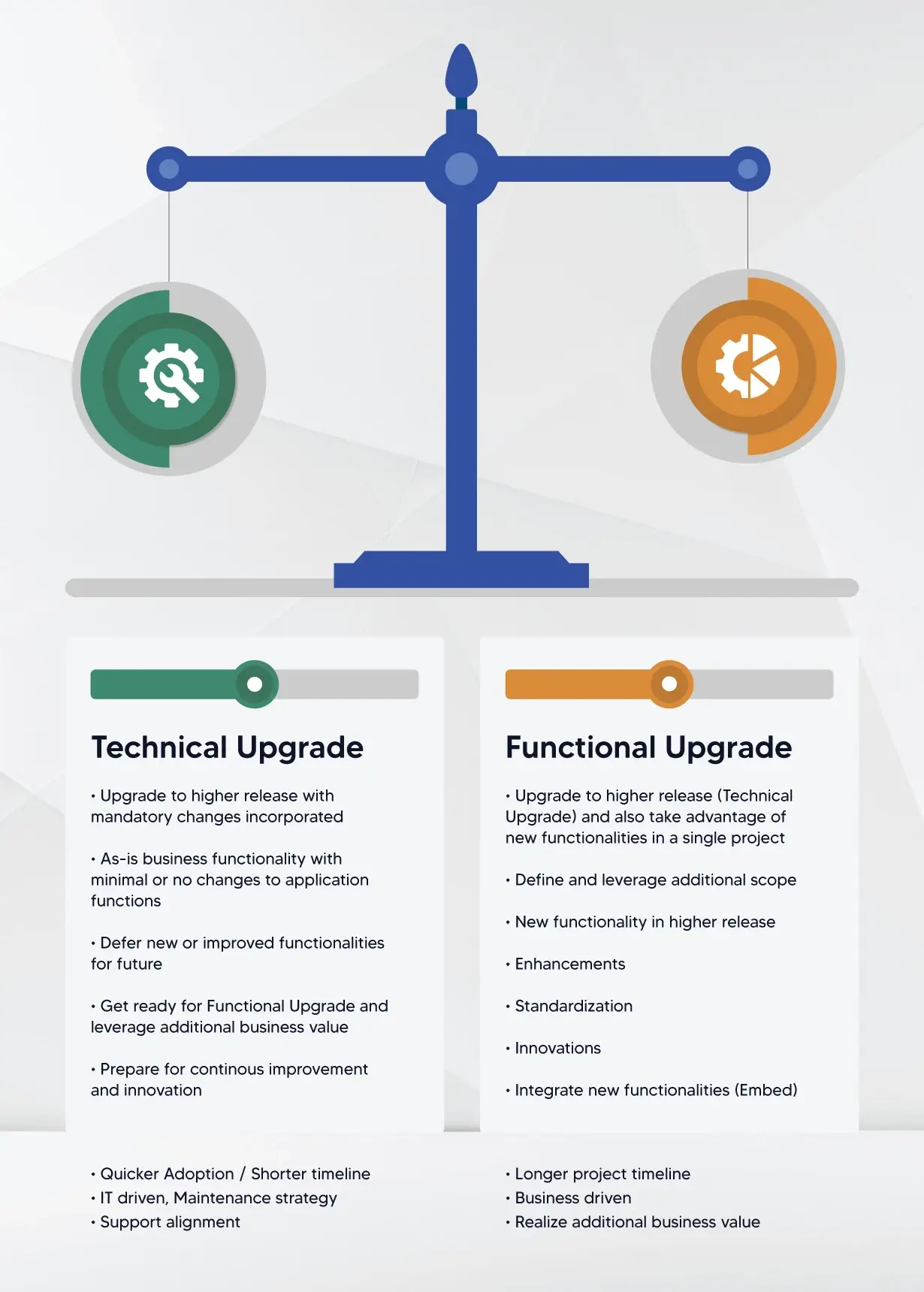
Interestingly, any enterprise upgrading to higher versions of S/4HANA gets quick access to numerous significant enhancements in functional areas like finance, procurement, supply chain, and customer experience. Leveraging these upgrades, the company can thrive in the changing market dynamics efficiently.
FREE RESOURCE: 2026 SAP S/4HANA Migration Checklist
The 2027 Deadline: Why 'Wait and See' is No Longer an Option
The SAP landscape is approaching a bottleneck. By December 2027, mainstream maintenance for SAP Business Suite 7 (ECC) will officially end.
- The Cost of Delay: Enterprises that fail to migrate by the deadline face a 2% premium surcharge for extended maintenance (available through 2030).
- The Talent Gap: As thousands of global organizations rush to migrate simultaneously in late 2026, the cost of specialized SAP consultants is projected to rise by 30-40%.
- Kellton’s Advantage: Early assessment is the only way to avoid inflated TCO (Total Cost of Ownership). By starting your readiness check now, you can opt for a "Greenfield" transformation rather than being forced into a rushed "Brownfield" lift-and-shift.
RISE with SAP: 2025–2026 Innovations and the 'Clean Core' Mandate
In the last 12 months, SAP has pivoted heavily toward Business AI and the Clean Core strategy. If you are upgrading to the latest S/4HANA 2023 or 2025 versions via RISE, these are the three pillars you must address:
- Generative AI with Joule: The 2025/2026 releases embed SAP’s AI copilot, Joule, across finance and supply chain modules. This allows for natural language querying of complex ERP data.
- Clean Core Strategy: SAP now mandates that customizations stay off the "core" ERP. By using the SAP Business Technology Platform (BTP) for extensions, your organization remains "upgrade-ready," allowing for seamless annual updates without breaking custom code.
- Sustainability Integration (The Green Ledger): The latest versions move beyond carbon estimates to actual "transactional" carbon accounting, integrating ESG data directly into your General Ledger.
SAP S/4HANA 2023: Key features shaping the future of intelligent enterprises
The latest release of SAP S/4HANA in 2023 unfolds a gamut of game-changing enhancements. These features have the power to undeniably revolutionize the future of intelligent enterprise technology and prioritize continuous business innovation. Here’s how:
- SAP S/4HANA 2023 combines Artificial Intelligence (AI) and Machine Learning (ML) capabilities together in SAP BTP, simplifying the automation journey of complex business processes. The benefits are enhanced decision-making and access to hidden insights within datasets.
- S/4HANA 2023 provides a range of services, best practices, and innovations combined with business process optimizations to help customer businesses achieve higher ROI.
- The new release provides enhanced end-to-end visibility across the supply chain, which enables enterprises to optimize their inventory levels, respond to demand fluctuations faster, and enhance their supplier collaboration seamlessly.
- Over 1000+ new and improved functionalities covering APIs, Apps, extensibility features, and functionality improvements across LoBs.
- UX innovation features like a more responsive home page and new collaboration capabilities facilitate improvements in user productivity.
- New and improved analytical apps provide more advanced operational and management reporting, which helps enterprises aid quicker and more efficient decision-making.
Navigate the SAP S/4HANA upgrade roadblockers with Kellton
Kellton, as a strategic SAP partner, plays a pivotal role in streamlining the enterprise's journey of a higher SAP S/4HANA upgrade version. During the process, our certified SAP experts perform a meticulous assessment followed by the development of a strategic roadmap to align the SAP upgrade with the company's broader business goals. At Kellton, our commitment extends beyond the immediate SAP S4 HANA implementation, ensuring enterprises are always future-ready for changing industry dynamics within the SAP ecosystem through our end-to-end, ongoing support post-upgrade
Frequently Asked Questions: SAP S/4HANA Upgrades
Q: How long does an SAP S/4HANA upgrade take in 2026?
Answer: A standard technical upgrade (Brownfield) typically takes 4–6 months. A full functional transformation (Greenfield) can take 12–18 months depending on organizational complexity.
Q: What is the latest version of SAP S/4HANA available?
Answer: As of 2026, SAP S/4HANA 2023 (FPS03) is the primary stable release for mainstream enterprises, offering support until 2040.
Q: Is RISE with SAP the only way to upgrade?
Answer: No, you can still choose "S/4HANA Public Cloud" or "AnyPremise." However, SAP incentivizes RISE for its bundled AI features and managed infrastructure services.
Q: What is the 2027 deadline I keep hearing about?
Answer: This is the end of mainstream support for SAP ECC. After this date, you must either be on S/4HANA or pay for expensive extended maintenance.
Q: Can I upgrade directly from 1909 to 2023?
Answer: Yes. A one-step upgrade is possible using the Software Update Manager (SUM) 2.0, provided your underlying database and OS meet the new version's requirements.