
When engineering teams evaluate backend stacks in 2026, the question is rarely "Can Python handle this?" Instead, it’s "Which framework minimizes technical debt, lowers cloud infrastructure costs, and scales our AI pipelines seamlessly?"
Python remains a cornerstone of enterprise computing, but its framework ecosystem has diverged into two distinct paths: battle-tested full-stack platforms and ultra-low-latency asynchronous API engines built for microservices and LLM inference.
Whether you are refactoring legacy microservices, launching a high-throughput SaaS product, or building custom AI wrappers, here are the top 10 Python web frameworks defining enterprise backend development in 2026.
This guide compares the leading Python web frameworks for 2026 through an enterprise lens rather than focusing only on popularity. The evaluation of each framework is based on scalability, cloud efficiency, AI readiness, developer productivity, and long-term maintainability so you can make informed technology decisions.
Key takeaways
- Learn which Python framework is best for enterprise SaaS platforms.
- Understand when FastAPI outperforms Django and Flask.
- Compare synchronous and asynchronous frameworks for AI workloads.
- Evaluate cloud cost, scalability, and architectural trade-offs.
- Identify the best framework for APIs, microservices, dashboards, and internal tools.
- Discover how enterprise teams should evaluate Python frameworks beyond performance benchmarks.
From Monolith legacy stack to Modern cloud-native backend systems.
Modernize with Kellton’s custom enterprise web development solutions.

What are Python frameworks, and advantage of Python frameworks?
Python frameworks are pre-built software libraries that provide a structured foundation for developing web applications, APIs, and enterprise software. They include reusable components for routing, authentication, database management, security, templating, and testing, enabling developers to build applications faster while adhering to proven architectural patterns.
Instead of writing common functionality from scratch, developers can focus on business logic, resulting in faster development, improved code quality, and easier maintenance. Python frameworks simplify application development by providing ready-to-use components, standardized architecture, and built-in best practices. Key advantages include:
- Faster development: Reusable modules reduce coding effort and accelerate time to market.
- Improved security: Many frameworks include built-in protection against SQL injection, CSRF, XSS, and other common vulnerabilities.
- Better scalability: Designed to support growing applications through modular architecture and cloud-native deployment.
- Simplified database management: Built-in ORMs and migration tools streamline database operations.
- Higher developer productivity: Features like routing, authentication, validation, and API generation reduce repetitive coding.
- Easier maintenance: Standardized project structures improve collaboration, debugging, and long-term maintainability.
- Cloud and AI readiness: Modern frameworks support asynchronous programming, containerization, microservices, and AI-powered applications.
- Strong community support: Mature ecosystems provide extensive documentation, plugins, and long-term updates.
Why are Python web frameworks becoming the default choice for enterprise backend development?
Python has evolved beyond a language for scripting and machine learning. It now powers mission-critical backend platforms, AI inference services, financial systems, customer-facing SaaS applications, and cloud-native APIs. That shift has changed how engineering leaders evaluate backend technologies. Five years ago, framework selection was primarily a developer preference. Today, it influences infrastructure spending, deployment velocity, security posture, technical debt, and AI adoption.
Modern engineering organizations are increasingly building applications that combine traditional business logic with machine learning models, event-driven architectures, and real-time APIs. These workloads require frameworks that support asynchronous execution, cloud-native deployment, API-first development, and predictable scalability.
As a result, Python's ecosystem has matured into three distinct categories:
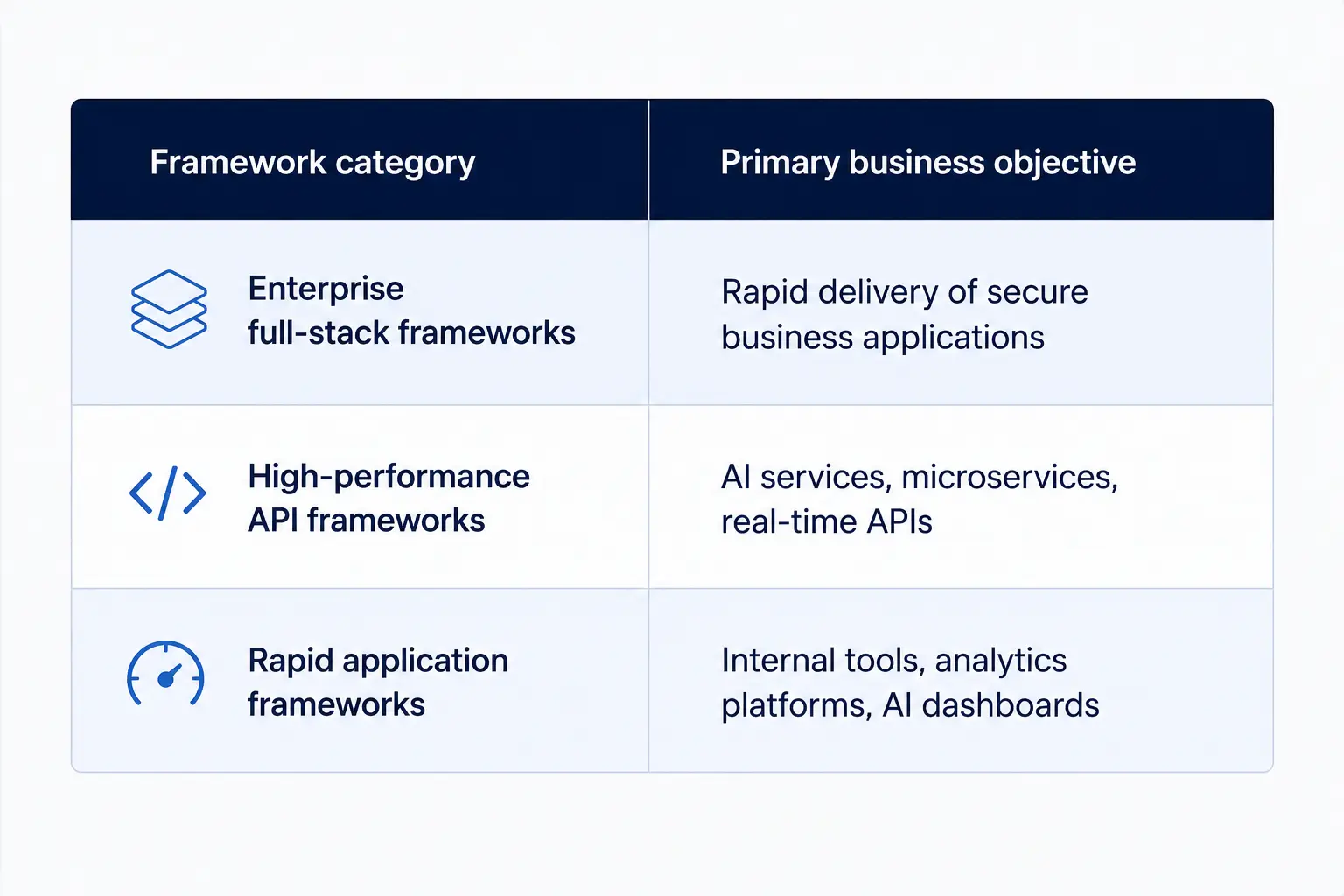
The right choice depends less on raw performance and more on how well the framework aligns with business priorities, engineering maturity, and long-term architecture. When it comes to choosing the best Python web framework for your enterprise application, it is always recommended to consider four questions.
- Is the application primarily an API, a complete business platform, or an internal tool?
- Will AI models, LLMs, or real-time inference become part of the architecture?
- Does the application need to scale horizontally across containers or Kubernetes?
- Is long-term maintainability more important than initial development speed?
These questions eliminate many frameworks before technical evaluation even begins.
Redefine your software architecture with Python backend development services
Build scalable, secure, and furure-ready application with expert Python engineering.
Best 10 Python frameworks for enterprise applications and backend development in 2026
1. Django
Django is a mature, full-stack Python web framework designed for building secure, database-driven applications with minimal configuration. Its batteries-included philosophy provides everything needed to build enterprise software, including an ORM, authentication, administrative interface, security protections, caching support, and migration tools.
Key benefits
- Complete framework with minimal third-party dependencies
- Built-in authentication, authorization, and admin portal
- Mature ORM with migration support
- Strong security against common web vulnerabilities
- Extensive ecosystem and long-term community support
Best for
Enterprise SaaS platforms, customer portals, healthcare systems, ERP applications, and content management platforms.
2026 context
Django continues evolving with improved asynchronous capabilities while remaining one of the most trusted frameworks for large-scale enterprise applications where maintainability, security, and rapid feature delivery outweigh raw API performance.
2. FastAPI
FastAPI is a modern ASGI framework built for high-performance APIs using Python type hints, Starlette, and Pydantic. It combines automatic request validation, interactive API documentation, and asynchronous processing to simplify development of cloud-native services.
Key benefits
- Native asynchronous architecture
- Automatic OpenAPI and Swagger documentation
- High throughput with minimal overhead
- Strong validation using Python type hints
- Excellent developer productivity
Best for
REST APIs, GraphQL services, AI inference endpoints, microservices, event-driven applications, and cloud-native backend platforms.
2026 context
FastAPI has become the preferred framework for organizations developing AI-powered applications, API-first products, and distributed microservices that require high scalability and low latency.
3. Flask
Flask is a lightweight Python micro-framework that gives developers complete control over application architecture. Its minimalist design allows teams to select only the components they need while keeping applications simple and easy to maintain.
Key benefits
- Fast development cycle
- Flexible architecture
- Large extension ecosystem
- Minimal learning curve
- Easy integration with existing systems
Best for
Internal tools, lightweight APIs, proof-of-concepts, utility services, and small-to-medium backend applications.
2026 context
Although newer asynchronous frameworks continue to gain traction, Flask remains widely adopted for existing enterprise services and projects that prioritize simplicity over built-in functionality.
4. Falcon
Falcon is a high-performance Python framework built specifically for developing reliable REST APIs and microservices. Designed with minimal overhead, it delivers predictable performance for latency-sensitive enterprise workloads.
Key benefits
- Extremely low memory consumption
- Fast request processing
- ASGI and WSGI compatibility
- Standards-compliant HTTP implementation
- Ideal for performance-critical APIs
Best for
Financial services, payment gateways, ad-tech platforms, IoT platforms, serverless applications, and large-scale API infrastructures.
2026 context
Falcon remains a preferred choice for engineering teams optimizing cloud infrastructure costs and building ultra-low-latency services deployed on Kubernetes or serverless platforms.
5. Pyramid
Pyramid is a highly flexible Python framework that scales from small applications to large enterprise systems without imposing rigid architectural conventions. It enables developers to build customized solutions while maintaining long-term stability.
Key benefits
- Flexible routing architecture
- Granular authentication and authorization
- Strong backward compatibility
- Modular application structure
- Suitable for complex enterprise environments
Best for
Enterprise software, government platforms, large business applications, and projects requiring highly customized architectures.
2026 context
Pyramid continues serving organizations with complex legacy systems where architectural flexibility and long-term maintainability are more important than adopting opinionated frameworks.
6. Tornado
Tornado is an asynchronous networking framework capable of handling thousands of concurrent connections through a non-blocking event loop. It excels in applications requiring persistent client-server communication.
Key benefits
- High concurrency
- Native WebSocket support
- Long-polling capabilities
- Built-in HTTP server
- Efficient event-driven architecture
Best for
Chat applications, streaming platforms, IoT systems, live dashboards, messaging platforms, and real-time analytics.
2026 context
Tornado remains a specialized framework for organizations building communication-intensive applications where maintaining thousands of simultaneous connections is a business requirement.
7. CherryPy
CherryPy is a minimalist object-oriented Python framework that enables developers to build production-ready web applications using straightforward Python code. It emphasizes simplicity while providing a stable and mature development environment.
Key benefits
- Lightweight architecture
- Embedded production-ready HTTP server
- Object-oriented design
- Easy deployment
- Low operational complexity
Best for
Internal enterprise applications, administration portals, embedded systems, automation platforms, and departmental web applications.
2026 context
Although less popular than Django or FastAPI, CherryPy continues to support organizations seeking lightweight, dependable web applications with minimal infrastructure requirements.
8. Reflex
Reflex is a full-stack Python framework that enables developers to build modern web applications entirely in Python by automatically generating React front ends and FastAPI back ends without requiring JavaScript expertise.
Key benefits
- Pure Python full-stack development
- Automatic frontend generation
- Rapid application delivery
- Native FastAPI backend
- Simplified developer experience
Best for
Internal business applications, enterprise dashboards, AI-powered interfaces, SaaS MVPs, and workflow automation platforms.
2026 context
Reflex has gained significant adoption among enterprise teams looking to accelerate application development, reduce frontend complexity, and improve developer productivity.
9. Streamlit
Streamlit is a rapid application framework that transforms Python scripts into interactive web applications without requiring frontend development. It enables data scientists and engineers to quickly build dashboards, analytics portals, and AI interfaces.
Key benefits
- Rapid development
- Native integration with ML libraries
- Interactive visualizations
- No JavaScript required
- Excellent developer productivity
Best for
Executive dashboards, AI assistants, analytics platforms, proof-of-concepts, and internal data science applications.
2026 context
Streamlit has become one of the leading frameworks for building internal AI applications, LLM interfaces, and enterprise analytics dashboards that shorten the path from experimentation to business adoption.
10. Gradio
Gradio is an open-source Python framework for building interactive web interfaces around machine learning models and AI applications. It enables teams to create demonstration environments, testing interfaces, and production-ready AI front ends with minimal code.
Key benefits
- Fast AI application development
- Native integration with Hugging Face
- Easy model sharing
- Interactive UI components
- Supports LLMs and multimodal applications
Best for
Generative AI applications, machine learning demos, chatbot interfaces, computer vision projects, and enterprise AI proof-of-concepts.
2026 context
As enterprise adoption of generative AI accelerates, Gradio has become a preferred framework for rapidly deploying secure interfaces for LLMs, predictive models, and internal AI assistants.
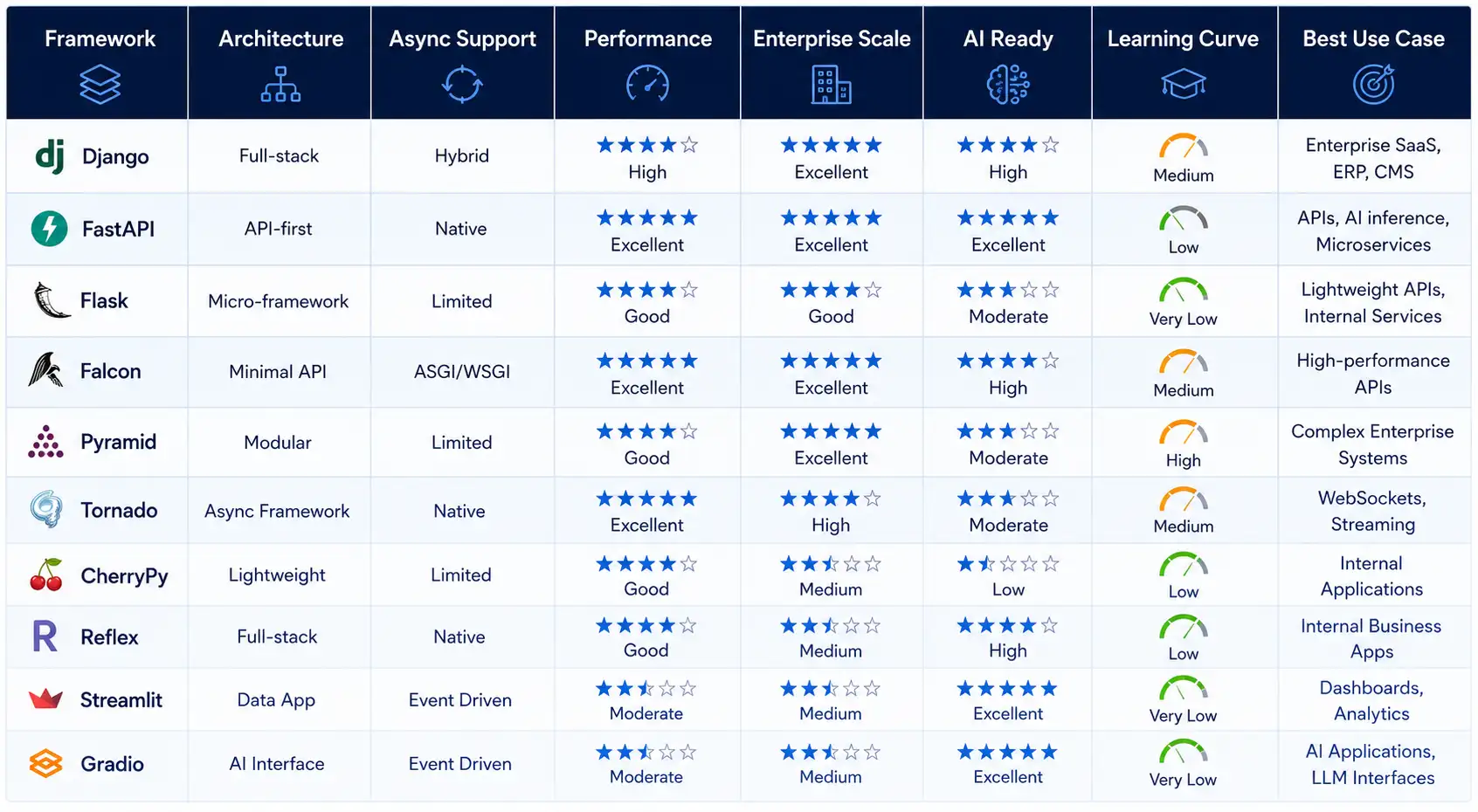
Python web framework comparison at a glance: The 2026 Selection Matrix
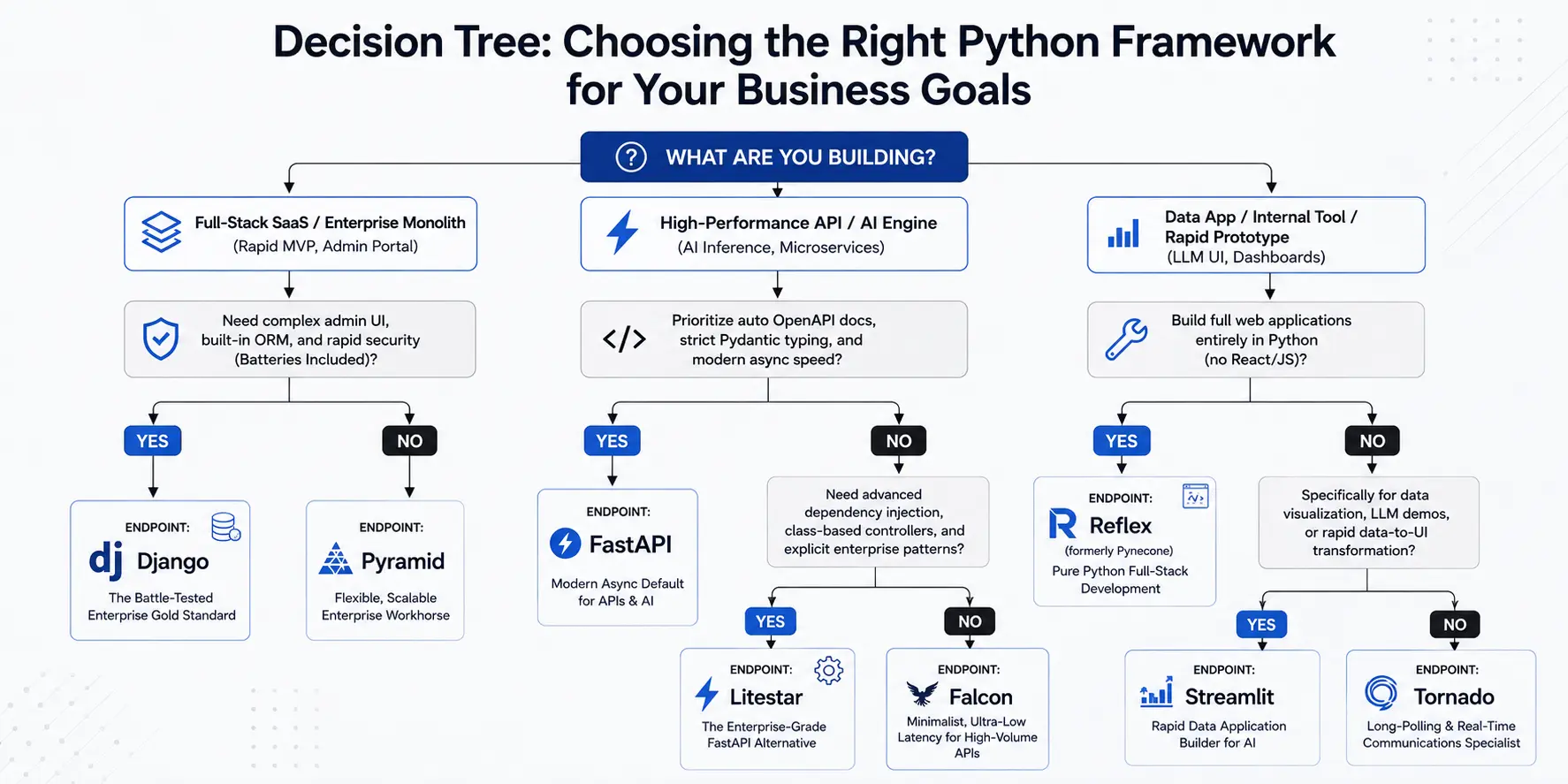
Decision Tree: Choosing the Right Framework for Your Business Goals
Selecting the optimal Python framework isn't about declaring a single winner—it's about aligning your architectural requirements, latency targets, and team capabilities with the right tool. For enterprise engineering leaders, the choice usually boils down to three core development paths.
If you're building a complex SaaS monolith or MVP, Django provides an out-of-the-box ORM and admin portal for rapid execution, while Pyramid offers deeper customization for non-standard corporate routing.
If your focus is high-speed microservices or AI endpoints, FastAPI stands out for its native Pydantic type safety and automated OpenAPI docs, whereas Litestar delivers strict class-based controllers for large-scale enterprise APIs and Falcon excels in ultra-low-latency, bare-metal serverless environments.
Finally, for data-heavy platforms or internal applications built without dedicated front-end developers, Reflex enables pure-Python full-stack React deployment, Streamlit accelerates executive dashboards and LLM wrappers, and Tornado remains the dedicated engine for high-concurrency WebSockets and real-time streaming.
Python Backend Frameworks in 2026: How to Choose for Enterprise & AI-Driven Apps
Selecting a Python web framework is not simply a technology decision. It influences application performance, cloud infrastructure costs, developer productivity, and long-term maintainability. While features and popularity matter, successful enterprise projects are driven by architectural fit rather than framework preference.
When evaluating Python backend frameworks for enterprise or AI-driven applications, consider the following decision criteria.
Project size and application complexity
The complexity of your application should guide framework selection. Lightweight frameworks may accelerate development for small services but often require additional tooling as applications grow. Conversely, enterprise frameworks provide built-in capabilities that reduce integration effort for complex systems.
- Small APIs and utility services: Flask, Falcon
- Enterprise SaaS platforms and business applications: Django, Pyramid
- AI-powered APIs and cloud-native microservices: FastAPI, Litestar
- Data applications and AI dashboards: Streamlit, Gradio
Performance and concurrency requirements
Application performance extends beyond request throughput. Consider how the framework handles concurrent users, asynchronous workloads, and resource utilization under production traffic.
Native ASGI frameworks such as FastAPI, Litestar, and Falcon are well suited for high-concurrency APIs, real-time applications, and AI inference services. Traditional WSGI frameworks like Django and Flask continue to perform well for business applications but may require additional architectural planning for highly asynchronous workloads.
Database performance and connection management
An asynchronous framework delivers its full value only when paired with an asynchronous data access layer. Using synchronous database drivers inside an async application introduces blocking operations that increase latency and reduce throughput.
When building modern APIs, align your framework with asynchronous database drivers, connection pooling, and efficient ORM strategies to maximize performance and scalability.
Cloud deployment and infrastructure costs
Framework choice directly affects infrastructure efficiency, especially on serverless and containerized platforms.
Lightweight frameworks such as Falcon and FastAPI generally achieve faster startup times and lower memory consumption, making them well suited for AWS Lambda, Google Cloud Run, and Kubernetes environments. Larger frameworks may increase cold-start times but often reduce development effort through richer built-in functionality. The right decision depends on balancing operational efficiency with developer productivity.
Scalability and system architecture
Scalability is determined by architectural design as much as framework capabilities. Evaluate whether the framework supports:
- Horizontal scaling across containers and Kubernetes clusters
- Event-driven and microservices architectures
- API-first development
- Background task processing
- Caching and distributed messaging
- Multi-region deployment and high availability
Organizations expecting rapid growth should prioritize frameworks that integrate seamlessly with cloud-native infrastructure and distributed system patterns.
Reliability and production stability
Frameworks that emphasize type safety, automated request validation, and standardized API contracts help reduce production defects and improve application reliability.
Solutions built on modern validation libraries such as Pydantic automatically verify incoming data before it reaches business logic or databases, reducing runtime errors and improving the quality of AI and data processing pipelines.
Scale Your Enterprise Backend with Kellton’s Python Backend Engineering Experts
Modernizing legacy infrastructure or building a cloud-native Python platform requires far more than basic syntax knowledge—it demands deep expertise in distributed systems, zero-trust security, and cloud cost optimization.
At Kellton, our Python Backend Engineering Experts partner with growth-stage and enterprise organizations to architect, optimize, and scale mission-critical Python applications.
We help:
- Monolith Modernization: Transition legacy Django or Flask systems into high-throughput microservices architectures with zero downtime and minimal business interruption.
- AI & LLM Backend Engineering: Build robust, high-concurrency API pipelines using FastAPI and Litestar to serve real-time AI models and enterprise data workflows.
- Performance & Cloud Cost Optimization: Refactor database queries, connection pooling, and caching layers to dramatically reduce latency and lower AWS/GCP infrastructure bills.
Stop losing developer hours to maintenance and slow API endpoints. Whether you need a dedicated team of senior Python engineers or an architectural review of your current stack, we are ready to build.
FAQs
What are the most popular Python frameworks in 2026?
The most popular Python frameworks in 2026 include Django, FastAPI, Flask, Falcon, Pyramid, Tornado, CherryPy, Reflex, Streamlit, and Gradio. Each serves different use cases, from enterprise web applications and microservices to AI interfaces, data dashboards, and cloud-native APIs.
Which Python version is best in 2026?
Python 3.13 is the recommended version for most new projects in 2026, offering performance improvements, enhanced error reporting, and better interpreter efficiency. If your dependencies haven't fully adopted Python 3.13, Python 3.12 remains a stable enterprise choice.
Is Python in demand in 2026?
Yes. Python remains one of the most in-demand programming languages in 2026 due to its widespread use in AI, machine learning, data engineering, web development, automation, cybersecurity, and cloud-native application development across startups and Fortune 500 enterprises.
How many Python frameworks are there?
There are more than 100 Python frameworks available, ranging from full-stack web frameworks and micro-frameworks to API, AI, and data application frameworks. Django, FastAPI, Flask, and Falcon remain among the most widely adopted for enterprise web development.
What are the key advantages of Python frameworks?
Python frameworks accelerate development with reusable components, built-in security, database integration, routing, and testing tools. They improve code quality, reduce development time, simplify maintenance, and help organizations build scalable, secure, and cloud-ready applications more efficiently.