

In today's hyper-competitive technology landscape, speed is everything. Businesses are racing to integrate AI, modernize legacy systems, and deploy cloud-native architectures before their competitors do. To win this race, engineering and product leaders face intense pressure to scale their teams quickly.
But rapid scaling comes with a dangerous pitfall: the temptation to compromise on hiring standards just to fill a seat.
When a project deadline is looming, a resume that ticks 7 out of 10 boxes can look like a lifesaver. However, rushing into a bad hire is one of the most expensive mistakes an enterprise or mid-sized company can make. The immediate financial hit is just the tip of the iceberg — the deeper, hidden costs can quietly derail your product roadmap, sink team morale, and erode market credibility.
| Quick answer |
|---|
| The cost of a bad hire is typically 3–4x the employee's annual salary, according to SHRM. IT staff augmentation eliminates this risk by giving enterprises access to pre-vetted, on-demand tech talent — with no severance liability, no long hiring cycles, and onboarding in days instead of months. |
This comprehensive guide breaks down the true cost of a bad hire for enterprises and mid-market organizations, why traditional recruitment models are failing in the modern tech ecosystem, and how IT staff augmentation eliminates these risks entirely.
A Familiar Tech Nightmare (And What It Actually Costs)
Consider a scenario that plays out in tech corridors every single day: A FinTech enterprise is racing to launch an AI fraud-detection module. Under pressure, HR rushes a 45-day hiring cycle to onboard a stellar Senior Backend Engineer.
By week four, the cracks show. The engineer's code is unstable, dropping sprint velocity by 30%. To save the launch, the team's top two high-performers must stop their own critical tasks to debug and rewrite the messy code. They work weekends, put in significant extra effort, and the project is delayed by two months.
Frustrated by the situation, leadership fires the hire, leaving them right back at square one. The company didn't just lose a recruiter's fee; they burned out their best talent and missed a critical market window. This nightmare is the direct consequence of an outdated hiring model trying to keep pace with rapid tech demands.
The Compounding Challenges of Modern Tech Recruitment
Before examining the financial fallout of a bad hire, it helps to understand why organizations end up making poor hiring decisions in the first place. The tech talent market has fundamentally changed, creating a perfect storm of challenges for internal HR teams and engineering leaders:
1. The Critical Skills Gap
The emergence of complex technologies such as generative AI, advanced machine learning, specialized cloud orchestration, and next-gen cybersecurity has left internal HR teams scrambling. Traditional recruiters often lack the technical depth required to accurately vet a developer's capabilities in these niche domains. As a result, candidates who sound great on paper often fail to perform in real-world engineering environments.
2. The Illusion of the Perfect Resume
In the era of AI-generated resumes and heavily coached interview prep, it has never been easier for a mediocre candidate to look like an expert on LinkedIn. Companies spend weeks interviewing candidates, only to realize within the first month of onboarding that the hire cannot code at the pace or standard required for the project.
3. High Turnaround Times (Time-to-Hire Crisis)
On average, finding and successfully onboarding a specialized full-time software engineer takes anywhere from 45 to 60 days. In the enterprise world, that means missed project milestones, delayed launches, and lost revenue opportunities. Out of sheer desperation to close the open position, management often greenlights sub-optimal candidates — which is precisely where IT staff augmentation changes the equation.
Anatomy of a Disaster: The 4 Hidden Costs of a Bad Hire
Most organizations calculate the cost of a bad hire by adding up the recruiter's fee and a few weeks of wasted salary. But according to data from the Society for Human Resource Management (SHRM), the true cost of a bad hire can be up to 3 to 4 times the employee’s annual salary.
For a senior developer earning $120,000, a bad hire can quietly cost an organization over $400,000. Let's look at where that money actually goes:
1. The Sunk Capital: Direct Recruitment and Offboarding Expenses
The most visible costs are just the starting point. When you hire a full-time employee who fails, you lose:
- Recruitment Fees: Agency margins or internal HR hours spent sourcing, screening, and interviewing.
- Onboarding and Training Costs: The hours spent by senior team members setting up environments, training the new hire on the codebase, and walking them through company processes.
- Severance and Legal Safeguards: Severance packages, legal paperwork, and the administrative burden of managing a termination or performance improvement plan (PIP).
2. The Technical Debt and Productivity Drain
When a bad hire writes substandard code, the damage isn't limited to their own lack of output.
- The Rewriting Tax: Your top-tier, highly paid senior developers must stop working on new features to review, debug, and rewrite the sloppy code of the bad hire.
- Velocity Drop: Instead of accelerating the project, the wrong hire actually slows down the sprint velocity of the entire team.
3. The Cultural Contagion: Team Demoralization and Burnout
Software development is a team sport. When one member cannot carry their weight, the burden falls squarely on the high performers.
- Burnout: Your best engineers become frustrated by continuously cleaning up someone else's messes — leading to burnout and, ultimately, the resignation of your A-players.
- Trust Erosion: A bad hire creates friction, slows down sprint planning, and breeds resentment within the engineering department.
4. The Enterprise-Level Risk: Opportunity Costs and Damaged Reputation
For mid-market companies and enterprises, the biggest threat is external.
- Delayed Time-to-Market: If an AI integration or critical feature is delayed by 3 months due to an incompetent engineering team, your competitors will capture that market share.
- Lost Client Trust: If the bad hire is working on a client-facing project, bugs, missed deadlines, and unstable deployments can permanently damage enterprise client relationships, leading to churn.
How IT Staff Augmentation De-Risks the Talent Equation
To survive in an environment where missing a tech cycle means irrelevance, forward-thinking enterprises are shifting away from traditional, rigid hiring models. They are leveraging IT staff augmentation to inject agility into their engineering DNA.
IT staff augmentation is not just about outsourcing work; it is a strategic framework in which an expert technology partner provides highly specialized tech talent that blends seamlessly with your internal teams.
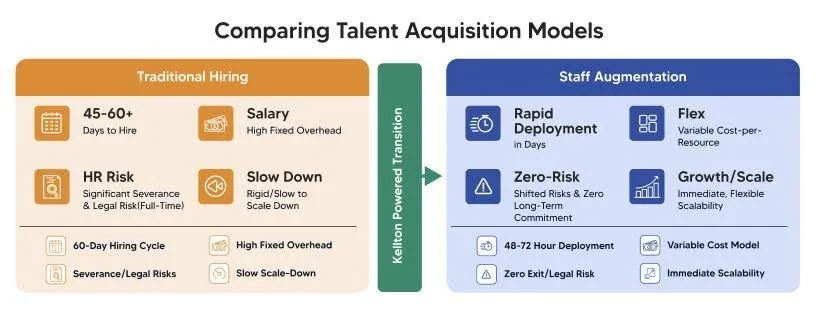
Here is exactly how IT staff augmentation systematically eliminates every hidden cost associated with a bad hire:
Zero Liability: Exit the Contract Without the Legal or Financial Trouble
In a traditional employment contract, letting go of an underperforming developer is a lengthy, legally sensitive, and expensive affair. With IT staff augmentation, the operational risk shifts completely away from your business. If an augmented resource doesn't fit culturally or technically, you simply notify your partner, who handles the transition and replacement immediately. There is no severance, no legal friction, no HR issue.
Accelerated Onboarding and Fast Time-to-Market
Staff augmentation providers maintain deep benches of specialized talent. Instead of waiting 60 days to source a Kubernetes or React Native expert, you can have a seasoned engineer integrated into your Slack and Jira environments within days. This keeps your product roadmap on schedule and protects your competitive advantage.
Financial Predictability and Variable Cost Efficiency
With an augmented team, fixed employee overhead — healthcare benefits, hardware provisioning, bonuses, bench-time costs — is converted into a predictable, transparent monthly operational expense (OpEx). You pay exclusively for active engineering hours spent building your product.
Traditional Hiring vs. IT Staff Augmentation: A Side-by-Side Comparison
Before committing to a hiring model, it helps to see the two approaches side by side:
| Factor | Traditional Full-Time Hiring | IT Staff Augmentation |
|---|---|---|
| Time to onboard | 45–60 days average | Days, not months |
| Risk if the hire underperforms | Severance, PIPs, legal exposure | Swap the resource, no legal friction |
| Cost structure | Fixed overhead: salary, benefits, bench time | Variable OpEx: pay only for active hours |
| Vetting depth | Resume + 2–3 interviews | Multi-layered technical + soft-skill vetting |
| Scaling flexibility | Slow to scale up or down | Scale up/down in 48–72 hours |
Why a Standard Vendor Isn't Enough: The Kellton Difference
If you search for IT staff augmentation companies, you will find thousands of agencies offering to send you resumes. But a standard recruitment vendor cannot solve the problem of a bad hire — they merely automate the resume-forwarding process, leaving the heavy lifting of technical vetting to your already strained team.
This is where a global digital transformation partner like Kellton transforms the model. Kellton doesn't just supply talent; it delivers Managed Engineering Expertise backed by a global technology ecosystem.
Here are the three pillars that set Kellton's IT staff augmentation services apart from commoditized staffing agencies:
1. Rooted in a Deep Product Engineering DNA
Kellton is, first and foremost, a premier Product Engineering and Digital Transformation consulting firm. It builds enterprise-grade AI platforms, complex cloud architectures, and core software solutions for Fortune 500 companies and innovative mid-market disruptors.
Kellton's engineers don't work in a vacuum; they operate within an ecosystem rich in technical excellence. When you bring in a Kellton engineer through IT staff augmentation, you're onboarding a professional who understands the product mindset, agile governance, and modern delivery lifecycles.
2. The Rigorous, Multi-Layered Tech Vetting Shield
Kellton doesn't match keywords on a resume and hope for the best. Before any Kellton engineer is presented to a client, they pass through a strict, multi-tiered evaluation process:
- Hands-on Coding & System Design Assessments: Conducted by internal Tech Leads and Architects.
- Soft Skills & Collaboration Vetting: Ensuring the engineer can communicate transparently and blend effortlessly into your existing team culture.
Because Kellton does the heavy technical lifting up front, clients frequently bypass extensive interview processes entirely. Kellton delivers engineers who are Day-1 Ready to pull tickets, write clean code, and push to production.
3. Scale on Demand with Cross-Functional Backing
When you hire an individual freelancer or a resource from a minor vendor, you are limited by that single person's knowledge. With Kellton's IT staff augmentation model, an augmented engineer is never truly alone — they carry the collective intelligence of Kellton's global network of Subject Matter Experts (SMEs), Solution Architects, and Cloud Pioneers.
If your project scope changes overnight, Kellton's vast talent infrastructure allows you to scale up or down within 48 to 72 hours seamlessly.
Frequently Asked Questions About IT Staff Augmentation
Question: What is the average cost of a bad hire?
Answer: According to SHRM, the average cost of a bad hire is 3–4x the employee's annual salary once you factor in recruitment fees, onboarding, lost productivity, and team disruption. For a $120,000 senior developer, that can exceed $400,000.(Estimated Pricing-may vary based on project requirements).
Question: What is IT staff augmentation?
Answer: IT staff augmentation is a staffing model where a technology partner provides pre-vetted engineers who work directly within your internal team, under your management, for the duration of a project or skill gap — without the overhead of a full-time hire.
Question: How is IT staff augmentation different from outsourcing?
Answer: With IT staff augmentation, you manage the augmented engineer directly as part of your team. With outsourcing, a vendor manages the entire project or deliverable independently. Staff augmentation is best when you want to keep control while adding capacity.
Question: How fast can you onboard talent through IT staff augmentation?
Answer: Providers with deep talent benches, like Kellton, can typically integrate a vetted engineer into your workflow within days — compared to 45–60 days for a traditional full-time hire.
Question: Does IT staff augmentation cost more than hiring in-house?
Answer: Hourly rates can look higher at first glance, but once you factor in recruitment fees, benefits, bench time, and the risk of a bad hire, IT staff augmentation is typically more cost-efficient on a total-cost-of-ownership basis.
Making the Strategic Choice: Protect Your Roadmap
Every day your critical engineering seats remain empty, or worse, filled by the wrong individual, your business loses ground to more agile competitors. The traditional playbook of lengthy hiring cycles, heavy fixed overheads, and high-stakes recruitment issues is fundamentally broken in today's rapid digital economy.
By shifting to a strategic IT staff augmentation model, you insulate your company from the compounding financial and operational damages of a bad hire. You gain the agility to scale your engineering bandwidth instantly, the flexibility to adapt to changing market requirements, and the confidence that your code is being written by verified professionals.
Don't let talent acquisition friction slow down your digital innovation. Let your core team focus on what they do best — driving business strategy and core product vision — while your technology partner manages the engineering scale.
Take the Risk Out of Engineering Scale
Are project deadlines shifting because of open engineering roles? Are you tired of wading through unqualified resumes and managing the operational fallout of mismatched tech hires?
Kellton can help. As a global digital consulting firm, Kellton specializes in providing pre-vetted, high-caliber tech talent tailored precisely to your tech stack and enterprise goals through IT staff augmentation. Whether you need niche AI specialists, cloud-native engineers, or full-stack development squads, Kellton deploys ready-to-scale talent that integrates seamlessly into your workflow.