Other recent blogs


Let's talk
Reach out, we'd love to hear from you!
A Point of View by Kellton
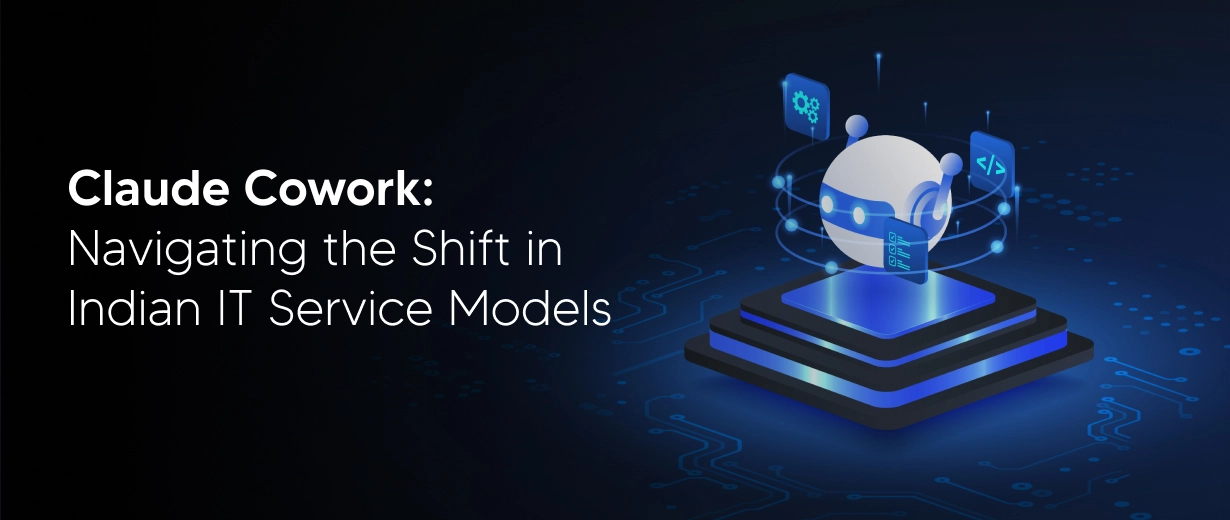
In early February 2026, a tremor moved through the Indian stock markets that had nothing to do with interest rates or global trade policy. In a single week, the Nifty IT index saw nearly ₹2 lakh crore in market value evaporate. The catalyst? The launch of Claude Cowork and its suite of autonomous agentic plug-ins.
For the first time, the buzz felt different. It wasn't just another chatbot. It was a tool that could move a mouse, navigate a CRM, audit a legal contract, and fix a bug in a codebase—autonomously. For an industry that has built its global empire on the foundation of man-hours and effort-based billing, the message was clear: The era of labor arbitrage is over. The era of the Digital Worker has begun.
The Ground Reality: Why India Feels the Heat
India is the back office and the engine room of the world. Our IT services market is built on the "pyramid model"; thousands of junior engineers performing repeatable, structured tasks in testing, application maintenance, and business process outsourcing.
The "Anthropic Effect" hits this model where it hurts most. When an AI agent like Claude can complete 15 hours of manual data reconciliation or junior-level coding in fifteen minutes, the math of charging per person, per hour, simply collapses. Clients are no longer asking how many people we have on a project; they are asking what the outcome is and why they should pay for hours that an agent can eliminate.
The "SaaSpocalypse" or a Strategic Reset?
Analysts have dubbed this moment the "SaaSpocalypse." The fear is that AI agents will bypass the very platforms (Salesforce, ServiceNow, etc.) that Indian IT firms are paid to customize and maintain. If Claude can operate the software directly, the middle layer of manual integration, i.e, a major revenue stream for Indian firms, faces a sudden deflation.
At Kellton, we view this not as an extinction event, rather a mandatory evolution. The future of India’s IT market will not be defined by the volume of work we do, but by the complexity of the ecosystems we orchestrate.
What the Future Looks Like: The Move to Outcome-Based Models
The future of IT services is agent-driven and outcome-linked. We are moving away from being a "factory of hands" to becoming a "studio of architects."
- From Execution to Orchestration: AI agents are powerful, but they are often paralyzed by the "spaghetti code" reality of global enterprises. While Claude Cowork thrives in modern, structured systems, it struggles with highly customized, undocumented legacy environments. In these cases, the "human-in-the-loop" isn't just a guardrail—they are the essential system historians. They are the only ones who understand why a specific patch exists or how a 20-year-old database interacts with a modern API. Our new role is to be the AI Orchestrator: providing the tribal knowledge and context that allows these agents to navigate complex, messy ecosystems safely and effectively.
- Hyper-Personalization at Scale: The "Digital Worker" allows us to offer services that were previously too expensive to automate. We are seeing a shift toward "Utilitarian AI", where AI isn't a shiny pilot project but a core utility that runs 24/7 to predict supply chain breaks, or self-heal server errors before a human even sees the ticket.
The Playbook for Relevance: How to Tackle the AI-Driven World
As leaders of this sector, we cannot wait for the market to stabilize. We must cannibalize our own outdated models before the competition does. Here is how we maintain our global edge:
- Kill the Hourly Rate: We must aggressively move toward Value-Based Pricing. If we deliver a project in two days using Claude Cowork that used to take two months, we should be paid for the value of those two months of saved time, not the two days of computing.
Equally important, we must also have the foresight to expect errors that an AI may have missed. - Invest in "Human-in-the-Loop" (HITL) Governance: Trust is the new currency. Enterprises are terrified of autonomous agents "hallucinating" or making rogue decisions. The Indian IT sector must position itself as the global hub for AI Governance. We provide the human oversight that ensures AI agents remain compliant, ethical, and accurate.
- Data Readiness as a Service: You cannot have an autonomous agent if your data is trapped in silos. The biggest barrier to Claude’s success in a Fortune 500 company is a messy data foundation. Our new "bulk work" is no longer manual testing; it is Data Modernization, i.e, cleaning and structuring the fuel that these agents need to run.
- Radical Upskilling: We must transform our junior developers from "coders" into "Agent Super-Users." An engineer who can manage a fleet of 50 AI agents is worth 100 times more than an engineer who writes code manually.
The Bottom Line
Claude is the current buzz because it feels the most like a human engineer, but in the corporate world, capability is nothing without compliance. Giving an autonomous agent mouse control and file access creates massive liability and security risks that most Fortune 500 companies aren't ready to take.
At Kellton, our PoV is clear: While the "math of billing" is changing, the responsibility of maintenance remains human. Enterprise complexity and security risks act as a massive friction layer that will slow this "shockwave" down, giving us the opportunity to lead the transition. We aren't just building with AI; we are building the security frameworks that make AI possible. The firms that thrive will be those that provide the human oversight to ensure these Digital Workers stay compliant, ethical, and safe. As Kelltonites know well, our tagline embodies our belief: Infinite possibilities with technology—delivered with total responsibility.