Other recent blogs


In the complex, fast-paced world of modern enterprise, the demand for efficiency, personalization, and seamless operation has never been higher. Yet, for too long, enterprise software has been a source of friction ,forcing employees to navigate complex, siloed interfaces to complex simple tasks. This era of fragmented work is rapidly ending, thanks to the groundbreaking ServiceNow AI Experience. It’s not just an upgrade; it’s a radical reimagining of the ServiceNow AI interface, turning every digital interaction into an intelligent workflow powered by sophisticated AI.
ServiceNow is now positioning itself as the ServiceNow AI platform for business transformation, an operating system that fundamentally changes how people work by embedding intelligence directly into the flow of their daily tasks. This is a new UI for enterprise AI, where natural language, contextual understanding, and autonomous agents replace tedious clicks and manual handoffs, powered by cutting-edge ServiceNow AI capabilities.
The Foundation: ServiceNow AI Platform and Capabilities
The ServiceNow AI platform is the unified, secure and intelligent backbone driving the transformation. It goes beyond simple machine learning to offer a full-stack AI system designed specifically for the rigorous demands of enterprise workflows, leveraging advanced ServiceNow AI capabilities.
Three pillars of intelligence
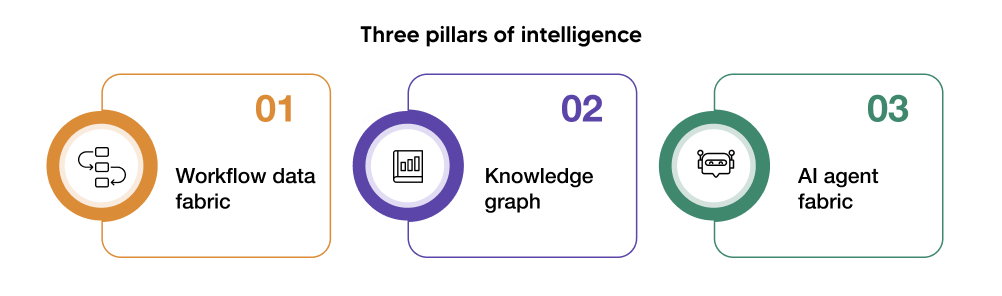
The platform’s strength lies in the three core, interconnected components that unify data, agents, and governance:
1. Workflow data fabric: This is the intelligent data layer that unifies access to all enterprise data, both structured and unstructured, regardless of where it resides, inside or outside the platform. It provides the real-time context necessary for AI agents to make smart decisions.
2. Knowledge graph: It maps out the relationship between all business entities, processes, and data, giving the AI a deep, contextual understanding of the entire organization. This allows the AI to deliver more accurate and relevant insights than systems based on a flat data table.
3. AI agent fabric: This is the communication and orchestration layer that allows different AI agents– ServiceNow-built, partner-built, or custom-built- to communicate, collaborate, and autonomously execute multi-step, cross-departmental tasks.
Core ServiceNow AI capabilities
The platform delivers its intelligence through a suite of advanced ServiceNow AI capabilities, highlighted by its generative AI offerings:
- NowAssist: This is the flagship feature, embedding generative AI directly into workflows across IT service management (ITSM), customer service management(CSM), and human resource service delivery (HRSD).
- Agent productivity: It instantly generates case summaries from long, messy ticket histories, drafts contextual email replies, and creates structured resolution notes, drastically cutting down on manual agent effort and handoff time.
- Developer acceleration: The text-to-code feature allows developers to describe the desired functionality with plain English, and the AI generates the corresponding code or workflow steps, accelerating custom application development on the Now platform.
- Intelligent virtual agents: These are the conversational interfaces that deflect common issues. Leveraging natural language understanding (NLU), they provide direct, accurate answers drawn from the knowledge base, dramatically improving self-service deflection for employees and customers.
- Predictive intelligence: This capability uses machine learning models to classify, prioritize, and route requests automatically. It can predict major incidents before they occur, triggering proactive workflows to prevent downtime, a crucial shift from reactive firefighting to proactive service delivery.
- Autonomous AI agents: These agents are the future of workflow automation. They move beyond simple task automation to autonomously execute complex, multi-step actions across systems, such as automatically fulfilling a software request, checking eligibility, getting manager approval, and provisioning the license - all without human touch.
The New UI: ServiceNow AI interface and UX
The true innovation of the ServiceNow AI Experience lies in its ServiceNow AI interface and revolutionary ServiceNow UX. The goal is to make the entire enterprise system disappear, replacing it with a simple, intelligent, conversational, and contextual experience.
1. Conversation-first interaction
The primary interaction model shifts from navigating menus and forms to using natural language- voice, text, or even images.
- AI voice agents: AI Voice Agents transform the traditional enterprise interface by enabling hands-free, conversational interaction with the entire ServiceNow platform and underlying workflows. Users can simply speak their request, such as "File an IT ticket for my slow laptop," and the AI, utilizing advanced Natural Language Processing (NLP), instantly understands the intent, classifies the issue (e.g., Performance Degradation), and initiates the appropriate automated workflow. This capability drastically improves accessibility and speed, allowing workers, particularly those in field services or mobile roles, to get support or complete administrative tasks without interrupting their physical work. The agents' primary use is to facilitate a truly seamless and instantaneous service experience, reducing the need for typing, searching, or navigating complex menus, which leads to immediate increases in employee productivity and satisfaction.
- AI Lens: The AI Lens is a groundbreaking visual intelligence capability that allows the ServiceNow system to perceive and understand context from images and screens, effectively transforming unstructured visual data into actionable workflow triggers. An employee can simply take a photo of an asset- like a piece of malfunctioning manufacturing machinery or a server rack - and the AI Lens instantly processes the image to extract relevant details such as asset ID, serial number, and physical location via text recognition and image analysis. This information is then used to automatically and accurately create a maintenance ticket, populate necessary fields, and route the issue to the correct maintenance team, eliminating manual data entry errors. The core use of AI Lens is to bridge the gap between the physical world and the digital workflows, dramatically accelerating incident logging and asset management in real-world environments.
- AI data explorer: The AI Data Explorer democratizes strategic data analysis by allowing enterprise users to query and derive insights from vast amounts of complex operational data using simple, natural language questions. Instead of relying on pre-built dashboards, navigating complex reporting tools, or waiting for a dedicated analyst, a user can ask a question like, "Show me the average resolution time for high-priority incidents in London last quarter and compare it to New York." The AI immediately processes this query, generates the necessary filters, and presents the data in an intuitive, visual format, turning complicated reports into actionable insights. Its primary use is to empower every decision-maker to perform ad-hoc data-driven analysis directly within their current workflow interface, ensuring that strategic decisions are based on real-time evidence without workflow disruption.
- AI web agents: AI Web Agents are intelligent, autonomous agents designed to perceive and interact with web interfaces, including third-party applications and websites, much like a human user would. Their primary use is to eliminate the tedious, repetitive manual process of logging into one system, extracting data, and entering it into another. For instance, an AI web agent can automatically resolve an It incident by logging into an external cloud portal, extracting system logs, and updating the corresponding ticket on the Now platform, or completing complex multi-step procurement processes across external vendor sites. They bring end-to-end workflow automation to systems that lack modern APIs, integrating legacy and external environments directly into ServiceNow intelligent workflows.
- AI control tower: The AI control tower acts as the central governance and oversight platform for all AI initiatives within the enterprise, ensuring that every AI agent and model operates securely, ethically, and in alignment with business policy. Its core use is to provide transparency and accountability by offering a unified view to track which models are deployed, how they are performing, and whether they are complying with internal standards and external regulations ( like the EU AI Act). It enables human-in-the-loop oversight, allows the setting of safety guardrails to prevent malicious or biased outputs, and monitors for model drift to ensure the continued accuracy and reliability of the entire AI ecosystem.
- Model provider flexibility: It is a strategic capability that allows organizations to choose and seamlessly integrate Large language models (LLMs) from various external vendors ( e.g, Google, Microsoft) with the ServiceNow AI platform. The primary use is to optimize AI outcomes and performance by matching the best-suited LLMs to a specific task - for instance, using one model for technical code generation and another for customer-facing empathetic responses. This flexibility is managed through a single interface that ensures data security, preventing proprietary enterprise data from being exposed to the external LLM provider, thereby offering the best of the breed AI without compromising on governance or data piracy.
2. Contextual and Personalized ServiceNow UX
The AI Experience fundamentally transforms the digital workspace, moving away from static interfaces to create a truly personalized, contextual UI. Utilizing real-time data and predictive analytics, the system intelligently anticipates user needs, ensuring employees and customers are only presented with the most relevant information and actionable options. This tailored approach drastically reduces cognitive load and "noise," enabling users to locate information and complete tasks swiftly and effortlessly. By seamlessly integrating intelligence into the presentation layer, the platform effectively augments the user's ability to make faster, better decisions and dramatically improves overall engagement.
- Workspaces: Instead of generic dashboards, AI-powered service operations workspaces provide agents with a unified, 360-degree view of the customer or the issue, along with AI-driven recommendations, next best actions, and summaries of past interactions.
- Proactive engagement: The AI constantly monitors the health of devices and applications. If any issue is detected- say an employee’s laptop running low on memory —the system proactively creates an incident and offers a Desktop Assistant to guide the employee through an automated fix, preventing the issue before the employee even submits a complaint. This transforms the UX from a passive receiver of complaints into an active, helpful partner.
3. Strategic growth: ServiceNow AI acquisitions
ServiceNow's aggressive stance on AI has been heavily supported by strategic acquisitions that rapidly accelerate the capabilities of its ServiceNow AI platform. This ServiceNow AI acquisition is not just about adding features; it is about acquiring domain expertise, cutting-edge technology, and top talent to deepen the platform’s intelligence:
- Moveworks (Agentic AI for enterprise automation): This ServiceNow AI acquisition significantly bolsters ServiceNow’s generative AI roadmap and is key to the shift towards agentic AI. Moveworks' technology allows ServiceNow's AI to move from merely assisting workflows (a co-pilot) to autonomously driving them (an AI agent), resolving requests across IT, HR, and other services in real-time.
- Logik.ai (AI-driven CPQ and revenue workflows): This acquisition enhances ServiceNow’s customer relationship management(CRM) and sales and order management(SOM) capabilities, specifically by using AI to simplify and accelerate Configure,Price, Quote(CPQ) processes, driving a more efficient sales cycle.
- Cuein AI (Conversational analytics): This adds advanced conversational analytics, allowing the platform to gain real-time insight into customer and employee interactions, automatically extracting sentiment, satisfaction, and underlying issues to enhance the Workflow Data Fabric's context.
These acquisitions indicate a clear strategy: to embed market-leading, autonomous, and contextual ServiceNow AI capabilities into every layer of the Now platform, making it the undeniable system of action for the enterprise.
The autonomous enterprise and responsible AI
The culmination of these technologies is the realization of the autonomous enterprise, where repetitive, complex tasks are handled by intelligent, trusted agents, freeing up human workers for high-value strategic work.
The culmination of these technologies is the realization of the autonomous enterprise, where repetitive, complex tasks are handled by intelligent, trusted agents, freeing up human workers for high-value strategic work. Crucially, ServiceNow understands that trust is paramount to AI adoption. The platform ensures this trust by integrating features like the AI Control Tower to enforce ethical guardrails and provide centralized governance, keeping human oversight at the core of all automated decisions.
- The impact: Intelligent workflows across the board
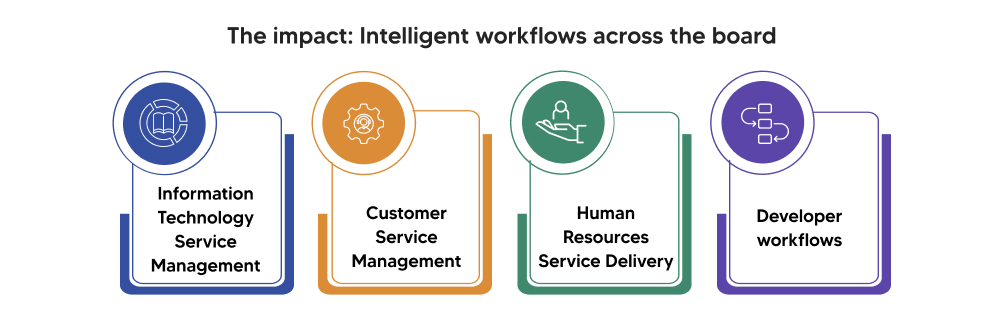
The ServiceNow AI experience is not limited to a single department; its unified nature delivers transformative value across all enterprise workflows:
- ITSM: The AI drives a crucial shift to proactive incident prevention by using predictive intelligence to identify potential system failures before they occur. It enables automated triage and routing for tickets, combined with instant self-service resolution via intelligent virtual agents, drastically reducing downtime and manual IT workload.
- CSM: AI capabilities ensure faster mean-time-to-resolution by equipping human agents with generative AI-powered summaries and next best actions. Through intelligent virtual agents, the platform achieves higher deflection rates and delivers personalized service by understanding customer sentiment and historical context.
- HRSD: Employees gain access to immediate, accurate answers to complex HR policy questions through conversational AI, significantly improving the employee experience. This intelligence supports automated onboarding and life-cycle event support, allowing HR staff to focus on strategic employee engagement rather than routine administration.
- Developer workflows: Developers benefit from accelerated application building via the text-to-code capability, which generates scripts and workflow steps from natural language descriptions. This feature dramatically shortens the development cycle, empowering citizen developers and speeding up time-to-market for custom digital solutions built on the Now platform.
By combining the powerful ServiceNow AI platform with a radical ServiceNow UX, the company is delivering on its promise to make the working world better. The friction is being removed, the silos are dissolving, and the ServiceNow AI interface is evolving into a single, intelligent conversation. The ServiceNow AI experience is the new operating model for the enterprise, ushering in the age of truly intelligent workflows, powered by sophisticated ServiceNow AI capabilities.
Conclusion
The ServiceNow AI experience marks a pivotal shift, moving the enterprise interface from a source of friction to a force of intelligent, autonomous work. Built on the secure ServiceNow AI Platform, the system is underpinned by the Workflow Data Fabric and the AI Agent Fabric, enabling cross-departmental automation. Features like Now Assist and Predictive Intelligence empower agents and proactively prevent issues, fundamentally changing reactive service models.
The new ServiceNow UX transforms interaction through conversational tools like AI voice agents and AI Lens, making the entire system hands-free. Crucially, autonomous AI Web Agents and Model Provider Flexibility break down application silos, integrating legacy systems and leveraging the best external LLMs. Governance is maintained through AI Control Tower, ensuring all automated actions are secure and compliant. Ultimately, the ServiceNow AI experience redefines productivity, delivering a unified, personalized, and proactive environment where every digital interaction fuels an intelligent workflow, ushering in the truly autonomous enterprise.