Other recent blogs


Picture a scenario: Your IT team spent 14 hours last week routing a single network incident across six departments. Each handoff required manual verification, data entry, and approval chains. The cost was not just time but missed SLAs, frustrated customers, and burned-out staff. This is the breaking point where traditional automation fails. Static if-then rules cannot handle the complexity of modern enterprise operations. Enter agentic AI, specifically ServiceNow AI agents. These autonomous systems understand context, make decisions, and execute multi-step workflows in every scenario without human intervention.
Agentic AI ServiceNow workflows enable enterprises to move from static automation to outcome-driven processes. AI agents interpret intent, make autonomous decisions, and execute actions across ITSM, ITOM, HRSD, and CSM workflows. Orchestrated agents reduce resolution times, handle exceptions dynamically, and enforce governance. CIOs implementing this need clear objectives, modular agent design, human-in-the-loop controls, and robust audit frameworks. Early investments in data readiness, skills, and policy alignment yield measurable ROI and scalable digital transformation in 2026.
This blog explains how agentic AI ServiceNow workflows operate, why they differ from traditional automation, and how CIOs should implement them responsibly at scale.
What is agentic AI workflow automation in the ServiceNow context?
Agentic AI workflow automation in the ServiceNow context refers to AI-driven agents that can interpret intent, make decisions, and execute actions across workflows with bounded autonomy. These agents operate within ServiceNow workflow automation rather than outside it, which is a critical distinction for enterprise adoption. The platform provides identity, policy, audit trails, and escalation paths that constrain agent behavior.
Unlike scripted automation, agentic AI ServiceNow workflows are goal-oriented. An agent is assigned an objective such as incident resolution, service request fulfillment, or employee onboarding completion. It evaluates context from ServiceNow records, historical outcomes, and real-time signals. It then determines the best next action rather than following a fixed path. This approach is particularly effective in domains where inputs are incomplete, priorities shift, and dependencies span teams and systems.
In practice, agentic workflow automation appears across IT service management, IT operations management, customer service management, HR service delivery, and enterprise operations. These are areas with high decision density and frequent exceptions. ServiceNow AI agents augment human teams by handling routine judgment calls while escalating edge cases based on confidence thresholds.
What problems does agentic workflow automation solve in ServiceNow?
Traditional ServiceNow implementations rely on pre-programmed automation that breaks when exceptions occur. An incident requires approval from a manager who is unavailable. A compliance check fails because data exists in an unintegrated system. These bottlenecks accumulate into operational drag.
Agentic AI servicenow systems operate differently. They are autonomous agents that understand business objectives, reason through problems, and adapt execution plans in real time. Where conventional automation follows rigid paths, agentic workflow automation evaluates context and chooses optimal actions.
You will find agentic capabilities embedded across your ServiceNow stack in 2026. The AI Agent Studio lets you build custom agents through natural language interfaces. Pre-built agents exist for ITSM, CSM, HRSD, and SecOps modules. The AI Agent Orchestrator coordinates multiple agents to handle complex, cross-department workflows. AI Control Tower provides governance and monitoring across all agent activity.
ServiceNow's Workflow Data Fabric and AI Agent Fabric enable this capability by connecting data across internal and external sources. Agents access information from CRM systems, financial databases, third-party APIs, and knowledge repositories to make informed decisions.
Where will you find agentic AI in your current tech stack?
Most enterprises already operate fragments of agentic behavior across their technology landscape. Observability tools detect anomalies. Virtual agents classify intents. RPA tools execute actions. The problem is fragmentation. Decisions are made in one system, actions in another, and accountability is unclear.
ServiceNow consolidates agentic AI capabilities into a unified workflow automation layer. AI agents are embedded within Flow Designer, Virtual Agent, case intelligence, predictive intelligence, and integration hubs. This makes ServiceNow the coordination layer for agentic workflow automation rather than just another execution tool.
Beyond ServiceNow, agents interact with monitoring platforms, identity providers, ERP, CRM, cloud infrastructure, and data platforms. The difference is that ServiceNow governs intent, policy, and execution order. This prevents uncontrolled AI behavior and ensures enterprise wide consistency. For CIOs, this architecture reduces risk while enabling scale.
How is Agentic AI workflow automation different from traditional rule based workflows?
Traditional workflow automation is deterministic. Every condition and action is predefined. This model works when processes are stable and inputs are predictable. It fails when variability increases. Each new exception adds complexity, technical debt, and maintenance cost.
Agentic AI workflow automation replaces rigid logic with contextual decision making. Instead of encoding every rule, organizations define objectives, constraints, and escalation criteria. AI agents assess the situation at runtime and choose actions that best meet the goal.
In ServiceNow, this means workflows that can handle ambiguous requests, partial data, and cross domain dependencies. The trade off is control complexity. Agentic systems require stronger governance, observability, and continuous evaluation. CIOs must accept that not every path is predefined, but every action is accountable.
The difference from traditional rule-based workflows is fundamental. Rule-based systems execute "if X happens, then do Y" logic. They cannot handle ambiguity or learn from outcomes. If a procurement request exceeds the approval threshold and the designated approver is on leave, the workflow stalls. An agentic system evaluates alternative approvers based on authority levels, relationship to the requester, and current workload, then routes accordingly. It also learns that certain suppliers consistently deliver late and factors this into future vendor selection.
What is the agentic AI ServiceNow workflow blueprint?
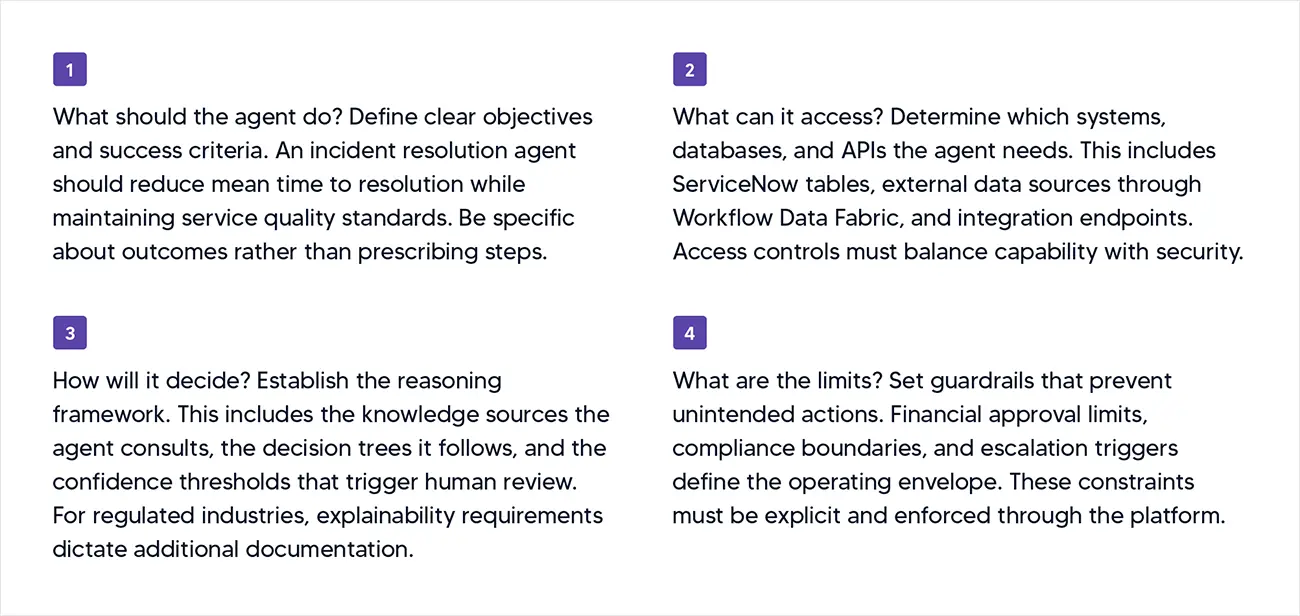
Building effective agentic workflows requires answering four foundational questions about each agent.
How does orchestrating AI agents in ServiceNow deliver cohesive and scalable workflow automation?
Single AI agents cannot operate effectively at enterprise scale without coordination. Orchestration is the mechanism that aligns multiple agents toward a shared outcome. In ServiceNow, an AI agent orchestrator manages task ownership, sequencing, and data flow across agents.
Each agent has a defined role. One may interpret intent. Another may assess risk or compliance. A third may execute remediation or fulfillment. ServiceNow workflow automation ensures that these agents operate within enterprise policies and hand off tasks predictably.
This orchestration model scales because responsibilities are modular while governance remains centralized. It also improves reliability. If one agent fails or lacks confidence, the orchestrator reroutes work to another agent or a human queue. This balance between autonomy and control is what makes agentic AI ServiceNow workflows enterprise-ready.
How do you implement agentic AI ServiceNow workflows?
Implementation requires a phased approach that balances ambition with operational reality.
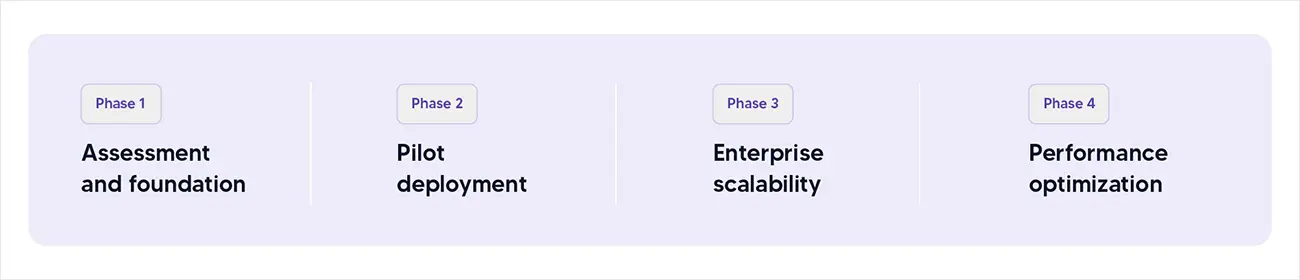
Phase 1: Assessment and foundation
Evaluate your current ServiceNow implementation maturity. Data quality determines the success of agentic AI more than any other factor. Agents trained on inconsistent, incomplete, or inaccurate data make poor decisions. Audit key tables for completeness, implement data governance policies, and establish quality metrics. Identify high-value use cases where agents can deliver quick wins. ITSM request fulfillment, common HR queries, and routine approvals typically offer clear ROI with manageable risk.
Phase 2: Pilot deployment
Start with contained workflows that have defined boundaries. Build one or two agents using AI Agent Studio, focusing on processes with high volume, clear success criteria, and low regulatory risk. Implement comprehensive monitoring from day one. Track agent decisions, measure performance against baseline metrics, and collect user feedback. Establish a review cadence to evaluate results and refine agent behavior. This phase proves feasibility and builds organizational confidence.
Phase 3: Enterprise scalability
Expand to additional use cases and departments. Deploy the AI Agent Orchestrator to coordinate multi-agent workflows. Integrate with AI Control Tower for centralized governance. This phase requires change management investment. Teams must understand how to work alongside agents, when to intervene, and how to provide feedback that improves agent performance.
Phase 4: Performance optimization
Continuously analyze agent performance data to identify opportunities for improvement. Refine decision logic based on outcomes. Expand agent capabilities as confidence grows. This is not a one-time project but an ongoing transformation of how work gets done.
Critical success factors include executive sponsorship, cross-functional collaboration, and realistic timelines. Organizations that treat agentic AI as an IT initiative alone typically fail. Successful implementations involve business process owners, compliance teams, and end users from the start.
How should organizations prepare for Agentic AI ServiceNow transformation?
Technology implementation is the easier part of this transition. The harder challenge is organizational readiness. Agentic AI fundamentally changes how work gets done, which means changing how people think about their roles.
Start with education. Most employees have limited understanding of how AI agents differ from traditional automation. Invest in training that explains agent capabilities, demonstrates practical applications, and addresses concerns about job security. The message is not that agents replace humans but that they handle routine cognitive tasks so humans can focus on complex problem-solving, relationship building, and strategic work.
Redesign processes for agentic execution. Many current workflows were designed around human limitations and organizational structures rather than optimal outcomes. Agentic systems operate differently. They do not need approval chains to prevent errors because they are programmed with decision boundaries. They do not require manual data entry because they pull information directly from source systems. Rethink processes from first principles rather than automating existing inefficiencies.
Establish governance frameworks that balance innovation with control. Determine which types of decisions require human oversight. Define escalation paths for situations outside agent parameters. Create audit mechanisms that ensure compliance with regulatory requirements. These guardrails should enable rather than constrain agent capabilities.
Build feedback loops that improve agent performance over time. Create channels for users to report issues, suggest improvements, and share successful applications. Designate agent owners responsible for monitoring performance metrics and implementing refinements. This continuous improvement mindset separates organizations that extract lasting value from those that plateau after initial deployment.
Cultural transformation matters as much as technical implementation. Leaders must model comfort with AI augmentation, celebrate successful human-agent collaboration, and address resistance constructively. Organizations that approach this as change management rather than just technology deployment see significantly higher adoption rates and faster time to value.
How does Kellton support ServiceNow agentic AI workflow automation?
Kellton helps enterprises move from traditional digital transformation to agentic AI ServiceNow execution. We design agentic workflow automation architectures, implement AI agent orchestrator patterns, and embed governance by design. Our ServiceNow specialists align AI autonomy with business risk, compliance, and ROI. Schedule a consultation to discuss how agentic AI ServiceNow workflows can transform your operations.
Frequently Asked Questions
What is agentic workflow automation?
Answer: Agentic workflow automation uses autonomous AI agents that understand objectives, make contextual decisions, and execute multi-step processes without requiring explicit programming for every scenario. Unlike rule-based automation, these systems adapt to exceptions and learn from outcomes.
What is the agentic AI in ServiceNow?
Answer: Agentic AI in ServiceNow refers to autonomous agents built on the ServiceNow AI Platform that gather contextual data, reason through problems, and execute workflows across IT, HR, customer service, and other business domains. The platform includes AI Agent Studio for building agents and AI Agent Orchestrator for coordinating multiple agents.
How does servicenow agentic ai workflow automation accelerate digital transformation in 2026?
Answer: ServiceNow agentic AI accelerates transformation by handling complex, cross-department workflows autonomously. Organizations report 30-50% process time reductions, improved accuracy, and freed capacity for strategic initiatives. The platform integrates with existing investments through Workflow Data Fabric and AI Agent Fabric, enabling rapid deployment.
What is an example of an agentic AI workflow?
Answer: Network incident resolution is a typical example. An agent detects a network issue, gathers data from monitoring systems, assesses business impact, identifies root cause, creates a remediation plan, executes fixes after human approval, and updates documentation. Throughout this process, it adapts to unexpected conditions and learns for future incidents.
What is the difference between intelligent automation and agentic AI?
Answer: Intelligent automation typically refers to RPA enhanced with basic AI capabilities like OCR or simple classification. It follows predetermined paths and requires explicit programming. Agentic AI systems reason through problems, make contextual decisions, and adapt their approach based on changing conditions. They operate with greater autonomy and learn continuously from experience.