Other recent blogs


The insurance industry is currently witnessing a large-scale shift. For decades, the sector relied on monolithic legacy systems—robust for their time, but increasingly brittle in an era of instant gratification and hyper-connectivity. Today. The competitive edge belongs to those who can unify their data. Achieving this requires a sophisticated strategy centred on insurance data integration, utilizing the twin engines of middleware and APIs to bridge the gap between old-world stability and new-world agility.
The Digital Mandate: Why Seamless Integration is No Longer Optional
In 2025, the silent data silos seem to be the greatest threat to an insurer’s bottom line. Customers no longer compare their insurance experience to other insurers; they compare it to Netflix, Amazon, and Uber. They expect real-time policy updates, instant claims processing, and personalized premiums. However, reaching this level of service is impossible if your underwriting data is wired in a 1990s setup while your customer portal sits on a modern cloud.
Recent data highlights the urgency of this transition. According to industry reports from CoinLaw, insurance providers running policies on legacy platforms face a 41% increase in IT costs compared to those using modernized, integrated systems. Furthermore, a 2025 Deloitte survey concluded that 60+% of executives in insurance now consider a robust API strategy to be the single most critical component of their digital transformation roadmap. To bridge this divide, firms are turning to a specialized integrated solution for insurance that doesn’t just patch systems together, but creates a living data ecosystem altogether.
The Role of Middleware: The Digital Glue of Your Enterprise
Middleware serves as the invisible intermediary that allows disparate software applications to communicate. In the complex landscape of insurance, where a single claim might touch a CRM, a policy administration system, a billing module, and a third-party repair network, the middleware acts as the translator. It ensures that data remains consistent and secure as it moves across various environments, providing a unified layer for insurance software integration.
How Middleware Powers Insurance Workflows
- Message-Oriented Middleware (MOM): This ensures that even if one system is temporarily offline—such as a legacy mainframe undergoing maintenance—the data packets (like a new claim submission) are queued and delivered as soon as the system returns.
- Enterprise Service Bus (ESB): Acting as a central hub, an ESB routes data between dozens of different applications using a standardized set of rules, reducing the "spaghetti code" that often plagues older architectures.
- Protocol Translation: Middleware can take modern JSON data from a mobile app and "translate" it into the COBOL or XML formats required by older back-end systems.
- Governance and Security: By centralizing the flow of data, middleware provides a single point for enforcing encryption standards and HIPAA/GDPR compliance across the entire organization.
The Power of APIs: Creating a Connected Insurance Ecosystem
If middleware is the internal nervous system, application programming interfaces (APIs) are the plugs that allow your system to connect to the outside world. Modern insurance integration solutions rely heavily on an “AI-first” philosophy. This allows insurers to move away from rigid, all-in-one software suites toward a modular architecture where new tools - like AI-driven fraud detection or telematics - can be plugged within weeks rather than years. By standardizing these connections, carriers can build a robust foundation for insurance software integration and API management that supports both legacy stability and modern speed. Ultimately, this connectivity transforms from a siloed risk-taker into a dynamic participant in a much broader, global financial ecosystem.
Strategic API Use Cases for 2026
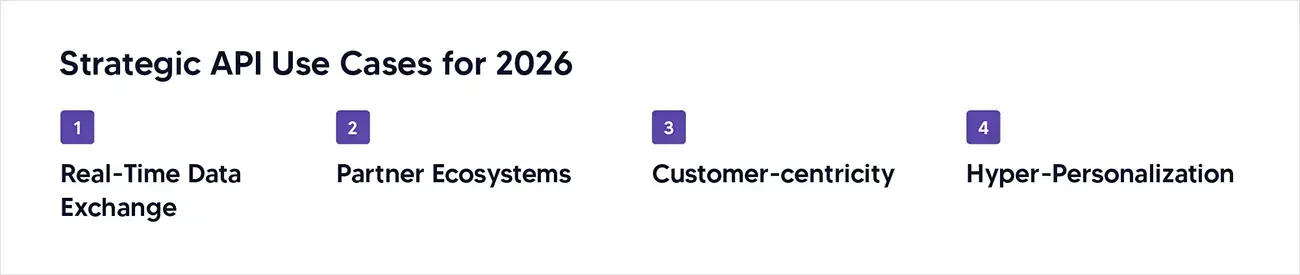
- Real-Time Data Exchange: APIs enable "straight-through processing" (STP), where a claim can be validated against policy data and external loss adjusters in seconds, not days. This rapid synchronization ensures that every department works with a single, live version of the truth. By utilizing these insurance integration solutions, carriers can virtually eliminate the manual data re-entry that frequently causes costly human errors.Learn more about how an AI-driven insurance data platform accelerates these workflows.
- Partner Ecosystems: Through open insurance APIs, carriers can integrate their products directly into third-party platforms. For example, a travel agency can sell insurance at the point of checkout via a simple API call, capturing customers exactly when they feel the most risk. This approach to insurance software integration allows traditional teams to compete directly with nimble insurance startups in the high-growth embedded insurance market.
- Customer-centricity: APIs power the mobile apps that let policy-holders upload photos of a car accident and see their claim status update in real-time, pulling data from the back-end via secure gateways. This transparency builds a level of trust that was previously impossible with opaque, slow-moving legacy systems. It demonstrates how modern insurance data integration shifts the focus from administrative complexity back to the actual human experience of the policyholder.
- Hyper-Personalization: By connecting to external data sources( IoT devices, weather sensors) via APIs, insurers can offer dynamic pricing such as “pay-how-you-drive” auto insurance. These real-time feeds allow for risk-adjustment on the fly, regarding safe behaviors with lower premiums almost instantly. Such advanced insurance software integration ensures that policies are no longer static documents, but living services that adapt to the user’s specific life circumstances.
Key Benefits of Unified Insurance Data Integration
Moving toward a seamless data flow isn't just a technical upgrade; it’s a fundamental business transformation. When data moves without friction, the entire value chain becomes more efficient. From the front-end agent portal to the back-end actuarial models, everyone works from a single version of truth, which is the ultimate goal of any insurance data integration project.
- Increased Productivity: McKinsey research indicates that modernized IT platforms can increase staff productivity by over 40% by automating routine data entry and reducing manual system-switching. This efficiency is a direct result of comprehensive insurance software integration, which allows underwriters to spend less time on administrative tasks and more time on complex risk assessment. By automating the data handshake between systems, employees are empowered to handle higher volumes of business without a linear increase in headcount.
- Faster Time-to-Market: With a library of reusable APIs, launching a new insurance product can be up to 75% faster, as developers don’t have to rebuild the integration logic from scratch every time. By deploying flexible integrated solutions for insurance, companies can respond to emerging market trends, like climate-related coverage, before their competitors can even update their legacy code. This speed allows for a “fail fast” innovation culture where new ideas can be tested in the real market with minimum upfront technical debt.
- Enhanced Risk Management: Real-time data integration allows for "continuous underwriting," where risk models are updated instantly based on new information, rather than waiting for an annual renewal cycle. Robust insurance data integration ensures that actuarial teams have immediate access to telemetry and external threat data, significantly narrowing the gap between data collection and actionable insights. Consequently, carriers can identify loss patterns as they happen, allowing for proactive policy adjustments that protect the bottom line.
- Cost Reduction: By streamlining operations and reducing the maintenance burden of legacy fixes, firms can lower their long-term operational expenses by an average of 70%. Choosing the proper insurance integration solutions essentially converts fixed legacy maintenance costs into variable, scalable growth investments that future-proof the entire technical stack. Furthermore, the reduction in data silos decreases the probability of expensive compliance failures and regulatory fines associated with inaccurate reporting.
A Step-by-Step Strategy for Implementation
Implementing a comprehensive integration strategy requires more than just buying new software; it requires a roadmap that respects the existing business logic while preparing for a cloud-native future.As firms move toward these architectures, staying updated on the latest cloud computing trends is essential for long-term scalability." Many successful firms adopt a "phased modernization" approach. This avoids the high-risk "rip and replace" method by using middleware to wrap legacy assets in modern interfaces, slowly migrating functions as the new ecosystem stabilizes. This structured methodology ensures that your insurance software integration remains resilient against evolving market demands while minimizing operational downtime.
- Audit and Mapping: Before writing a single line of code, you must map your existing data flows. Identify which systems are the systems of records and where data bottlenecks currently occur. This phase is crucial for determining which insurance software integration tools will offer the highest ROI. A thorough audit acts as the essential blueprint for all subsequent insurance data integration efforts, preventing costly mid-project architectural pivots.
- Establish a Middleware Layer: Implement a robust middleware solution( like iPAAS or ESB) to act as the traffic controller. This layer will manage the "heavy lifting" of data transformation and queuing, ensuring that your legacy core remains stable while you build modern features on top of it. By effectively decoupling the front-end from the back-end, these integration solutions for insurance provide the flexibility to update individual modules without disrupting the entire enterprise system.Selecting the right architecture at this stage is critical; you can explore the best backend web development frameworks to understand which technologies provide the best scalability for middleware applications.
- Develop a Reusable API Library: Instead of building custom integrations for every new partner, create a set of standardized APIs. For example, create one "Claims Status" API that can be used by your website, your mobile app, and your independent agent portals. This “write once, use many” approach is the hallmark of effective insurance integration solutions. Standardizing these endpoints significantly accelerates the onboarding of new ecosystem partners and simplifies the long-term maintenance of your insurance data integration infrastructure.
- Prioritize Security and Compliance: In the insurance world, data is the most sensitive asset. Ensure your integration layer includes robust API gateways that handle authentication (OAuth2), rate limiting (to prevent DDoS attacks), and detailed logging for regulatory audits. Advanced insurance software integration must treat security as a foundational element rather than an afterthought to protect both policyholder privacy and corporate reputation.
Overcoming Common Hurdles
The path to seamless integration is rarely a straight line. Cultural resistance and data debt are often bigger obstacles than the technology itself. IT teams may be hesitant to touch decades-old code, while business units may fear that opening up data via APIs will lead to security breaches. Education is key; stakeholders must understand that integration is the only way to remain competitive against agile insurance startups.
Another common challenge is data quality, which acts as the foundation for any successful digital transformation. If the data sitting in your legacy system is inconsistent, duplicated, or poorly formatted, integrating it will only spread the problem faster across modern applications.
A successful data integration project must include a rigorous data cleansing phase with the middleware logic to ensure that only high-quality information reaches the front-end. Without this verification layer, the automated processes enabled by insurance integration solutions could lead to cascading errors in underwriting and claims.
Furthermore, many organizations struggle with the risk of vendor lock-in when selecting their integration solutions for insurance. It is easy to fall into the trap of choosing a proprietary platform that promises a "quick fix" but eventually limits your ability to connect with best-of-breed third-party tools in the future. To avoid this, your insurance software integration strategy must prioritize open-source standards and cloud-agnostic architectures that allow for maximum flexibility. By maintaining a modular and vendor-neutral integration layer, your firm ensures that the insurance data integration framework built today remains an asset rather than a liability as the technological landscape evolves in the coming years.
Conclusion
The journey towards seamless insurance data integration is a marathon, not a sprint. By leveraging Middleware to stabilize legacy systems and APIs to unlock real-time connectivity, insurers can finally break free from the constraints of their technological heritage. The result is a more agile, cost-effective, and customer-centric organization that is ready to thrive in a digital age. The numbers don't lie: with the potential for 40% gains in productivity and massive reductions in maintenance costs, the question is no longer if you should modernize your integration strategy but how fast you can execute it. In a world where data is the new premium, your integration layer is the most valuable asset you own.
Frequently Asked Questions (FAQs)
Q1. What is the primary difference between middleware and APIs in insurance software integration?
Middleware is the internal plumbing for data transformation between back-end systems, while APIs are the external connection points for interaction. Both are vital for a complete insurance software integration strategy.
Q2. Can we achieve seamless insurance data integration without replacing our existing legacy mainframe?
Yes, middleware allows you to wrap legacy systems with modern interfaces, protecting your core investment. This ensures seamless insurance data integration without high-risk system overhauls.
Q3. How do these integration solutions for insurance handle data privacy and regulatory compliance?
Integration layers centralize security, enabling uniform encryption and access control across all data endpoints. This simplifies adhering to global regulations through consistent insurance integration solutions.
Q4. What is the typical ROI timeline for a major insurance software integration project?
Most firms see positive ROI within 18 months due to 40% boost in productivity and lower maintenance costs. Efficient insurance software integration turns technical debt into a competitive advantage.