Other recent blogs


Most organizations face a critical decision point in 2026. AI adoption has jumped to 72 percent according to McKinsey's 2024 survey, up from approximately 50 percent over the past six years. This surge creates a fundamental problem: teams build AI applications without proper infrastructure, leading to failed deployments, model drift, and wasted resources. The solution is not more AI talent but the right AI technology stack.
This blog examines how modern AI tech stacks solve deployment challenges through frameworks, MLOps platforms, and development environments. Seventy percent of organizations experienced difficulties with data, including defining processes for data governance frameworks and developing the ability to quickly integrate data into AI models. The components discussed here address these exact pain points, providing a blueprint for scalable AI development in 2026.
What is an AI tech stack?
An AI tech stack represents the complete set of technologies, tools, and platforms required to build, train, deploy, and maintain artificial intelligence applications. Unlike traditional software stacks, AI technology stacks must handle massive datasets, computational workloads, model versioning, and continuous monitoring. The stack includes data infrastructure, development frameworks, training platforms, deployment tools, and monitoring systems.
Organizations typically build AI tech stacks around three core layers: data management and storage, model development and training, and deployment and operations. Each layer requires specialized tools that integrate seamlessly to support the complete machine learning lifecycle. The quality of your AI technology stack directly determines development velocity, model performance, and operational costs.
Why does data matter in AI tech stack?
Data forms the foundation of every AI system, yet defining processes for data governance and developing the ability to quickly integrate data into AI models remain top challenges, with insufficient training data also presenting significant obstacles. Your AI tech stack must handle data collection, storage, versioning, and pipeline orchestration.
Modern data infrastructure requires tools like Apache Kafka for streaming data, data lakes for storage, and versioning systems like DVC (Data Version Control). Data quality directly impacts model accuracy. Organizations that invest in robust data infrastructure within their AI tech stack achieve faster iteration cycles and better model performance. The data layer must support both batch and real-time processing while maintaining strict governance controls.
MLOps in the AI tech stack
MLOps represents the engineering discipline that combines machine learning, DevOps, and data engineering to reliably and efficiently deploy and maintain ML systems in production. The MLOps component of your AI technology stack automates model training, validation, deployment, and monitoring workflows.
MLflow remains the most widely adopted open-source MLOps platform in 2025, providing a comprehensive lifecycle solution for tracking experiments, managing models, and deploying them across multiple environments. Key MLOps platforms include Kubeflow for Kubernetes-native orchestration, AWS SageMaker for cloud-native deployments, and Weights & Biases for experiment tracking.
IDEs in AI tech stack
Integrated Development Environments specialized for AI development accelerate coding, debugging, and experimentation. Top IDEs for AI development in 2026 include PyCharm, Visual Studio Code, and Jupyter Notebook, offering support for multiple languages, debugging, and version control.
PyCharm provides intelligent code assistance with seamless integration into TensorFlow, PyTorch, and Scikit-learn frameworks. VS Code delivers lightweight performance with extensive Python extensions and native Git integration. Jupyter Notebook remains essential for data scientists, enabling interactive coding with visualization capabilities built directly into notebooks.
Cloud-based IDEs like Google Colab and AWS Cloud9 offer additional benefits including scalable compute resources, collaboration features, and remote access for distributed teams. The right IDE integration within your AI tech stack reduces development friction and improves team productivity.
How have AI tech stacks evolved from traditional to modern approaches?
Early AI development relied on monolithic architectures with manual model training, local development environments, and ad-hoc deployment processes. Teams built custom scripts for every stage of the ML lifecycle, creating maintenance nightmares and limiting scalability.
Modern AI tech stacks embrace microservices architecture, containerization, and cloud-native deployments. Docker containers package models with dependencies, Kubernetes orchestrates scaling, and API gateways manage inference endpoints. This shift enables teams to deploy hundreds of models simultaneously while maintaining consistency and reliability.
The rise of foundation models and transfer learning changed infrastructure requirements. Organizations now need GPU clusters for fine-tuning, vector databases for embeddings, and specialized serving infrastructure for large language models. Modern stacks incorporate these components as standard building blocks rather than custom implementations.
What are the key stages of a modern AI tech stack?
Modern AI tech stacks operate across five distinct stages. Data ingestion and preparation involves collecting, cleaning, and transforming raw data into training-ready formats. Tools like Apache Airflow orchestrate complex data pipelines while maintaining lineage tracking.
Model development and experimentation requires frameworks, experiment tracking, and collaborative notebooks. Teams iterate rapidly using version-controlled datasets and reproducible environments. Feature stores like Feast centralize feature engineering, ensuring consistency between training and serving.
Training and optimization leverage distributed computing, hyperparameter tuning, and automated machine learning. Cloud platforms provide elastic GPU resources, while tools like Optuna automate hyperparameter search. Model validation ensures performance meets business requirements before deployment.
Deployment and serving transforms trained models into production APIs. Container orchestration, load balancing, and A/B testing frameworks enable safe rollouts. Inference optimization techniques like quantization and model distillation reduce latency and costs.
Monitoring and maintenance track model performance, data drift, and infrastructure health. Automated retraining pipelines respond to performance degradation while observability tools provide visibility into production behavior.
What are the top AI development frameworks in 2026?
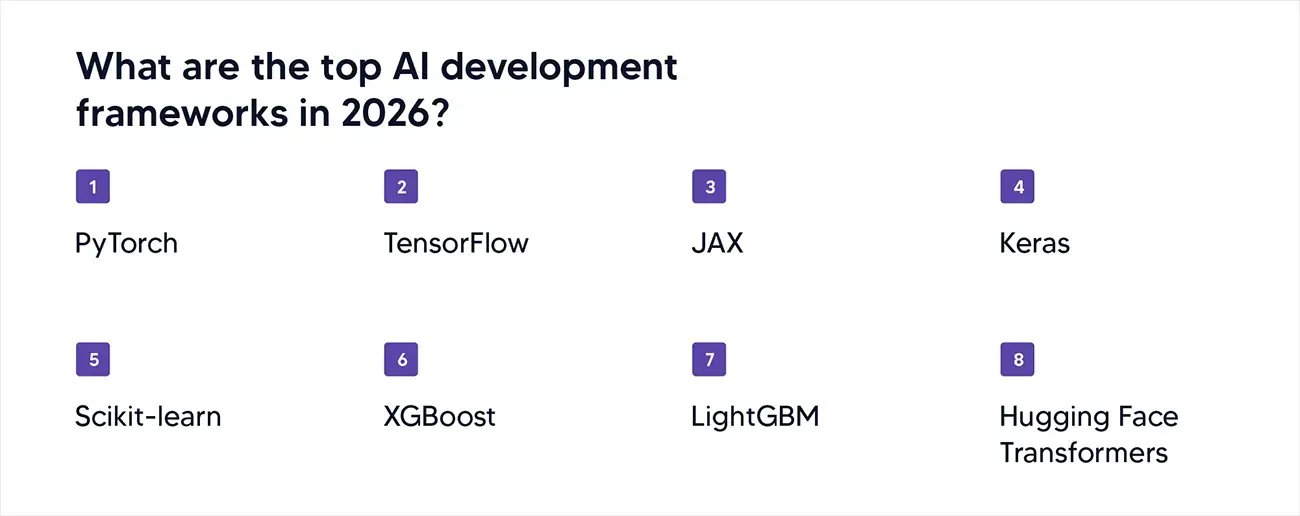
1. PyTorch
PyTorch claims over 55 percent of the production share in Q3 2025, thanks to its research-friendly architecture that no longer compromises on production performance. Dynamic computation graphs enable developers to debug models intuitively while maintaining deployment speeds that now rival TensorFlow's static approach. The framework's Pythonic syntax reduces learning curves for Python developers, while native integration with Hugging Face Transformers provides immediate access to state-of-the-art models for NLP and computer vision tasks. Teams choose PyTorch when rapid experimentation matters more than established deployment infrastructure.
Mobile deployment support through PyTorch Mobile continues maturing but lacks the polish of TensorFlow Lite for edge devices. Organizations deploying primarily to mobile platforms or requiring extensive pretrained model libraries should evaluate whether PyTorch's research advantages justify these infrastructure trade-offs.
2. TensorFlow
TensorFlow maintains dominance in production environments where deployment infrastructure and operational maturity outweigh research flexibility. The ecosystem delivers complete ML workflows through TensorFlow Serving for API deployment, TensorFlow Lite for mobile and edge devices, and TensorFlow Extended for production pipelines spanning data validation to model monitoring. Battle-tested deployments at Google, Uber, and Airbnb demonstrate TensorFlow's ability to serve billions of predictions daily with consistent latency and reliability. TensorBoard provides visualization capabilities that exceed competing frameworks, enabling teams to diagnose training issues and communicate results effectively to stakeholders.
3. JAX
JAX targets teams where computational performance justifies ecosystem immaturity and steeper learning curves. Google's functional programming framework enables automatic differentiation and just-in-time compilation through XLA, delivering performance that outpaces PyTorch and TensorFlow on large-scale training workloads. Composable transformations allow developers to parallelize code across multiple GPUs and TPUs without rewriting core logic. The clean functional design appeals to researchers familiar with functional programming paradigms and teams building custom numerical computing applications beyond standard deep learning.
4. Keras
Keras provides the shortest path from concept to working prototype through high-level APIs that abstract neural network complexity into intuitive building blocks. Tight integration with TensorFlow combines Keras's simplicity with TensorFlow's production capabilities, enabling teams to prototype rapidly without sacrificing deployment options. The framework requires minimal code for standard architectures, with consistent APIs across CNNs, RNNs, and transformers that reduce cognitive overhead when switching between model types. Excellent documentation with practical examples makes Keras ideal for educational settings and teams with limited deep learning expertise.
5. Scikit-learn
Scikit-learn remains essential for structured data problems including fraud detection, customer churn prediction, and recommendation systems where traditional machine learning outperforms deep learning. The library provides battle-tested implementations of classification, regression, and clustering algorithms through a consistent API that reduces learning overhead when switching between methods. Extensive preprocessing and feature engineering tools handle missing values, categorical encoding, and feature scaling without requiring external libraries. Outstanding documentation with practical examples enables teams to implement production-grade models without deep statistical expertise, while CPU-only execution eliminates GPU infrastructure costs.
6. XGBoost
XGBoost delivers exceptional performance on tabular data through optimized gradient boosting, consistently winning Kaggle competitions and powering production recommendation engines at major tech companies. Histogram-based splitting and parallel tree construction achieve training speeds that exceed traditional gradient boosting by orders of magnitude. Built-in regularization prevents overfitting without manual tuning, while automatic handling of missing values eliminates the need for preprocessing complexity. The algorithm excels in structured data problems where feature engineering is more important than model architecture, including fraud detection, credit scoring, and ranking systems.
7. LightGBM
Microsoft's LightGBM optimizes memory usage and training speed through tree-based learning, handling datasets with millions of features more efficiently than XGBoost. Benchmark tests show training time reductions from 192 seconds to 13 seconds on datasets with 119 million data points, enabling rapid iteration on large-scale problems. A lower memory footprint allows for training on modest hardware without the need for a distributed computing infrastructure. Native categorical feature support eliminates the overhead of one-hot encoding, which can balloon dataset sizes. The framework excels in large-scale ranking systems, recommendation engines, and applications where training speed directly impacts development velocity.
8. Hugging Face Transformers
Transformers achieves over 3 million daily pip installations, up from 20,000 in version 4, by providing unified access to more than 400 architectures and over 750,000 pretrained models spanning NLP, vision, and multimodal tasks. Users report saving five hours on six-hour tasks through plug-and-play integration that eliminates the need for model implementation and training from scratch. The unified API abstracts the differences between BERT, GPT, T5, and Vision Transformers into consistent interfaces, reducing cognitive overhead when switching between tasks. Rich documentation with step-by-step guides and active community support enables teams to deploy state-of-the-art models without deep expertise in transformer architectures.
How do these tools transform AI deployment and management?
Modern AI tech stacks play a crucial role in compressing AI deployment cycles from weeks to hours through automated MLOps pipelines. Model and data version control provides instant rollback when production issues emerge while eliminating the recovery delays and plague manual deployments. Next step in the process comes the continuous monitoring which identifies drift patterns before they impact business outcomes, enabling teams to shift from reactive firefighting to proactive optimization.
The real transformation occurs when frameworks, MLOps platforms, and IDEs collaborate. Data engineering experts iterate three times faster when experiment tracking automatically logs every parameter change. ML engineers push updates daily instead of monthly because standardized pipelines eliminate the guesswork associated with deployment. Business leaders make informed decisions using real-time dashboards, rather than waiting for quarterly performance reports.
Additionally, the timely and effective adoption of AI Tech Stack helps drop AI Infrastructure spending by 30 to 50 percent through containerization and autoscaling compared to overprovisioned, static clusters. Multi-model serving squeezes more predictions from the same hardware and quantization, along with distillation cut, inference costs, while maintaining model accuracy, directly improving margin on AI-powered products.
Team dynamics improve when everyone uses centralized model registries and shared development environments. Research teams hand off validated models to production engineers without translation friction. Domain knowledge spreads more quickly because standardized tooling creates a shared language across data science services, engineering, and operations roles.
How can enterprises optimize their AI stack for better ROI?
Organizations must align their AI technology stack with strategic objectives and operational maturity. Kellton specializes in AI infrastructure optimization, helping enterprises assess current capabilities, identify gaps, and implement modern AI tech stacks that deliver measurable business value.
Our approach combines technical expertise with industry knowledge to design AI platforms that scale with your business. We implement best practices for MLOps, establish governance frameworks for responsible AI, and train teams on modern development workflows that prepare them for the rise of multimodal AI agents.
Ready to transform your AI capabilities? Contact Kellton today for a comprehensive AI tech stack assessment. Our experts will design a customized roadmap that reduces deployment time, improves model performance, and delivers sustainable competitive advantage through optimized AI infrastructure.
Frequently Asked Questions (FAQs)
1. What is an AI tech stack?
An AI tech stack is a layered combination of tools, platforms, and infrastructure used to build, deploy, and operate AI systems. It typically includes data pipelines, models, orchestration, integrations, and governance layers that together enable intelligent, automated decision-making.
2. What are the core layers of a 2026 AI tech stack?
A 2026 AI tech stack includes data ingestion and storage, model layer (LLMs, ML models), retrieval and context (RAG), orchestration and agents, integration layer (APIs, workflows), and governance covering security, monitoring, compliance, and cost control.
3. How does an AI tech stack differ from a traditional software stack?
Traditional stacks focus on deterministic logic and fixed workflows, while AI stacks handle probabilistic outputs, continuous learning, and dynamic reasoning. AI stacks require model management, data context, observability, and guardrails, making them more adaptive but also more complex.
4. Do I need to be a developer to manage an AI tech stack?
Not necessarily. Modern AI stacks offer no-code and low-code tools for configuration, orchestration, and monitoring. However, technical expertise is still required for architecture decisions, integrations, governance, and scaling beyond simple use cases.
5. How do I choose the right AI tech stack for my business?
Start with business problems, not tools. Match stack complexity to ROI, data maturity, and risk tolerance. Use RAG for knowledge retrieval, automation tools for workflows, and agentic systems only when decision autonomy adds measurable value.
6. How do AI platforms connect with CRM and CPQ systems?
AI platforms integrate with CRM and CPQ systems through APIs, event triggers, and middleware. They ingest customer, pricing, and transaction data to enable use cases like lead scoring, quote optimization, recommendations, and automated sales or support workflows.