Other recent blogs


Many enterprise leaders are struggling with a critical inflection point in 2025. While 89% of CIOs identify agent-based AI as a strategic priority, over 40% of agentic AI projects are expected to face cancellation by the end of 2027 due to poor enterprise readiness, said Gartner. The primary barrier is not technological capability, but rather coordination complexity.
Organizations deploy multiple AI agents across departments without unified orchestration, creating fragmented systems that fail to deliver enterprise-wide value. Agentic orchestration solves this fundamental challenge by coordinating autonomous AI agents, traditional automation, and human oversight within governed business processes.
This blog examines how agentic orchestration transforms the deployment of autonomous AI systems in enterprises, exploring implementation frameworks, business value realization, and strategic adoption pathways.
What is agentic orchestration?
Agentic orchestration represents the coordination and management of multiple autonomous AI agents, automation systems, and human contributors within unified business processes. Unlike traditional workflow automation, which follows predetermined, rule-based paths, agentic orchestration bridges the gaps between AI workflow components through integration, automation, and management pillars. The system enables specialized AI agents to collaborate on complex, multi-step workflows while maintaining governance, transparency, and compliance.
Rather than relying on centralized engines, agentic orchestration uses integrated process intelligence to coordinate AI agents, RPA bots, and human contributors. The architecture incorporates Business Process Modeling and Notation (BPMN) 2.0 models for process clarity and Decision Model and Notation (DMN) for business rule management. This framework allows enterprises to design agent-driven processes spanning multiple systems while establishing clear guardrails and permission structures.
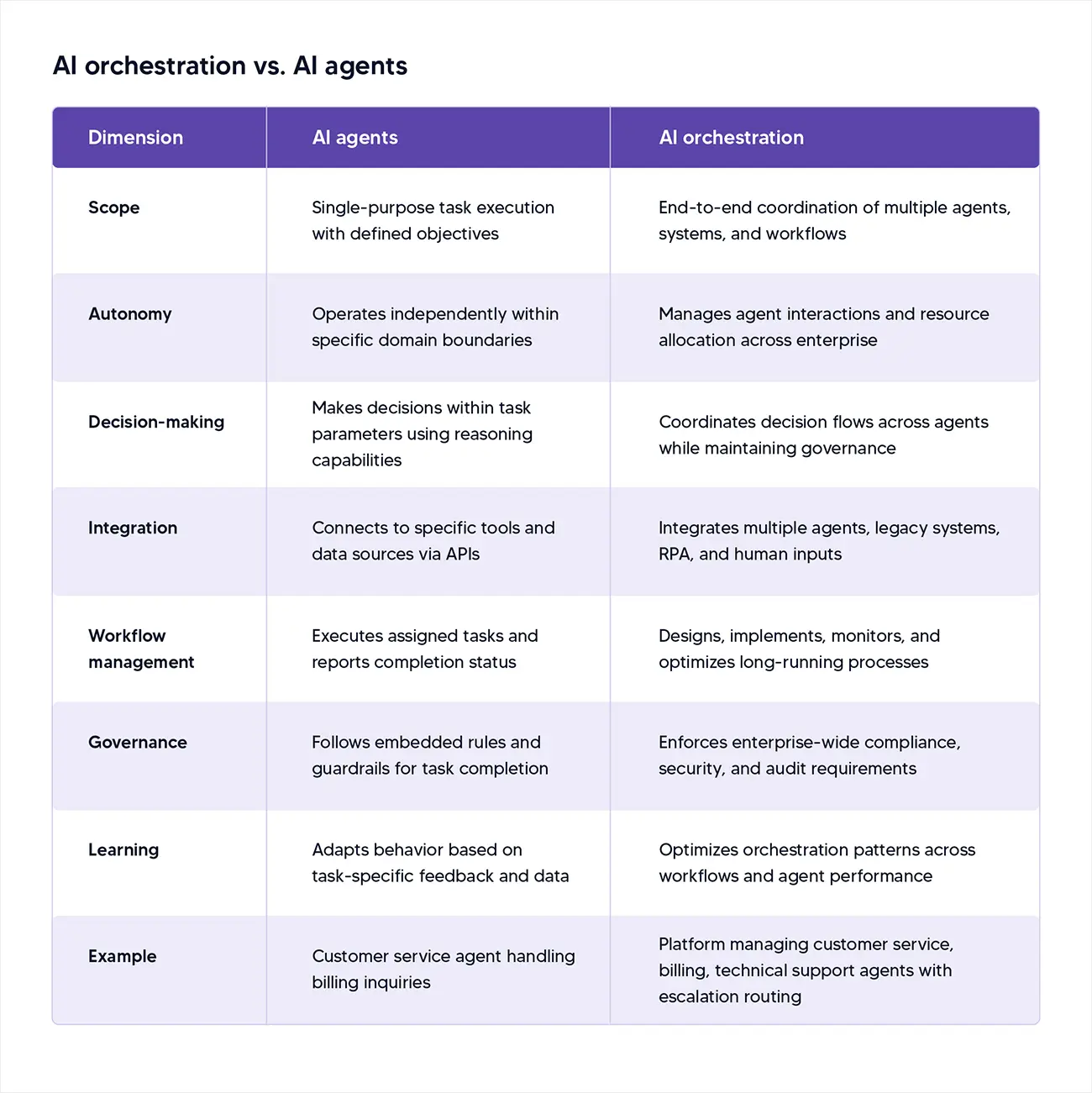
The distinction between agentic orchestration and multi-agent systems is critical. Agentic orchestration manages and coordinates autonomous AI agents to work together seamlessly, bringing agents into a unified system where they communicate, share information, and collaborate on complex tasks. Individual agents may possess sophisticated capabilities, but without orchestration, they operate in isolation, creating data silos and coordination inefficiencies.
Modern agentic orchestration platforms leverage large language models for natural language understanding, retrieval-augmented generation for contextual awareness, and application programming interfaces for cross-system integration. The orchestrator, either a central AI agent or framework, manages and coordinates agent interactions, ensuring the right agent activates at the right time for each task. This coordination proves crucial for handling multifaceted workflows involving various tasks, helping ensure processes run seamlessly and efficiently.
Why is agentic orchestration important?
Agentic orchestration addresses fundamental limitations in enterprise AI adoption that constrain value realization. It helps organizations achieve 30% reduction in operational costs through autonomous automation, resolving 80% of customer service issues without human intervention by 2029. However, these outcomes remain unreachable without coordinated orchestration frameworks managing complex agent interactions.
The importance stems from four strategic imperatives facing modern enterprises:
- Coordination complexity at scale: Major software vendors shifted decisively from AI hype to embedded, operational, agentic AI in 2025, integrating intelligence directly into workflows, data layers, and multi-agent orchestration frameworks. As enterprises deploy dozens or hundreds of specialized agents across departments, coordination overhead escalates exponentially without orchestration. Individual agents cannot self-organize into coherent workflows spanning procurement, finance, operations, and customer-facing functions.
- Integration with legacy systems: Many companies operate on complex, decades-old infrastructure that was not designed to support autonomous AI agents, resulting in brittle, expensive, and slow integration. Agentic orchestration provides smart middleware that translates between modern agent interfaces and legacy systems, enabling AI-driven automation to operate through existing user interfaces without requiring deep re-platforming.
- Governance and risk management: CIOs cite security, compliance, and data control as primary barriers to scaling agent-based AI. Orchestration platforms embed governance throughout workflows, ensuring every agent decision remains logged, traceable, and interruptible. This capability proves essential for regulated industries requiring audit trails and human oversight of critical decisions.
- ROI and value demonstration: Buyers increasingly prioritize measurable business outcomes over capabilities, evaluating vendors on multi-agent orchestration, governance, and data unification layers rather than task-level efficiency claims. Orchestration connects AI capabilities directly to financial KPIs, enabling enterprises to demonstrate revenue expansion, margin improvement, and scaled productivity gains rather than isolated automation wins.
The shift from AI-assisted to AI-orchestrated operations represents the fundamental transformation. Effective AI agents can accelerate business processes with recent computing advances, reducing human error and cutting low-value work time. Organizations that adopt orchestrated approaches gain a competitive edge in productivity, responsiveness, and innovation compared to those maintaining fragmented AI implementations.
What are the stages of AI workflow orchestration?
AI workflow orchestration progresses through five distinct stages, each building organizational capability for increasingly sophisticated automation:
Stage 1: Assessment and design
Organizations begin by systematically evaluating current operations to identify optimal orchestration opportunities. Before orchestration begins, organizations assess existing AI ecosystems and identify processes benefiting from multi-agent orchestration, defining clear objectives, determining integration scope, and selecting appropriate AI technologies. This stage requires business process analysis documenting workflow dependencies, data flows, decision points, and human intervention requirements.
The design phase establishes orchestration architecture capable of managing complex business workflows. Teams create Business Process Modeling and Notation diagrams visualizing agent interactions, system integrations, and exception handling procedures. Organizations define success metrics connecting orchestration outputs to financial KPIs and operational performance indicators.
Stage 2: Agent selection and integration
AI engineers and developers choose task-specific AI agents specializing in data analysis, automation, or decision-making, using generative AI and machine learning models to enhance functions. The selection process evaluates agent capabilities against process requirements, considering factors including natural language processing sophistication, reasoning capabilities, tool integration flexibility, and learning mechanisms.
Integration involves establishing data pipelines connecting AI agents with enterprise systems. Critical to AI integration are data pipelines, the automated processes organizing, storing, and moving data through organizations with efficient transfer, reliable quality, and ease of maintenance. System architects configure APIs enabling real-time communication between agents, legacy applications, databases, and external data sources.
Stage 3: Orchestration framework deployment
System architects integrate selected AI agents into unified orchestration frameworks, establishing workflows facilitating smooth agent-to-agent communication. The deployment configures orchestration engines managing task sequencing, resource allocation, and failure handling. Organizations implement deterministic controls for predictable logic while delegating to agents where AI-driven reasoning, planning loops, and retrieval-augmented generation add value.
This stage incorporates governance frameworks defining authorization boundaries, audit logging requirements, and escalation protocols. Agentic orchestration includes Business Process Modeling and Notation 2.0 models clarifying IT process efficiency and industry-standard Decision Model and Notation adding business rule tasks and managing decisions within processes. These standards ensure transparency and compliance throughout orchestrated workflows.
Stage 4: Workflow execution and monitoring
Orchestration platforms execute designed workflows at enterprise scale, coordinating AI agents, automation systems, and human contributors. AI orchestration oversees the entire AI lifecycle, focusing on AI workflow management defining task sequences, performance monitoring continuously tracking system operations, and compliance and security ensuring operations meet relevant laws and regulations.
Real-time monitoring provides visibility into workflow health, agent performance, and process bottlenecks. Dashboards track metrics including task completion rates, processing times, error frequencies, and resource utilization. Automated alerts notify teams of exceptions requiring human intervention or workflow adjustments.
Stage 5: Optimization and scaling
The final stage focuses on continuous improvement and enterprise expansion. Leveraging machine learning algorithms, agentic orchestration systems continuously refine performance, adapting to new scenarios and improving decision-making processes over time. Organizations analyze performance data identifying optimization opportunities, adjusting orchestration patterns, refining agent selection, and streamlining integrations.
Scaling involves extending successful orchestration patterns across additional business processes and departments. Teams develop reusable workflow templates, standardized integration patterns, and shared agent libraries accelerating deployment. The orchestration platform matures into enterprise infrastructure supporting widespread autonomous operations.
How does AI orchestration work?
AI orchestration functions through coordinated interaction of specialized components creating intelligent, adaptive workflow systems. The operational mechanics involve five core mechanisms:

1. Central coordination engine
The orchestration engine serves as the conductor managing workflow execution. If AI models are the brain, orchestration engines are project managers or conductors ensuring data flows correctly from one step to the next, handling dependencies and error logic. The engine maintains workflow state, tracks task progress, manages agent availability, and routes work based on real-time conditions.
Modern orchestration engines support multiple coordination patterns. Sequential orchestration involves step-by-step processing, where each stage builds upon the previous stages. Concurrent orchestration enables the parallel execution of agents for independent tasks. Dynamic orchestration adapts routing based on intermediate results and changing business conditions.
2. Agent communication protocols
Orchestration platforms establish standard protocols enabling agent-to-agent communication. Agent-to-agent protocols make integration across systems, machines, and humans easier and cheaper, democratizing technology and data through an agentic AI mesh. These protocols define message formats, data exchange standards, and coordination mechanisms allowing heterogeneous agents to collaborate effectively.
Communication includes both synchronous request-response patterns for immediate interactions and asynchronous event-driven patterns for long-running processes. Agents publish events notifying the orchestration layer of status changes, completion signals, or escalation requirements. The orchestrator consumes these events, updating workflow state and triggering subsequent actions.
3. Context and memory management
Agentic orchestration platforms leverage both static knowledge bases and real-time data streams building comprehensive contextual understanding, accessing historical data, current system states, and predictive analytics informing decision-making processes. The orchestration layer maintains shared context accessible to all participating agents, ensuring consistent decision-making across workflow stages.
Memory systems store workflow history, agent performance data, and learned patterns. Short-term memory tracks active workflow state and recent interactions. Long-term memory preserves organizational knowledge, process optimizations, and patterns for handling exceptions. This memory enables orchestration platforms to adapt behavior based on accumulated experience.
4. Resource allocation and optimization
Orchestration platforms dynamically allocate computational resources in response to evolving workflow needs. AI orchestration platforms dynamically allocate computational resources based on evolving task needs and priorities, with self-healing systems monitoring health and automatically detecting and correcting issues without human intervention. The system prioritizes memory and processing power for urgent demands while throttling lower-priority workloads.
Resource optimization involves automated model selection, which matches AI capabilities to task requirements. The orchestration engine evaluates factors including data characteristics, performance requirements, cost constraints, and quality thresholds when assigning work to agents. This intelligent routing maximizes efficiency while controlling operational expenses.
5. Governance and compliance enforcement
Security, authorization, and audit capabilities are embedded throughout orchestrated workflows. Every agent decision becomes observable, auditable, and interruptible, with logging, traceability, and interrupt capability critical for regulated industries. Role-based access controls restrict agent permissions to authorized actions. Encryption protects sensitive data as it flows between components.
Compliance frameworks enforce industry-specific regulations and internal policies that govern the organization's operations. The orchestration platform ensures that workflows comply with segregation of duties requirements, data residency rules, and retention policies. Automated testing verifies compliance before production deployment, reducing audit findings and regulatory risks.
What are the benefits of AI orchestration?
AI orchestration delivers quantifiable business value across operational, financial, and strategic dimensions:
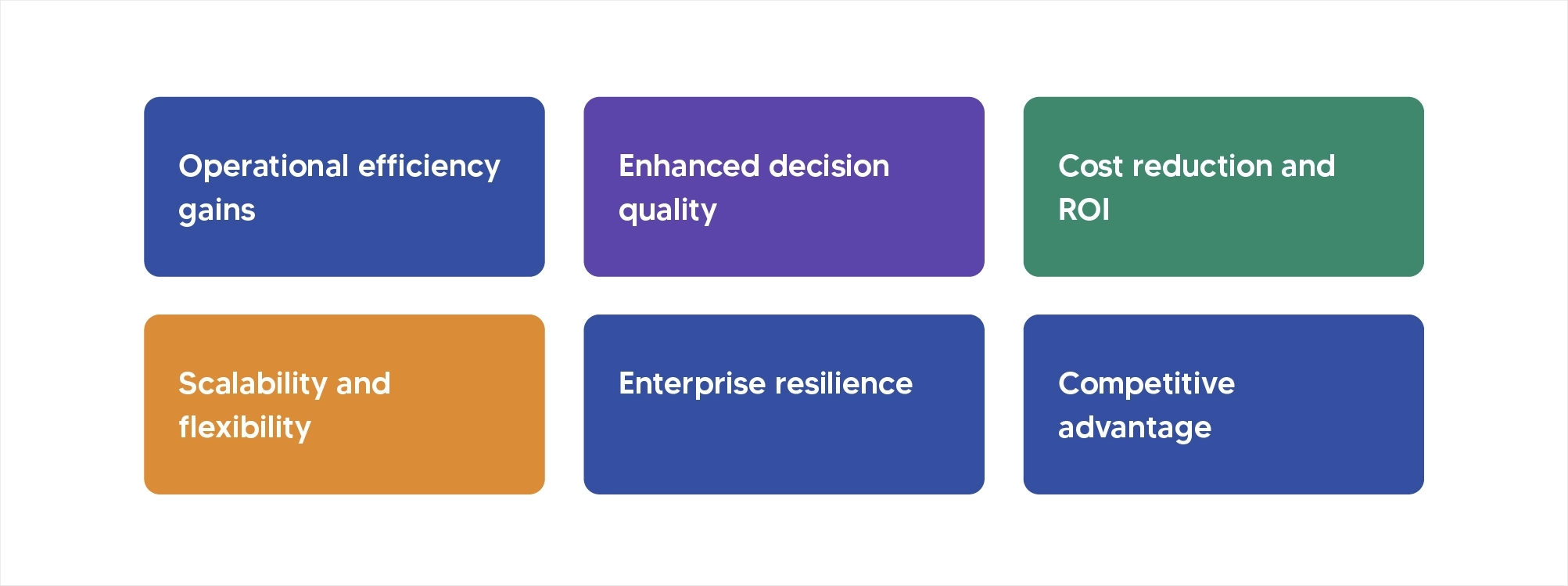
1. Operational efficiency gains
Organizations achieve 99% accuracy and over 60% containment success across orchestrated business processes, thanks to superior performance. The coordination reduces manual handoffs, eliminates redundant work, and accelerates cycle times. Processes that require days of coordination are compressed into hours or minutes through the collaboration of automated agents.
By automating finance processes including invoice triage, vendor onboarding, and month-end close, agentic business orchestration scales capacity without adding headcount. Employees redirect their time from routine coordination tasks toward strategic initiatives that require human judgment, creativity, and relationship management.
2. Enhanced decision quality
Orchestrated systems leverage comprehensive data and specialized expertise exceeding individual agent or human capabilities. Organizations embracing agentic AI reduce manual coordination, accelerate cycle times, and improve decision quality at scale through coordinated agent reasoning. Multiple agents contribute domain-specific insights while orchestration synthesizes perspectives into coherent recommendations.
Real-time monitoring enables continuous process optimization. Performance tracking identifies bottlenecks, quality issues, and improvement opportunities invisible in manual operations. Data-driven insights guide iterative refinements enhancing accuracy and effectiveness over time.
3. Cost reduction and ROI
Strategic agentic orchestration implementation enables rapid deployment achieving 85% reduction in staffing costs and superior business performance within 60 days from concept to production. The business case extends beyond labor arbitrage to encompass error reduction, accelerated revenue recognition, improved customer retention, and avoided compliance penalties.
Financial benefits accrue across multiple dimensions. Reduced manual processing lowers direct labor costs. Faster cycle times accelerate cash conversion and revenue realization. Improved accuracy minimizes rework, refunds, and error correction expenses. Enhanced compliance reduces audit findings and regulatory fines.
4. Scalability and flexibility
Because agents are digital, execution capacity expands or contracts in real-time depending on workload, business seasonality, or unexpected surges, difficult to achieve with fixed human resource models. Organizations handle volume spikes without proportional cost increases or service degradation. The architecture supports rapid deployment across additional processes and geographies without linear resource scaling.
Orchestration platforms adapt to changing business requirements without extensive reconfiguration. AI agent orchestration allows organizations to adapt quickly, flexibly responding to market changes and competitive pressures. Teams modify workflows through visual modeling tools rather than custom development, accelerating innovation cycles.
5. Enterprise resilience
Agents make operations more resilient by monitoring disruptions, rerouting operations, and escalating only when needed, keeping processes running whether facing supply chain delays or system outages. Orchestration platforms detect failures, implement recovery procedures, and maintain service continuity. Self-healing capabilities automatically address transient issues without human intervention.
The distributed nature of orchestrated systems reduces single points of failure. If one agent becomes unavailable, the orchestrator redirects work to alternative agents. Workflow state preservation enables seamless recovery after interruptions, preventing data loss and maintaining process integrity.
6. Competitive advantage
Companies embracing AI orchestration decisively gain competitive edges in productivity, responsiveness, and innovation, leading in landscapes where AI no longer just informs decisions but makes them. Organizations execute strategies faster, respond to market changes more rapidly, and deliver superior customer experiences. The orchestration foundation enables continuous innovation as enterprises integrate new AI capabilities without disrupting existing operations.
Streamline enterprise workflow efficiency with Kellton
Kellton partners with enterprises navigating the adoption of agentic orchestration, delivering end-to-end transformation capabilities that span strategy, architecture, implementation, and optimization. Our approach begins with a comprehensive process assessment identifying high-value orchestration opportunities aligned with business priorities. We design orchestration architectures balancing innovation ambition with implementation pragmatism, ensuring solutions deliver measurable ROI while maintaining governance and compliance requirements.
Our implementation methodology accelerates time-to-value through proven frameworks and reusable assets. We integrate leading orchestration platforms with existing enterprise systems, configure specialized AI agents, and establish governance frameworks ensuring responsible AI deployment. Our teams provide change management support preparing organizations for orchestrated operations, including stakeholder engagement, training programs, and performance management system updates.
Contact Kellton today to discuss how agentic orchestration can transform your enterprise AI systems