Other recent blogs


Quick Summary
In 2026, enterprise technology shifts from generative tools to Autonomous Agents and Industry-Specific Clouds. Key priorities for B2B IT leaders include Agentic AI, Quantum-Safe Security, and Digital Immunity. This roadmap outlines the 12 innovations driving ROI and innovation management this year.
Introduction
By 2026, 80% of leading companies will embrace AI-driven innovation tools, fundamentally transforming how they approach product development and market expansion. Integrating emerging technologies and trending technologies is no longer a luxury—it's a necessity in 2026. Innovation management, which involves the processes and strategies for introducing new ideas, products, or services, increasingly relies on top trends in the technology service industry to stay competitive in rapidly evolving markets.
This blog will explore the key technology trends reshaping innovation management for businesses in 2026. With the advent of breakthrough innovations, the history of IT, software development, and innovation management has been steadily evolving. The most prominent trending technology predictions for 2026 discussed are rooted firmly in the next frontiers of Artificial Intelligence, human-machine synergy, sustainable tech, data protection, and cloud computing.
Monitoring these top strategic tech trends will help organizations streamline innovation processes, enhance collaboration, and leverage data to make smart decisions. Let’s have a closer look.
2026 Tech Strategy: Trend vs. Business Impact Matrix
| Trend Category | Core Technology | Strategic Business Impact |
|---|---|---|
| Autonomous AI | Agentic AI Workflows | 40% reduction in manual operational tasks |
| Cloud Evolution | Industry Cloud Platforms | Faster time-to-market for sector-specific apps |
| Security | Digital Immune Systems | 80% reduction in system downtime |
| Efficiency | Low-Code/No-Code 2.0 | Democratized app dev for non-technical teams |
12 Trending Technologies Reshaping Innovation Management in 2026
1. Multiagent Systems (MAS): The Rise of the AI Workforce
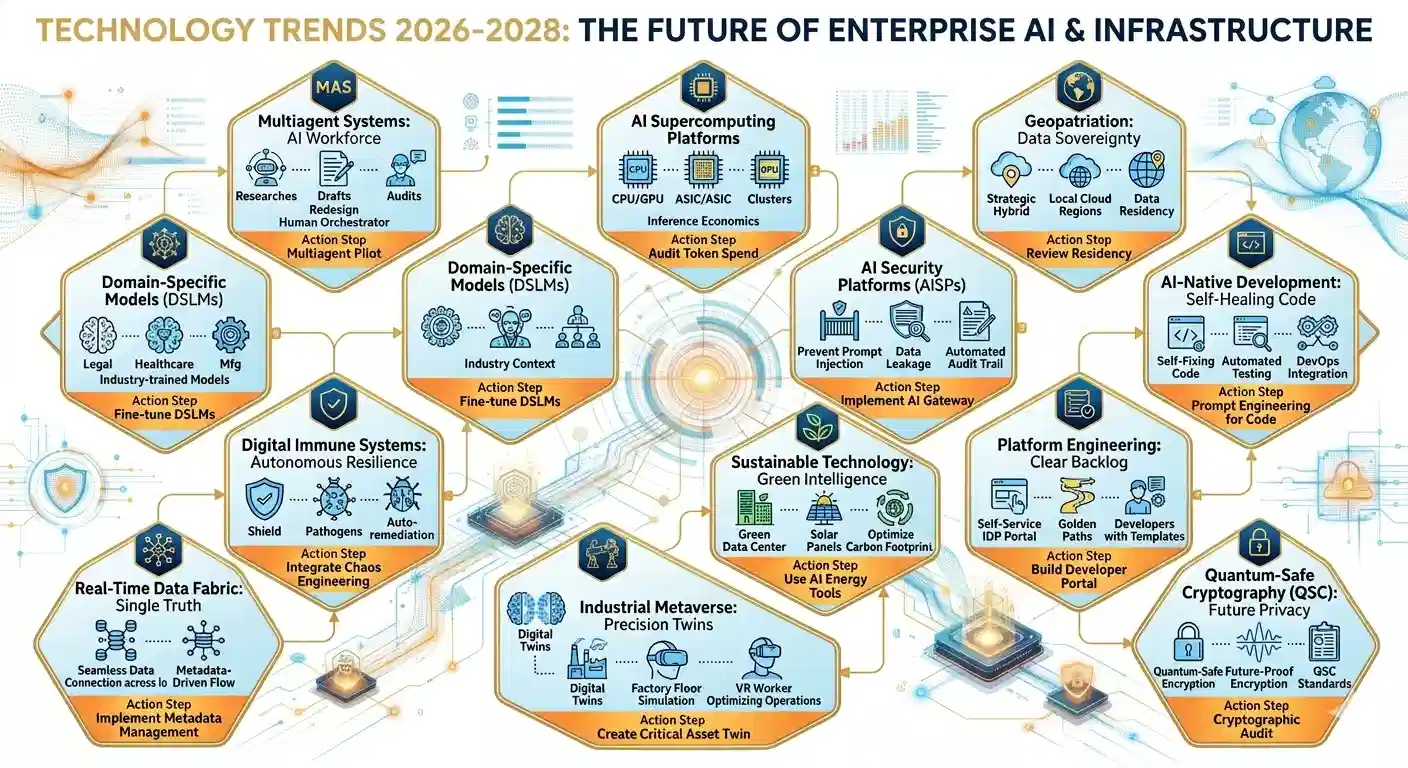
The biggest shift for 2026 is moving from single-purpose chatbots to Multiagent Systems. These are networks of specialized AI agents that interact to achieve complex goals (e.g., one agent researches, another drafts, and a third audits).
Kellton Insight: Success in 2026 requires "Redesign, not just Automation." We help businesses architect human-agent teams where humans move from "doers" to "orchestrators."
Action Step: Start with a "Multiagent Pilot" in a high-friction area like supply chain logistics or complex customer onboarding.
Is your infrastructure ready for an autonomous AI workforce?
Book a MAS Readiness Audit with Kellton Experts2. AI Supercomputing Platforms
Enterprises are outgrowing generic cloud instances. New platforms integrate CPUs, GPUs, and specialized AI ASICs into unified clusters to handle "inference economics"—the cost of running AI at scale.
Kellton Insight: By 2028, 40% of leading enterprises will adopt these hybrid computing architectures to reduce AI operational costs.
Action Step: Audit your "token spend" versus your current infrastructure to identify when a private AI cluster becomes more cost-effective than public cloud APIs.
3. Geopatriation: The Data Sovereignty Shift
As global regulations tighten, the "Cloud Exit" is maturing into Geopatriation. This involves moving sensitive data and AI workloads from centralized global clouds to localized, sovereign regions to ensure compliance and reduce latency.
Kellton Insight: This is no longer just about GDPR; it's about "Strategic Hybrid" models that balance global elasticity with local control.
Action Step: Review your data residency requirements for 2027 to identify workloads that must be repatriated to local servers.
4. Domain-Specific Language Models (DSLMs)
Generic LLMs are being replaced by DSLMs—models trained on industry-specific data (Legal, Healthcare, Manufacturing). These provide higher accuracy and lower risk than general-purpose models.
Kellton Insight: Context is the new differentiator. A model trained on your proprietary B2B data is worth 100 generic models.
Action Step: Identify your most valuable "Internal Knowledge Base" and explore fine-tuning a small, domain-specific model.
5. AI Security Platforms (AISPs): Defensive Guardrails
As AI agents gain autonomy, the attack surface expands. AISPs provide centralized security layers to prevent prompt injections, data leakage, and "rogue" agent behavior. They ensure that while AI is productive, it remains within enterprise ethical and safety boundaries.
Kellton Insight: In 2026, AI security is no longer a checkbox; it is a prerequisite for deployment. We focus on "Governance-by-Design," ensuring every model has an automated audit trail.
Action Step: Implement an AI gateway that monitors all LLM traffic for sensitive data exfiltration and adversarial prompt patterns.
Move from 'Shadow AI' to 'Secure AI' with Kellton’s Governance-by-Design.
Book a 15-Minute AI Security Audit6. AI-Native Development Platforms: The Era of Self-Healing Code
Traditional DevOps is evolving into AI-Native Dev. These platforms use generative AI not just to write snippets, but to architect systems, conduct automated security testing, and deploy code that can "self-heal" by detecting and fixing bugs in real-time.
Kellton Insight: AI-native platforms will accelerate software delivery cycles by over 40%, moving developers from "writing syntax" to "reviewing logic."
Action Step: Shift your engineering team toward "Prompt Engineering for Code," prioritizing platforms that offer integrated AI debugging and deployment workflows.
7. Digital Immune Systems: Autonomous Software Resilience
A Digital Immune System combines observability, AI-augmented testing, and automated remediation to protect the software supply chain. It functions like a biological immune system, identifying "pathogens" (bugs or breaches) and neutralizing them before they impact the user.
Kellton Insight: Gartner predicts that organizations investing in digital immunity will reduce system downtime by up to 80% by 2027.
Action Step: Integrate automated chaos engineering and self-remediation scripts into your CI/CD pipeline to build systemic resilience.
8. Sustainable Technology (Circular IT): Green Intelligence
With AI consuming massive amounts of power, "Sustainable IT" uses AI to optimize energy usage in data centers and manages the lifecycle of hardware through Circular IT (reusing and recycling components).
Kellton Insight: ESG is now a boardroom priority. Using AI to manage your carbon footprint is no longer optional—it is a competitive necessity in the B2B space.
Action Step: Use AI-driven energy monitoring tools to identify "zombie servers" and optimize cooling cycles in your cloud or on-premise infrastructure.
9. Platform Engineering: Clearing the Innovation Backlog
Platform Engineering creates self-service internal developer platforms (IDPs). This allows developers to spin up environments, databases, and resources without waiting for IT tickets, effectively removing the "friction" from digital transformation.
Kellton Insight: By 2026, 80% of large software engineering organizations will establish platform teams as internal service providers to clear legacy IT backlogs.
Action Step: Build a centralized developer portal that provides "Golden Paths"—pre-approved, secure templates for deploying new services instantly.
10. Real-Time Data Fabric: The Single Source of Truth
A Data Fabric uses metadata and AI to connect disparate data silos across hybrid-cloud environments. It creates a unified, real-time layer that allows data to be accessed securely regardless of where it is stored.
Kellton Insight: A Data Fabric is the "fuel" for Agentic AI. Without a unified data layer, your AI agents will operate on fragmented—and often incorrect—information.
Action Step: Implement a metadata-driven data management strategy to replace rigid, manual ETL (Extract, Transform, Load) processes with dynamic data access.
11. Industrial Metaverse: Precision via Digital Twins
The Industrial Metaverse uses high-fidelity Digital Twins and Spatial Computing to simulate complex environments. This allows for remote high-risk maintenance training, factory floor optimization, and real-time troubleshooting without physical risk.
Kellton Insight: We see the highest ROI in "Simulation-before-Execution." Testing a new manufacturing process in the metaverse saves millions in potential physical downtime.
Action Step: Create a digital twin of your most critical operational asset to simulate "what-if" scenarios and optimize maintenance schedules.
12. Quantum-Safe Cryptography: Future-Proofing Privacy
Quantum computers are approaching the ability to break standard encryption. Quantum-Safe Cryptography (QSC) involves transitioning to new mathematical standards that are resistant to quantum attacks before they occur.
Kellton Insight: This is about "Harvest Now, Decrypt Later" protection. If your data is stolen today, it could be decrypted tomorrow. The transition to QSC must begin now for long-term data security.
Action Step: Conduct a cryptographic audit to identify which of your sensitive data assets are most vulnerable to future quantum threats and prioritize them for migration.
Exploring the benefits of adopting trending technology predictions in 2026
Adopting the latest tech innovations and top trends in the technology service industry i.e., innovation management, offers organizations several transformative benefits that can significantly improve both their internal processes and external competitive positioning. One of the most notable advantages is the improvement in the efficiency of innovation cycles.
By integrating tools like AI and automation, companies can automate routine tasks such as data analysis, market research, and initial product development steps. This not only accelerates the innovation process but also reduces human error, resulting in faster, more accurate outcomes. As a result, organizations can bring new products and services to market more swiftly, capturing opportunities before competitors.
Moreover, technologies like cloud platforms, blockchain, and IoT foster enhanced collaboration within organizations and across external ecosystems. Cloud platforms enable real-time sharing of data and ideas, making it easier for teams across geographies to work together seamlessly. Blockchain adds a layer of security and transparency to collaboration, ensuring that intellectual property (IP) rights, contract terms, and product development milestones are clearly defined and securely tracked.
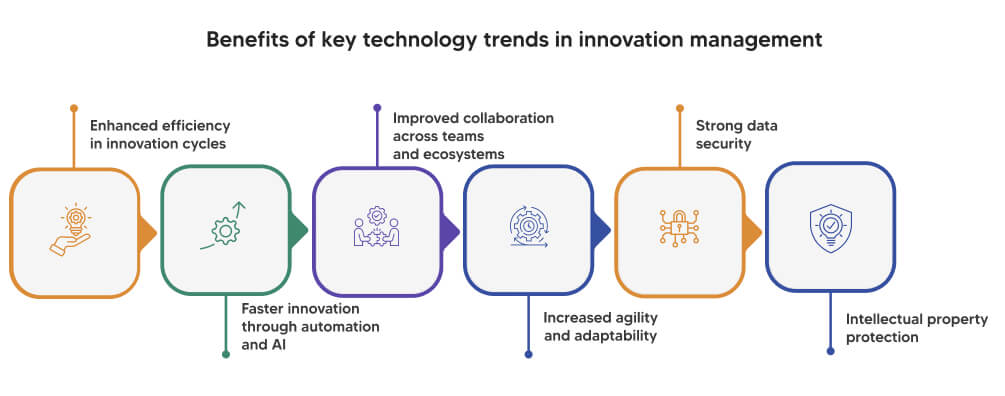
IoT further enhances collaboration by enabling devices to communicate and share data, offering real-time insights that drive more informed decision-making. Together, these technologies build a more interconnected and collaborative environment, fostering innovation through diverse expertise and insights.
Lastly, adopting these technologies also enhances an organization's agility and adaptability. Companies that leverage these innovations can adapt quickly and effectively in a fast-paced business environment where market conditions, customer preferences, and technological landscapes constantly shift. For example, with data-driven decision-making, businesses can anticipate customer needs and adjust their strategies accordingly.
Additionally, cloud-based systems allow for scalable and flexible innovation, enabling companies to adjust their resources based on demand. By pivoting swiftly in response to changes, organizations can stay ahead of market trends and maintain their competitive edge, ultimately ensuring long-term success and resilience in an ever-evolving marketplace.
Strategic FAQ: Preparing for the 2026 Shift
Q: What are the top technology trends for 2026?
A: The top trends for 2026 include Multiagent Systems, AI-Native Development, and Geopatriation. These technologies focus on moving from simple AI tools to autonomous systems that can execute complex business processes.
Q: What is the ROI of Agentic AI in 2026?
A: Organizations using AI agents report a 34% increase in productivity for low-skilled tasks and an 88% executive commitment to increasing AI budgets based on measurable autonomous outcomes.
Q: How does a "Digital Immune System" protect my business?
A: A Digital Immune System combines observability and AI-augmented testing to automatically remediate system bugs. Gartner predicts this can reduce system downtime by up to 80% by 2027.
Q: What is the most important technology trend for 2026?
A: Agentic AI is the defining trend of 2026. It marks the transition from AI as a chatbot to AI as an autonomous agent capable of executing complex business workflows independently.
Q: What technology trends will shape 2027?
A: Trends like Geopatriation and Digital Immune Systems, already gaining traction in 2026, are expected to mature further by 2027 as organizations prioritize data sovereignty and system resilience.
What is the future of technology in innovation management?
As we move into 2026 and toward technology trends for 2027, technological advancement continues to reshape how organizations manage innovation as a transformative force. As a result, the journey of innovation management in 2026 is expected to be influenced by Artificial Intelligence (AI), Machine Learning, and data analytics, which will be pivotal in accelerating the innovation cycle through continuous improvement. What’s more? When companies implement these top tech trends into their innovation strategy, they can enhance their competitive edge, drive meaningful progress while unlocking new growth opportunities, and streamline their innovation processes.
Want expert guidance on incorporating these trends into your strategy? Contact us today to explore how our solutions can help you stay ahead of the curve in innovation management.