

Most financial institutions still approach identity with a false choice: strengthen security or simplify customer onboarding. In reality, neither objective can succeed independently. Every additional verification step designed to reduce fraud also risks increasing customer abandonment, while every shortcut introduced to accelerate onboarding creates new opportunities for identity fraud.
That balancing act has become significantly more complex with the rise of generative AI. Fraudsters can now generate convincing synthetic identities, manipulate identity documents, and automate account takeover attempts at unprecedented speed. At the same time, legitimate customers expect to open accounts, apply for loans, or access financial services within minutes—not days.
Customer Identity and Access Management (CIAM) sits at the center of this transformation. Modern CIAM platforms continuously verify customer identities using contextual signals such as device intelligence, behavioral analytics, biometrics, geolocation, and transaction risk. Instead of applying identical security controls to every user, CIAM adapts authentication based on real-time risk, allowing legitimate customers to move seamlessly while stopping suspicious activity before fraud occurs.
Digital identity in Banking: The numbers driving change
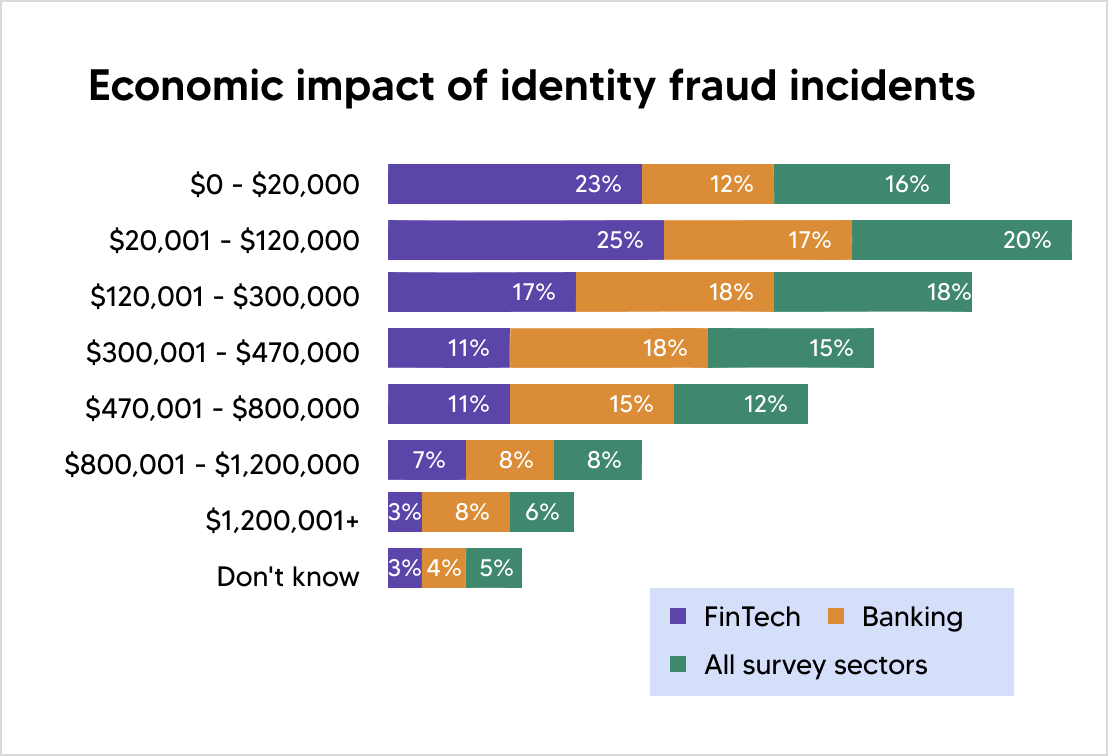
For US banks and financial institutions, this shift is becoming a business imperative. Deloitte projects AI-enabled fraud losses in the United States could reach $40 billion annually by 2027, while McKinsey estimates that secure digital identity ecosystems could unlock economic value equivalent to 3–13% of GDP by 2030. These trends highlight that identity is no longer just an IT concern—it is a competitive advantage.
This is not a security problem or a growth problem. For BFSI organizations, CIAM (Customer Identity and Access Management) is the foundational security layer that protects against synthetic identity fraud.
What is Customer Identity and Access Management (CIAM) for Banks and why does it matter in BFSI?
Customer Identity and Access Management (CIAM) is the technology that enables banks and financial institutions to securely manage customer identities across every digital interaction—from account opening and authentication to payments, account recovery, and ongoing engagement.
Unlike traditional identity systems that simply verify usernames and passwords, modern CIAM continuously evaluates customer risk using real-time identity signals. This allows financial institutions to strengthen security while delivering frictionless digital experiences.
A modern CIAM platform typically combines:
- Digital identity proofing and eKYC verification
- Adaptive, risk-based authentication
- Passwordless authentication and biometrics
- Single Sign-On (SSO) and identity federation
- Consent and privacy management
- API-first integration with core banking platforms
- Fraud analytics and behavioral intelligence
- OAuth 2.0 and OpenID Connect (OIDC) standards
Instead of relying on static authentication rules, CIAM determines the appropriate level of verification based on transaction context. A customer checking an account balance may require minimal authentication, while a high-value wire transfer or unusual login attempt can automatically trigger additional verification.
This adaptive approach enables financial institutions to reduce fraud without introducing unnecessary friction for legitimate users.
Banking IAM vs. CIAM: What's the difference?
Although the terms are often used interchangeably, Identity and Access Management (IAM) and Customer Identity and Access Management (CIAM) serve different business purposes.
| Traditional IAM | Modern CIAM |
|---|---|
| Manages employee identities | Manages customer identities |
| Supports thousands of users | Scales to millions of customers |
| Focuses on internal security | Balances security with customer experience |
| Fixed authentication policies | Adaptive, risk-based authentication |
| Administrative provisioning | Self-service registration and profile management |
| Limited customer insights | Identity intelligence and behavioral analytics |
| Internal applications | Omnichannel digital banking experiences |
Banks increasingly require both capabilities. IAM secures employees, partners, and contractors, while CIAM protects customers interacting across digital banking channels. Together, they create a unified identity ecosystem that supports secure growth.
Why Legacy Banking Identity Management and Authentication Systems are becoming a business risk?
Many banks continue to rely on identity platforms originally designed for workforce access or custom-built authentication systems that have evolved over decades. While these systems may still function, they were not built to handle today's digital customer expectations, sophisticated fraud tactics, or evolving regulatory requirements.
As financial services become increasingly digital, legacy identity infrastructure creates challenges that extend beyond cybersecurity and directly affects customer acquisition, operational efficiency, compliance, and revenue growth. Let’s delve deeper:
- Static banking authentication creates unnecessary customer friction
Traditional IAM platforms apply identical authentication requirements to every customer regardless of transaction risk. Low-risk logins receive the same treatment as high-risk wire transfers, increasing abandonment during onboarding and everyday banking activities. According to Fenergo, 70% of banks reported losing customers because of slow onboarding, highlighting how identity friction directly affects customer acquisition and revenue.
- Legacy identity management cannot prevent modern synthetic identity fraud
Synthetic identity fraud has evolved far beyond rule-based detection systems. Criminals now combine real and fabricated identity information, AI-generated documents, and automated attack tools that bypass conventional verification workflows. Without behavioral analytics, biometric verification, device intelligence, and continuous risk scoring, legacy identity platforms leave significant security gaps throughout the customer lifecycle.
- Legacy financial identity management increases compliance risk
Modern privacy regulations require organizations to manage customer consent, identity lifecycle, audit trails, and data governance across multiple digital channels. Older identity platforms were never designed with these requirements in mind, forcing organizations to rely on manual processes that increase operational complexity and compliance risk.
Identity proofing and adaptive authentication: The foundation of secure digital banking
Modern banking authentication begins long before a customer enters a password or receives a one-time passcode. It starts with identity proofing, where financial institutions verify that a customer is genuinely who they claim to be during account creation.
Modern digital identity verification combines multiple trust signals, including:
- Government-issued document verification
- Biometric facial matching and liveness detection
- Device intelligence
- Geolocation analysis
- Behavioral analytics
- Network reputation
- AML and KYC verification
- Third-party identity validation
Once the customer's identity is established, adaptive authentication banking continuously evaluates risk throughout every session. Customers exhibiting normal behavior enjoy seamless access, while suspicious activities automatically trigger step-up authentication.
This intelligent approach replaces traditional "one-size-fits-all" authentication with risk-based security that protects customers without slowing legitimate transactions.
How does modern CIAM strengthen banking authentication, fraud prevention, and customer experience?
Modern Customer Identity and Access Management (CIAM) for financial services fundamentally changes how banks establish trust. Instead of treating authentication as a one-time checkpoint during login, modern banking identity management continuously evaluates customer risk throughout the digital journey. Every interaction—from account creation and login to payments, account recovery, and high-value transactions—is assessed in real time to determine whether additional verification is necessary.
This shift from static authentication to continuous trust allows financial institutions to strengthen fraud prevention in banking while delivering frictionless digital experiences. Rather than asking every customer to complete identical verification steps, CIAM uses contextual intelligence to authenticate customers based on actual risk.
For banking leaders, this means security is no longer a barrier to customer experience. Instead, it becomes an enabler of digital growth.
By the Numbers
- AI-enabled fraud losses in the US are projected to reach $40 billion annually by 2027.
- 68% of consumers abandon digital financial applications because of lengthy onboarding and verification processes.
- Synthetic identity fraud is expected to exceed $3.1 billion in unsecured credit losses in the United States.
- Well-designed digital identity ecosystems could unlock economic value equivalent to 3–13% of GDP by 2030.
These trends demonstrate why digital identity in banking has become both a cybersecurity and business growth priority.
How does Customer Identity and Access Management deliver measurable value across financial services?
The business value of CIAM for financial services extends well beyond authentication. Modern financial identity management helps institutions reduce fraud, accelerate customer acquisition, simplify regulatory compliance, and improve digital engagement across every business line.
| BFSI Sector | Business Value Delivered Through CIAM |
|---|---|
| Retail Banking | Accelerates digital onboarding banking, reduces abandonment, and strengthens retail banking authentication through adaptive security. |
| Commercial Banking | Protects high-value corporate transactions using continuous risk assessment and contextual authentication. |
| Wealth Management | Enables secure advisor-client collaboration through identity federation and high-assurance authentication. |
| Insurance | Speeds up policy issuance and claims processing with automated identity verification and fraud detection. |
| Lending | Detects synthetic identity fraud during loan origination, reducing credit losses and bad debt. |
| Payments & Fintech | Supports secure Open Banking and embedded finance using API-first identity federation and consent management. |
Future-proof Banking Identity Management: Five CIAM priorities reshaping digital identity in Banking
Identity has evolved from an IT security function into a strategic business capability. As financial institutions modernize their digital ecosystems, successful organizations are investing in banking identity management that simultaneously improves security, regulatory compliance, customer experience, and operational efficiency. The following priorities will define digital identity in banking over the next several years.
1. Replace traditional MFA with adaptive authentication for Banking
Static multi-factor authentication no longer reflects today's threat landscape. Applying identical verification requirements to every customer increases friction without necessarily improving security. Leading banks are adopting adaptive authentication banking, where authentication decisions are based on contextual signals such as customer behavior, device reputation, transaction value, geolocation, and historical activity. This approach strengthens fraud prevention while reducing unnecessary customer interruptions.
2. Expand passwordless Banking across digital channels
Consumers increasingly expect secure authentication without managing complex passwords. Passwordless banking leverages biometrics, passkeys, hardware-backed credentials, and trusted devices to simplify customer access while reducing credential theft, phishing attacks, and password reset costs. As passwordless technologies mature, they will become the default authentication model across retail and commercial banking.
3. Strengthen digital identity verification throughout the customer lifecycle
Identity verification should not end once an account is opened. Modern digital identity verification continuously validates customer behavior throughout onboarding, login, payments, account recovery, and high-risk transactions. This ongoing verification enables institutions to detect anomalies earlier while maintaining a frictionless customer experience.
4. Build privacy, consent, and identity governance into every customer journey
Privacy regulations continue to evolve across the United States and globally. Financial institutions are embedding consent management, audit trails, identity lifecycle management, and policy governance directly into their financial identity management strategies. This proactive approach simplifies compliance while strengthening customer trust.
5. Unify Banking IAM and CIAM through identity orchestration
The traditional separation between workforce IAM and customer CIAM is gradually disappearing. Partners, fintech providers, contractors, employees, and customers increasingly interact across shared digital ecosystems.
Rather than managing multiple identity silos, leading organizations are adopting identity orchestration to unify Banking IAM vs CIAM governance under a common identity framework.
This enables consistent authentication policies, centralized identity intelligence, and stronger enterprise-wide security without sacrificing customer experience.
Best Practices for Implementing CIAM for Financial Services and Secure Digital Banking
Modernizing banking identity management is not simply a technology upgrade—it's a strategic transformation that affects customer acquisition, fraud prevention, regulatory compliance, and digital growth. Financial institutions that achieve the strongest outcomes treat CIAM for financial services as a phased business initiative rather than a standalone IT project.
The following best practices can help banks maximize the value of their CIAM investments.
Assess identity risks before selecting a platform
Successful implementations begin with understanding where identity challenges create the greatest business impact—not by comparing vendor feature lists.
Financial institutions should first evaluate their customer journeys to identify:
- Digital onboarding bottlenecks
- Customer onboarding security gaps
- Synthetic identity fraud exposure
- Account takeover risks
- Authentication failures
- High-abandonment customer journeys
Once these risks are mapped, organizations can define measurable business objectives, such as reducing onboarding time, improving authentication success rates, lowering fraud losses, or increasing digital account openings.
This business-first approach ensures the selected financial identity management platform aligns with enterprise priorities rather than becoming another isolated security tool.
Prioritize high-impact customer journeys
Replacing every authentication workflow simultaneously introduces unnecessary complexity and business risk.
Leading banks typically begin with customer journeys that generate the highest return on investment, including:
- Banking customer onboarding
- Digital account opening
- Login authentication
- Account recovery
- High-value payment authorization
Modernizing these high-friction journeys delivers immediate improvements in customer experience while strengthening fraud prevention in banking. Once these workflows are optimized, institutions can gradually extend adaptive authentication banking, identity orchestration, and digital identity verification across the broader customer lifecycle without disrupting day-to-day operations.
Build an API-First Banking Identity Management Ecosystem
Modern CIAM delivers the greatest value when it operates as the intelligence layer across the digital banking ecosystem—not as a standalone authentication platform.
An API-first architecture enables seamless integration with:
- Core banking platforms
- Digital channels and mobile banking applications
- CRM systems
- KYC and AML solutions
- Fraud detection platforms
- Payment gateways
- Customer data platforms
- Open Banking and embedded finance APIs
This connected ecosystem supports real-time banking authentication, consistent customer experiences across channels, and scalable identity orchestration that can adapt as new services and regulations emerge.
Build Secure Banking Customer Onboarding Into Every Digital Journey
Security should not come at the cost of customer experience. Modern CIAM platforms use adaptive, risk-based authentication to evaluate contextual signals—such as device reputation, user behavior, geolocation, and transaction risk—and apply additional verification only when necessary.
At the same time, organizations should embed privacy controls, consent management, audit trails, and identity lifecycle governance into the platform from the outset.
Designing security and compliance into every stage of the customer journey helps financial institutions meet evolving regulatory requirements while reducing fraud, strengthening customer trust, and minimizing unnecessary authentication friction.
Establish cross-functional governance and continuously optimize
CIAM is a business transformation initiative that extends well beyond the IT department. Successful implementations require ongoing collaboration between cybersecurity, fraud prevention, compliance, digital banking, customer experience, risk management, and enterprise architecture teams.
Establishing shared governance ensures identity policies support both security objectives and business growth. Equally important is continuous optimization.
Banks should continuously monitor key performance indicators, including:
- Customer onboarding completion rates
- Authentication success rates
- Digital onboarding abandonment
- Fraud detection accuracy
- Account takeover attempts
- Customer satisfaction scores
- Password reset requests
- Identity verification success rates
These insights help security teams refine authentication policies, improve retail banking authentication, and maintain the right balance between customer convenience and security.
How Kellton is revolutionizing customer onboarding and future-proofing digital identity in BFSI?
Kellton works with BFSI institutions to modernize identity infrastructure without disrupting core banking operations. Our approach combines adaptive authentication, a fraud-aware onboarding architecture, and API-first CIAM integration, designed to reduce abandonment and close gaps exploited by synthetic identity fraud.
Whether you are replacing a legacy IAM system stretched to cover customer use cases or designing CIAM from the ground up for a digital-first launch, our BFSI identity specialists help you sequence the rollout around your highest-risk, highest-friction moments first.
Whether you're modernizing an existing IAM platform or building a digital-first identity ecosystem, Kellton delivers a phased implementation approach that reduces risk and accelerates business outcomes.
FAQs
Q: What is Customer Identity and Access Management (CIAM) for banks?
A: CIAM is the technology that manages identity, authentication, and authorization for external users, such as banking customers, rather than employees. It handles registration, login, adaptive risk scoring, and consent management across digital channels.
Q: How can Kellton contribute to clients implementing CIAM solutions?
A: Kellton designs and integrates CIAM architecture tailored to BFSI, sequencing rollout around the highest-risk points in the customer journey, from onboarding through transaction authentication, without disrupting core banking systems.
Q: What is the difference between Banking IAM and CIAM?
A: IAM manages internal, employee-facing access. CIAM manages external, customer-facing identity at far greater scale, with a stronger emphasis on user experience, self-service, and consent.
Q: What are the benefits of CIAM?
A: Reduced onboarding abandonment, lower fraud losses from synthetic and stolen identities, improved regulatory compliance through built-in consent management, and a consistent, lower-friction customer experience across channels.
Q: How does adaptive authentication improve banking security?
A: Adaptive authentication improves banking security by continuously evaluating real-time risk signals such as device reputation, user behavior, geolocation, transaction value, and login history.
Q: What is identity proofing in digital banking?
A: Identity proofing is the process of verifying that a customer is genuinely who they claim to be before granting access to banking services. It combines digital identity verification methods such as document validation, biometric checks, liveness detection, and database verification to prevent identity theft, meet KYC requirements, and secure digital onboarding.
Q: How does CIAM reduce synthetic identity fraud?
A: IAM reduces synthetic identity fraud by combining identity proofing, biometric authentication, behavioral analytics, device intelligence, and continuous risk scoring. These capabilities detect inconsistencies across customer interactions, identify AI-generated or fabricated identities
Q: Why is passwordless banking becoming popular?
A: Passwordless banking is gaining popularity because it eliminates the security risks and user frustration associated with passwords. By using biometrics, passkeys, or trusted devices for authentication, banks improve customer convenience and reduce credential theft and phishing attacks.
Q: How does CIAM improve customer onboarding in financial services?
A: CIAM improves customer onboarding by automating identity verification, enabling adaptive authentication, and reducing unnecessary friction during account opening. Through digital identity verification, identity proofing, and real-time risk assessment, financial institutions can accelerate onboarding, improve application completion rates, strengthen fraud prevention