
Other recent blogs


Generative AI is fundamentally reshaping how businesses operate. From automating knowledge-intensive workflows to generating hyper-personalized customer experiences, GenAI is no longer a future bet—it is today's competitive differentiator. Yet for every CTO ready to scale, there is a CFO asking the same question: What is the actual return on investment?
This blog breaks down the ROI of Generative AI in measurable, board-ready terms—with specific metrics, sector-level proof points, and a clear framework for evaluating whether your GenAI initiatives are delivering real value.
What is the Main ROI of Integrating Generative AI into Workflows?
The main ROI of integrating Generative AI into workflows is Operational Leverage. By automating high-volume cognitive tasks—such as KYC verification, fraud pattern recognition, contract generation, and regulatory reporting—enterprises achieve a 30–50% reduction in operational costs while increasing throughput by up to 2x without adding headcount. In banking alone, GenAI has the potential to add $200B to $340B in annual value, representing 9–15% of global operating profits.
Key ROI Statistics at a Glance
- Operating Profit Boost: $200B–$340B annual value added to global banking.
- Productivity Improvement: 90% gain in core banking operations via agentic AI workflows.
- Fraud Reduction: 50% decrease in fraud rates reported by high-performing institutions.
- Compliance Efficiency: 85% reduction in false-positive KYC alerts.
- Processing Speed: 25% faster loan approvals and 60% reduction in manual document analysis time.
Four Core ROI Drivers for Banking & FinTech
The impact of Generative AI development services is spread across four interconnected pillars:
1. Fraud Detection & Loss Reduction: Using synthetic data to simulate rare fraud scenarios, GenAI models reduce actual losses by an estimated $5.7B industry-wide.
2. Customer Experience & Revenue Growth: Hyper-personalization drives a 68% year-over-year increase in customer engagement.
3. Compliance & Regulatory Cost Savings: Automation of AML/GDPR reporting saves the industry an estimated $27B annually.
4. Speed to Market: Intelligent document processing slashes manual review hours into minutes, accelerating underwriting and legal workflows.
Key factors driving the adoption of Generative AI
Generative AI technology isn’t just a passing trend; by looking at the unprecedented growth this domain has witnessed in the past 2 to 3 years, one can safely say that GenAI is here to stay. Here’s what’s shaping its rapid growth across industries:
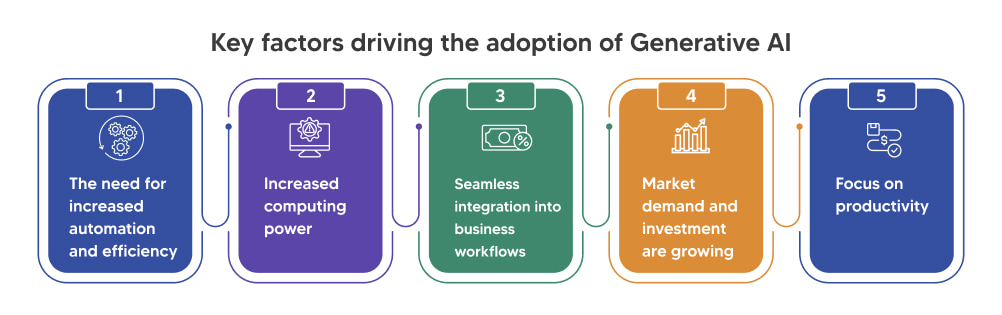
1. The need for increased automation and efficiency: Strategic implementation of GenAI tools and technologies can help automate tasks, streamline processes, and improve operational efficiency. Take GitHub Copilot for instance. It’s helping coders write neater and better code at a faster pace. And that’s impacting the entire software development lifecycle. Businesses are able to build better digital products at a faster pace.
2. Increased computing power: Advancements in hardware, particularly GPUs and TPUs, allow for the training of complex AI models with billions of parameters, enabling the development of more sophisticated generative AI systems.
3. Seamless integration into business workflows: One key factor that has driven the adoption of GenAI technologies is the great ease with which companies are able to adopt and integrate them into their existing systems. Introducing them to your tech stack does not cause disruptions or delays, and you can use them almost immediately. Sierra is a great example. It’s a conversational AI agent that you can embed onto your website and make it converse with your customers. However, it’s not any other chatbot that you often see when you land on a website. It’s different. It’s more capable and learns from its past interactions.
4. Market demand and investment are growing: Enterprises are betting big on Generative AI. The market is expected to grow significantly in the coming years as companies recognize its potential to create a competitive edge.
5. Focus on productivity: GenAI technology is freeing up employees from manual, time-consuming tasks, allowing them to focus on strategic, high-value work. This shift is increasing overall business efficiency.
By keeping up with these trends, companies can ensure they’re using Generative AI effectively to maximize ROI.
How exactly Generative AI helps (Think ROI)
Implementing GenAI apps and systems leads to increased automation, collaboration, and efficiency. Here are some of the areas where you can harness the power of GenAI and achieve great ROI.
1. Operational efficiency & cost savings
GenAI technology helps significantly with process or task automation and improves productivity. Some common use-cases include the following:
- Automated reports: AI can analyze large datasets and generate reports in seconds.
- Email assistance: AI-powered writing tools help draft and refine emails quickly.
- AI-assisted coding: Developers use AI to generate and debug code faster.
2. Elevated customer experience (CX)
AI-powered chatbots, virtual assistants, and personalized recommendations improve customer interactions. Businesses measure AI’s impact through:
- Increased customer engagement levels: Look at how AI agents, such as Sierra, are helping automate a larger part of customer service. Powered by Agentic AI models, these AI agents are capable of engaging your customers across different digital channels and ensure they feel heard and their grievances are resolved without much human intervention. The best part? These AI agents are there working for your business 24x7.
- Improved Net Promoter Score (NPS): Net Promoter Score measures customer loyalty and helps businesses identify areas of improvements and also helps track the effectiveness of customer service programs. The strategic use of AI-based chatbots and service assistants can help modern businesses make their customers feel included and heard and thus, score high on NPS surveys.
- Better conversions: Increased customer engagement and satisfaction leads the way for better conversions. And when you convert more leads, your bottom line improves.
3. Innovation & competitive-edge
One of the areas where GenAI has had a big impact is how it helps teams think more clearly and build better products. Increased automation and intelligence relieves teams from repetitive tasks and therefore they have more time and energy for creating real value in their roles. Companies reduce human errors and roll out new products and services in a comparatively shorter period of time, which eventually helps them build competitive advantage. Some of the things that GenAI can really help with, include:
- Rapid prototyping: Designers and product managers are leveraging modern AI and GenAI solutions to brainstorm more effectively and build world-class prototypes at the speed of business.
- Creative problem-solving: There’s so much you can do with ChatGPT and hundreds of other GenAI-powered tools, technologies, and platforms. You can share a problem statement and ask for 10 different solutions. You can ask for feedback on your work. And then you can take those solutions as they are or tweak them to fit your specific circumstances.
- Better data-driven decision-making: Using AI, GenAI, and a slew of other advanced technologies, the senior leadership can get access to critical insights in real-time and make informed decisions. And when data insights are the driving force behind business decisions, companies succeed.
4. Revenue growth
Marketing and sales teams are also increasingly leveraging modern AI and GenAI tools to better optimize campaigns, improve lead generation, and boost customer retention. Businesses measure success using:
- Sales growth: With AI and GenAI taking care of a large chunk of everyday work, teams can focus on customer service and help businesses sell more. We’ve talked about Sierra and how it helps improve engagement and leads to increased conversions.
- Customer Lifetime Value (CLV): It’s an important business metric and refers to all the revenue a business can make or generate from a customer throughout their relationship. Embedding GenAI or AI agents deep into your systems can help significantly improve this metric.
- Marketing campaign performance: GenAI apps and systems are enabling a new era of customer personalization and helping marketing and sales teams conceptualize and run hyper personalized campaigns, designed to achieve increased engagement and conversions.
How to measure the ROI of Generative AI
Measuring ROI requires a structured approach. Here’s a step-by-step process:
- Set your goals: It is imperative for GenAI adopters to gain greater clarity on what you want to achieve whether it is cutting costs, improving customer satisfaction, or elevating overall effectiveness.
- Identify baseline metrics: Capture the current performance metrics before implementing AI. This will aid in evaluating the results before and after the AI intervention.
- Measure both qualitative & quantitative metrics: While revenue generation and cost saving are critical, don’t lose focus of other important metrics like employee productivity and satisfaction, customer loyalty and feedback, and brand image.
- Assess the costs and advantages: Analyze the proposed investment in AI technology, training, and maintenance, alongside the expected return to determine the overall tangible investment and profits.
- Optimize on an ongoing basis: Generative AI is not a set-it-and-forget-it tool. While businesses need to gather insights over time, they must also monitor performance, redefine goals, and refine AI strategies to ensure maximum ROI.
Final thoughts
The value of Generative AI will only increase as it further develops. Breakthroughs involving natural language understanding, advanced computing peripheral imaging, and predictive data analytics are creating new hyper-personalized customer experiences alongside automating entire processes. These advancements are not only increasing productivity but completely transforming industries.
Still, businesses need to move past trial and error to maximize profitability. To achieve success, companies need to integrate AI-driven projects within the traditional frameworks of business strategy, strategic scalable system architecture, and a robust talent management system focused on agile optimizing.
Foresighted companies planning to scale along with rapidly evolving technology will reward themselves with remarkable results for long-term investment in Generative AI. To simplify and accelerate the adoption of the right set of GenAI technologies, it is imperative for companies to engage the right partners - Generative AI companies that have the right talent onboard, and have been at the forefront of AI, delivering secure, scalable, and business-aligned solutions. These partners bring a deep understanding of domain-specific challenges and the expertise to design GenAI strategies that drive real business outcomes – from improved productivity and personalization to entirely new revenue streams.
Frequently Asked Questions (FAQ)
Q1. What is the average payback period for GenAI investments in banking?
While results vary, many Tier-1 institutions see initial ROI within 6 to 12 months by focusing on "low-hanging fruit" like automated document analysis and KYC triaging, which can reduce operational costs by up to 50% almost immediately.
Q2. How does GenAI improve employee productivity without replacing staff?
GenAI acts as a "force multiplier." For example, GitHub Copilot helps developers write code faster, while AI agents handle 24/7 customer service. This allows human teams to shift from repetitive triage to high-value strategic oversight.
Q3. Can Generative AI actually reduce regulatory compliance costs?
Yes. By automating AML and GDPR reporting, the banking industry can save an estimated $27B annually. Specifically, GenAI reduces false-positive KYC alerts by 85%, significantly lowering the manual workload for compliance officers.
Q4. What are the biggest risks to achieving positive GenAI ROI?
The primary barriers are poor data readiness, lack of integration architecture, and failing to set precise baseline metrics. Successful enterprises treat AI as a core business strategy rather than a technical experiment.