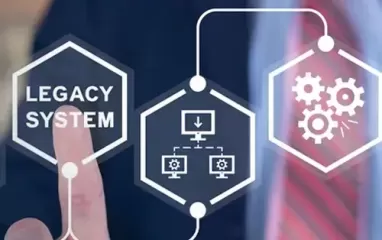
Legacy applications do not fail overnight instead, they quietly become the biggest obstacle to enterprise growth. Release cycles stretch from weeks to months. Security patches take longer because dependencies are poorly documented. Every new integration demands custom work. Product teams postpone innovation because maintaining existing systems consumes most of the engineering budget.
Individually, these issues feel manageable. Collectively, they signal something far more serious: technology is no longer enabling the business—it is constraining it.
For many enterprises, this isn't simply an IT concern. It has become a strategic business challenge. Technical debt increases operational costs, slows product delivery, weakens security, and makes emerging initiatives like generative AI significantly harder to implement.
Research from McKinsey estimates that technical debt consumes 20–40% of the value of an enterprise technology estate before depreciation, while 10–20% of the budget for new digital initiatives is often diverted to resolving legacy issues rather than creating new business value. Those numbers illustrate why enterprise application modernization has become a boardroom priority rather than another infrastructure project.
Modernization today is about far more than moving workloads to the cloud. It is about building an application portfolio that supports faster innovation, resilient operations, stronger cybersecurity, and the flexibility to adopt technologies that will shape the next decade of enterprise growth.
In this blog, we will explore enterprise application modernization: why legacy systems throttle growth, what it actually costs to leave them alone, and how enterprises are running modernization programs without blowing up budgets or timelines. If you're evaluating whether now is the right time to modernize legacy applications, here are the key takeaways.
- Technical debt eats away at the average technology estate's value and 10 to 20 percent of every new project's budget, according to McKinsey research.
- Roughly 68 percent of modernization projects overshoot their initial budget, so sequencing and governance matter more than the technology stack chosen.
- Gartner's six R framework, retire, retain, rehost, replatform, refactor, and rebuild, gives CIOs a structured way to decide what to fix and what to leave alone.
- AI-assisted code analysis and refactoring are cutting modernization timelines and costs, but they do not remove the need for architectural judgment and governance.
- Modernization is now an AI-readiness issue. Clean, modern application layers are a prerequisite for reliable AI deployment, not a nice-to-have.
What Is Enterprise Application Modernization?
Enterprise application modernization is the process of transforming legacy software into platforms that better support today's business, operational, and security requirements. Most core systems running in large US enterprises today were architected for a world without cloud elasticity, API-first integration, or real-time data expectations. That mismatch has a price.
McKinsey surveyed CIOs at financial services and technology companies with revenue over one billion dollars and found that technical debt consumes 20 to 40 percent of the value of the technology estate, and that 10 to 20 percent of the budget for new products gets diverted to resolving tech debt issues instead of building anything new. Sixty percent of the CIOs in that same survey said their organization's tech debt had visibly increased over the prior three years.
The business case is not abstract. McKinsey's later analysis found that as much as 71 percent of the value created in business transformations at financial services and telecom firms depended directly on technology performing well. When the technology cannot keep up, that value simply does not materialize. This is the core argument for enterprise application modernization: it is not a refresh project, it is the precondition for growth, AI adoption, and competitive speed.
Depending on business priorities and technical complexity, organizations may choose to:
- Refactor existing code to improve maintainability
- Replatform applications onto modern infrastructure
- Rehost workloads in the cloud
- Replace outdated systems with SaaS solutions
- Rebuild business-critical applications using cloud-native architectures
- Retire applications that no longer deliver business value
The objective is not newer technology for its own sake. The objective is enabling faster innovation, reducing technical debt, improving resilience, and creating an application ecosystem that can evolve as business needs change.
What's Driving Enterprise Application Modernization?
Several long-term business trends are converging, making modernization increasingly difficult to postpone.
1. Innovation Is Limited by Legacy Architecture
Speed has become a competitive advantage.
Organizations that release new capabilities faster respond more effectively to market changes, customer expectations, and competitive pressure.
Legacy applications slow that process.
Highly interconnected systems often require changes across multiple applications before a single feature can be released. Testing cycles become longer, deployments become riskier, and engineering teams spend more time understanding existing code than delivering new functionality.
Research from McKinsey suggests organizations that actively reduce technical debt can redirect significant engineering capacity toward innovation instead of maintenance, allowing development teams to focus on creating measurable business value.
Modern application architectures support continuous delivery, API-driven integration, and modular services that allow teams to innovate independently without disrupting entire systems.
2. Operating Costs Continue to Rise
Many organizations underestimate how expensive legacy systems have become. Infrastructure maintenance is only one part of the equation. Hidden costs include:
- Manual operational processes
- Expensive software licensing
- Specialized legacy skill requirements
- Increasing integration complexity
- Extended testing cycles
- Security remediation
- Compliance management
Industry research consistently shows enterprises devote the majority of IT budgets to maintaining existing environments, leaving relatively little capacity for innovation. Application modernization changes this balance. Cloud-native architectures, automation, standardized deployment pipelines, and managed services reduce operational overhead while allowing infrastructure to scale according to actual business demand. Instead of investing primarily in maintenance, organizations can redirect spending toward growth initiatives.
3. Cybersecurity Risks Continue to Grow
Security has become one of the strongest business cases for modernization.Many legacy applications depend on operating systems, middleware, or databases that receive limited—or no—vendor support.Even when patches remain available, applying them often requires extensive regression testing because of tightly coupled dependencies.As vulnerabilities accumulate, organizations face increasing operational and regulatory risk.
Modern architectures improve security in several ways:
- Automated patch management
- Identity-first security models
- Continuous vulnerability monitoring
- Cloud-native security controls
- Improved observability
- Built-in compliance capabilities
While modernization does not eliminate cybersecurity risk, it provides a significantly stronger foundation for managing it.
4. AI Readiness Depends on Modern Applications
Perhaps the strongest modernization driver today is artificial intelligence.
Organizations across every industry are investing in generative AI, intelligent automation, predictive analytics, and AI-powered customer experiences.
- These initiatives depend on reliable data.
- They require modern integration patterns.
- They require scalable infrastructure.
And they require applications that expose business capabilities through secure APIs rather than isolated legacy environments.
Organizations attempting to build AI capabilities on fragmented application landscapes frequently discover that the underlying systems—not the AI models themselves—become the primary constraint.
Modernization therefore isn't separate from an AI strategy. It is one of its foundational enablers.
Why Enterprise Application Modernization Projects Fail?
Application modernization has never been easier from a technology perspective. Cloud platforms, containerization, DevSecOps pipelines, AI-assisted code analysis, and low-code development have significantly reduced the technical barriers that once made modernization prohibitively expensive. Yet large modernization initiatives continue to miss deadlines, exceed budgets, or fail to deliver the expected business outcomes.
The reason is surprisingly consistent across industries: modernization problems are rarely technology problems. They are planning, governance, and execution problems.
Organizations that treat modernization as an enterprise transformation initiative rather than an infrastructure upgrade consistently achieve better results by aligning technology decisions with measurable business outcomes.
The most common challenges appear long before the first workload is migrated.
Budget overruns. A majority of modernization projects, by some industry tracking closer to 68 percent, exceed their initial cost estimates, frequently by more than a quarter. McKinsey's research on core system replacements in the insurance sector found similar patterns, with projects routinely running 50 percent or more over budget. The root cause is almost always the same: teams underestimate the complexity of dependencies buried inside decades-old systems.
Scope creep from big-bang rewrites. Attempting to replace an entire system in one release is the highest-risk path available, and Gartner explicitly recommends against it in favor of continuous, incremental modernization. The strangler fig pattern, where new services are built alongside the legacy system and traffic is migrated gradually, converts a high-risk single event into a series of contained, reversible steps.
Weak executive sponsorship. Bain's research on transformation leadership found that appointing a dedicated transformation owner with real authority correlates with 24 percent more of the planned value actually being achieved. Modernization programs that report into a committee instead of a single accountable owner tend to stall.
Underinvestment in change management. A large share of failed ERP and core system rollouts dedicated less than 10 percent of their budget to training and change management. Technology can be perfect and the rollout can still fail if the people using the new system were never properly brought along.
The way we avoid these failure patterns is by refusing to treat modernization as a single monolithic project. We break it into 90-day increments with clear ownership, we classify every application before touching it, and we build in rollback paths before we build in new features.
The Cost of Delaying Application Modernization
Maintaining legacy applications often appears less expensive than replacing them. In reality, the opposite is frequently true. The costs simply become harder to measure because they accumulate across multiple parts of the business.
Some costs are visible
- Infrastructure maintenance
- Vendor support
- Licensing
- Security remediation
Technical debt compounds the same way financial debt does. Every workaround, every deferred upgrade, and every unpatched dependency adds interest to a bill that eventually comes due, usually at the worst possible time, such as during a security incident or a failed integration with a new SaaS partner.
Development teams spend more time maintaining aging systems than building new capabilities. Product launches are delayed because integrations take longer than expected. Customer experiences suffer when applications fail to meet modern digital expectations. Every workaround introduces additional technical debt. Every deferred upgrade increases the complexity of future migration. Over time, these costs compound.
What begins as a decision to postpone modernization eventually becomes an increasingly expensive obligation. McKinsey's 2026 research on CIO technology budgets found that companies which keep run costs disciplined by retiring legacy systems rather than building new capability on top of them free up meaningfully more budget for growth initiatives like agentic AI. The companies McKinsey calls strained transformers, those adding new AI capability on top of legacy platforms without retiring anything, actually see their technical debt increase, not decrease, because they are now maintaining two stacks instead of one.
The timing argument matters too. AI-assisted code analysis has changed the economics of modernization. Automated COBOL-to-Java conversion accuracy has climbed from roughly 40 percent in 2020 to the 70 to 85 percent range more recently, and Gartner has projected that generative AI tooling could cut legacy modernization costs meaningfully by 2027 by accelerating the work of explaining and rebuilding legacy applications. Waiting does not just preserve the current cost. It forfeits a genuine efficiency window that current AI tooling has opened.
How to know if your enterprise applications need modernization: warning signs
A few patterns show up consistently in enterprises that need to act.
Release cycles keep getting longer even though the team has not gotten smaller. Every new integration takes disproportionately long because there is no clean API layer. The people who understand the core system's logic are close to retirement, and the documentation does not exist or is years out of date. Security and compliance teams are flagging the same unpatched components release after release. The system cannot support real-time data flows, which blocks every AI or analytics initiative the business wants to run. And perhaps the clearest signal: the IT budget conversation is dominated by "keep the lights on" spending, with innovation budget shrinking every year rather than growing.
If two or more of these describe your environment, modernization is no longer a future consideration.
Where to focus your modernization efforts
Not every application deserves the same level of investment. Gartner's six R framework, retire, retain, rehost, replatform, refactor, and rebuild, gives CIOs a disciplined way to sort a large application portfolio instead of guessing. Kellton and other practitioners in the field extend this into a seven R model that adds relocate as a distinct category for straightforward hypervisor migrations.
The practical approach is to prioritize by business impact, not by which system is oldest. Core back-end applications and data and analytics platforms are where most enterprises are focusing modernization spend right now, because those are the systems that block AI adoption and real-time decision-making most directly. A legacy HR portal with clunky navigation is an annoyance. A legacy core banking ledger that cannot support real-time payments is a competitive threat. Sequence accordingly.
Proven 7-step enterprise application modernization strategy and best practices for low-risk delivery
Step one: baseline the portfolio. Inventory every application, classify it against the seven Rs, and quantify technical debt in financial terms so the business side can see the cost of inaction clearly.
Step two: define the target architecture first. Gartner's research consistently flags the absence of a clear target architecture as one of the top three reasons modernization programs stall. Decide what the end state looks like before writing a line of migration code.
Step three: sequence for business value, not technical convenience. Start with the systems that unlock the most revenue, reduce risk, or improve AI readiness, not simply the oldest or easiest ones.
Step four: Use the strangler fig pattern for anything mission-critical. Build the new service alongside the old one, migrate traffic incrementally, and keep a rollback path live until the new system has proven itself under real load.
Step five: run in 90-day increments with a single accountable owner. Short cycles with executive visibility catch scope creep early and keep the program honest about progress.
Step six: apply AI-assisted code analysis where it earns its keep. Use it to accelerate legacy code comprehension and refactoring, but pair it with experienced engineering review. AI accelerates the work. It does not replace architectural judgment.
Kellton's approach to enterprise application modernization
Kellton brings structured engineering methodology to every phase of the modernization lifecycle, from portfolio assessment and Rs-based classification through cloud-native architecture design and phased migration execution. Rather than defaulting to high-risk big-bang rewrites, Kellton's teams favor the strangler fig pattern for mission-critical systems, building modern microservices alongside legacy cores and migrating traffic incrementally to protect business continuity. With delivery experience spanning financial services, healthcare, retail, and travel, Kellton builds modernization roadmaps sequenced around business impact rather than technical convenience, and pairs AI-accelerated code analysis with senior engineering oversight to keep delivery both fast and safe. If your legacy applications are limiting what your business can do next, connect with Kellton's enterprise modernization team to assess your portfolio and build a phased, low-risk roadmap.
Frequently asked questions
Q1. What is enterprise application modernization?
It is the process of updating outdated software, infrastructure, and codebases, through rehosting, replatforming, refactoring, or rebuilding, to reduce technical debt, cut operating costs, and support current business and AI needs.
Q2. How do you modernize legacy applications?
Start by classifying every application using a framework like Gartner's six Rs, define a target architecture, then migrate incrementally using patterns like strangler fig rather than one large rewrite.
Q3. What are the two most common challenges enterprises face with legacy systems?
Budget overruns, often exceeding estimates by 27 percent or more, and hidden dependency complexity that makes timelines unpredictable and integrations fragile.
Q4. What are the 7 R's of application modernization?
Retire, retain, rehost, relocate, replatform, refactor, and repurchase or rebuild, depending on which framework variant is used.
Q5. What is enterprise application modernization?
It is the process of updating outdated software, infrastructure, and codebases, through rehosting, replatforming, refactoring, or rebuilding, to reduce technical debt, cut operating costs, and support current business and AI needs.
Q4. What are the risks involved in legacy modernization?
Cost overruns, business disruption during migration, data loss or corruption, integration failures with dependent systems, and stalled adoption if change management is underfunded.
Q5. How do you typically approach an enterprise system modernization program?
Baseline the portfolio, define target architecture, sequence by business value, migrate incrementally with rollback paths, and run the program in short, accountable increments.
Q6. What are application modernization strategies for CIOs in 2026?
Prioritize AI-ready data architecture, use AI-assisted code analysis to accelerate refactoring, retire rather than layer new capability on top of legacy systems, and fund change management adequately.
Q7. How does low-code accelerate application modernization?
Low-code platforms handle the large class of workflow and process applications that consume maintenance resources but do not require full custom rebuilds, freeing specialized engineering capacity for mission-critical core systems.