It is 4:45 PM on a Friday afternoon. Sarah, the VP of Human Capital at a rapidly scaling manufacturing and logistics firm, is staring at three different monitors, nursing a lukewarm cup of coffee. On screen one, she has a standalone shift-scheduling tool showing a sudden spike in weekend line-worker absences. On screen two, an Excel sheet contains real-time product demand data pulled from the warehouse management system. On screen three, the legacy payroll module sits open, completely blind to the overtime costs accumulating on the other two screens.
When the CEO calls to ask if they have the labor capacity to fulfill a major last-minute enterprise order without tanking the quarter's profit margins, Sarah faces hours of manual data extraction, reconciliation, and guesswork.
This isn't an isolated IT hiccup; it is the daily reality of the "swivel-chair effect", the exhausting process of manually bridging fractured software systems. For decades, companies treated Human Capital Management (HCM) and Enterprise Resource Planning (ERP) as church and state: separate, siloed, and rarely speaking the same language.
However, in a business landscape defined by volatile market shifts, hybrid work arrangements, and complex labor regulations, keeping these systems isolated is no longer just inconvenient, it's a financial risk. To survive and scale, forward-thinking organizations are shifting toward a unified strategy: anchoring their modern Workforce Management with ERP.
The Anatomy of the Disconnect: Why Standalone HCM Falls Short
Traditional, point-solution HCM applications are excellent at what they were originally built for: onboarding talent, tracking basic compliance, and storing employee records. But they operate in a vacuum. They understand who your employees are, but they have no context regarding what those employees are producing, how much those hours cost relative to project margins, or where demand will spike next Tuesday.
When your workforce metrics are disconnected from your operational and financial data core, several structural fissures appear:
- The Latency Lag: Data exported from an HR tool into a finance system via a weekly batch CSV file is already outdated by the time it lands. Decisions are made using rearview-mirror data rather than real-time insights.
- The Overtime Blindspot: Line managers approve shift extensions to meet localized deadlines without seeing the macro-level financial impact on corporate profitability.
- Compliance Friction: Managing complex labor laws, shift differentials, and localized union mandates across disparate systems leaves a paper trail vulnerable to human error and costly compliance audits.
To truly future-proof operations, enterprise leaders must transition from reactive administration to proactive workforce orchestration.
Enter Workforce Management with ERP: The Unified Core
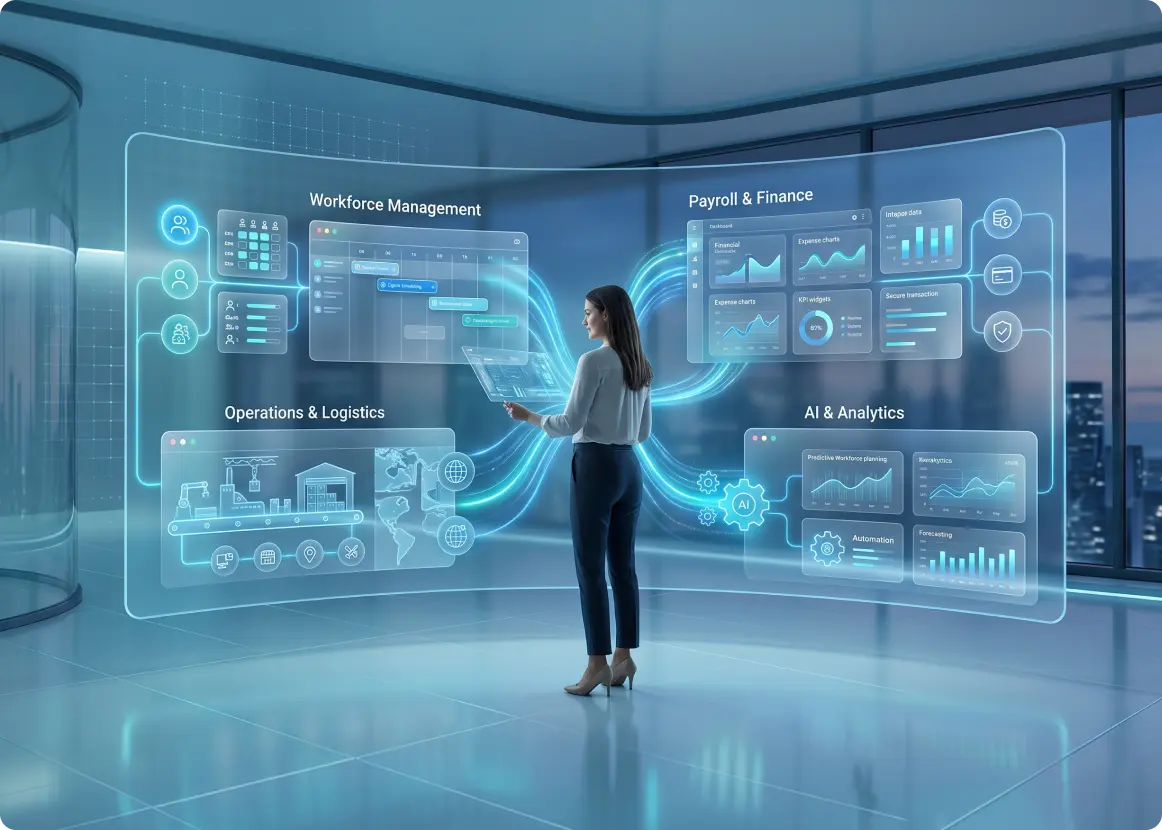
Modernizing your infrastructure means placing people directly into the operational equation. Enterprise Resource Planning platforms have evolved from rigid, back-office ledger systems into dynamic data fabrics. Integrating Workforce Management with ERP creates a single source of truth where human capability seamlessly intersects with operational capacity and financial reality.
The Operational Reality: When a worker clocks in, they aren't just logging time for payroll; they are burning capital, executing an operational task, impacting inventory velocity, and contributing directly to gross profit margins. A unified system recognizes this instantly.
The Contrast at a Glance
| Strategic Dimension | Siloed HCM Point Solutions | Unified Workforce Management with ERP |
|---|---|---|
| Data Synchronization | Delayed batches, manual data clearing | Real-time, continuous data streams |
| Financial Visibility | Disconnected from real-time job costing | Instantaneous calculation of labor vs. margins |
| Operational Agility | Reactive scheduling based on guesswork | Proactive, demand-driven workforce scaling |
| Compliance Integrity | Manual tracking and disparate audit trails | Systemic, hard-coded regulatory guardrails |
Quantifying the Modernization Push
Making a business case for comprehensive technological shifts requires hard data. Organizations are no longer modernizing simply for the sake of adopting new technology; they are doing it to secure measurable operational advantages.
Consider these key benchmarks:
- The Enterprise Shift: The corporate landscape has moved definitively away from isolated software architectures. Enterprise investments reflect this reality, with global spending on ERP software projected to hit approximately $106 billion, driven primarily by organizations replacing fragmented legacy platforms with integrated, intelligent cloud suites.
- The Productivity Dividend: Unifying business operations yields immediate efficiency gains. Data indicates that 78% of organizations experienced distinct improvements in overall productivity after migrating to an integrated ERP framework that bridges the gap between workforce tracking and operational planning.
- The Retention Factor: True modernization impacts cultural health as much as financial metrics. Organizations that leverage integrated, cloud-driven workforce scheduling and employee self-service options experience a 30% to 60% reduction in frontline employee turnover, proving that operational predictability directly enhances the employee experience.
Strategic Pillars of a Future-Proof Workforce
How exactly does a unified approach to Workforce Management with ERP protect an enterprise against economic unpredictability? It comes down to four fundamental operational capabilities.
1. Demand-Driven, AI-Powered Predictive Scheduling
Legacy scheduling is typically based on historic templates: "We always run twelve people on Saturday mornings." But what if a major supply chain delay shifts your raw material arrival to Saturday afternoon, or a sudden demand spike requires a double shift?
By embedding workforce scheduling directly within the ERP architecture, artificial intelligence agents can analyze inbound logistics, sales pipelines, and historical productivity patterns simultaneously. The system can automatically generate optimized schedules that align shift coverage with expected workload, reducing both labor waste and worker burnout.
2. Real-Time Labor Costing and Margin Protection
For service-oriented, construction, and manufacturing enterprises, labor is the most volatile variable expense. If you track hours in a separate HCM system, you cannot calculate the precise cost of goods sold (COGS) or project profitability until weeks after a job concludes.
With an integrated ERP system, every minute logged by an employee is instantly mapped against specific project codes, cost centers, and material inputs. If a particular production line begins running over budget due to unexpected overtime, financial and operations leaders are alerted immediately—enabling adjustments before profit margins collapse.
3. Hyper-Automated Compliance Guardrails
Global labor laws, localized overtime regulations, and industry-specific safety mandates change rapidly. Relying on manual oversight to ensure compliance is a massive liability.
A unified ERP framework embeds regulatory and corporate rules directly into the operational workflow. For instance, if a manager attempts to schedule an employee for a back-to-back shift that violates localized rest-period mandates, the ERP system flags the conflict and blocks the schedule automatically. This shifts compliance from a reactive audit concern to an automated, systemic guarantee.
4. Frictionless Employee Self-Service and Empowerment
Modern workforce management isn't just about supervisory control; it's about empowering the frontline employee. Cloud-based ERP extensions offer mobile-first interfaces where employees can view schedules, trade shifts with certified peers, request time off, and access earned-wage data in real time.
By removing administrative friction, you build a culture of autonomy that reduces the workload on HR personnel while significantly boosting retention and engagement among hourly and field staff.
The Digital Blueprint: Navigating Your Integration Journey
Transitioning to a unified framework requires a deliberate, strategic approach. You cannot simply flip a switch; you must cultivate an ecosystem prepared for continuous evolution.
- Step 1: Audit the Tech Debt: Map every point solution your organization currently uses for time tracking, scheduling, payroll, and core HR. Identify where data bottlenecks occur and quantify the manual hours spent moving information between systems.
- Step 2: Prioritize Composable Cloud Architectures: Avoid rigid, monolithic suites that require extensive, brittle custom coding. Look for modern, API-first, composable ERP platforms that allow you to plug in modular workforce management capabilities seamlessly.
- Step 3: Design the Data Flow Around Outcomes: Define your critical business questions before configuring your system. If your primary goal is optimizing project margins, ensure your time-tracking elements map perfectly to your financial ledger modules.
- Step 4: Focus Heavily on Change Management: Software is only as effective as its adoption rate. Train your frontline managers and operations teams to see the unified ERP system not as a monitoring tool, but as an efficiency driver that simplifies their daily workflows.
Conclusion
Modernizing your HCM infrastructure by anchoring it to a comprehensive enterprise ecosystem is no longer a luxury, it is a strategic necessity for the modern enterprise. By systematically uniting people analytics with financial and operational realities, organizations can permanently eliminate the fractured data silos that stall growth and drain resources.
Transitioning to a unified strategy for Workforce Management with ERP empowers leadership to make proactive, data-backed decisions, protect shifting profit margins, and cultivate an agile environment capable of navigating market volatility. Ultimately, this integration is far more than a standard IT upgrade; it is a foundational commitment to operational clarity, financial intelligence, and long-term organizational resilience.
Frequently Asked Questions
Q1. What is the main difference between standalone HCM software and Workforce Management integrated into an ERP?
Standalone HCM software focuses primarily on HR-centric administrative tasks like talent acquisition, performance reviews, benefits management, and employee record-keeping in isolation. Workforce Management integrated into an ERP merges those employee records directly with live operational, financial, logistics, and project-management data streams, creating a unified ecosystem where labor and operational metrics inform one another in real time.
Q2. Why shouldn’t we just use middleware to connect our separate HR and finance tools?
While middleware can sync data between point solutions, it often functions as a digital patch rather than a true integration. Point-to-point connections frequently suffer from data lag, require ongoing IT maintenance, and fail to provide the unified, real-time analytics environment that native or deeply embedded ERP platforms offer.
Q3. How does integrating Workforce Management with ERP lower operational costs?
It lowers costs by eliminating duplicate software license fees, automating manual data entry, reducing scheduling errors, and curbing unapproved overtime. More importantly, it provides real-time visibility into labor cost fluctuations against specific project margins, allowing leaders to optimize their labor spend proactively.
Q4. Is an integrated ERP framework suitable for companies with high numbers of hybrid or remote workers?
Absolutely. Modern cloud-based ERP environments feature mobile-first access and localized tracking capabilities, making them highly effective for distributed workforces. They handle location-independent scheduling, project-based time allocation, and remote compliance validation far more reliably than legacy, on-premises systems.