The modern enterprise landscape is no longer asking if it should migrate to the cloud, but rather how dynamically it can leverage cloud capabilities to outpace the competition. As large-scale enterprises move away from legacy infrastructures, choosing the foundational Cloud Platform for your operations is one of the most critical structural decisions your technology leadership will make this decade.
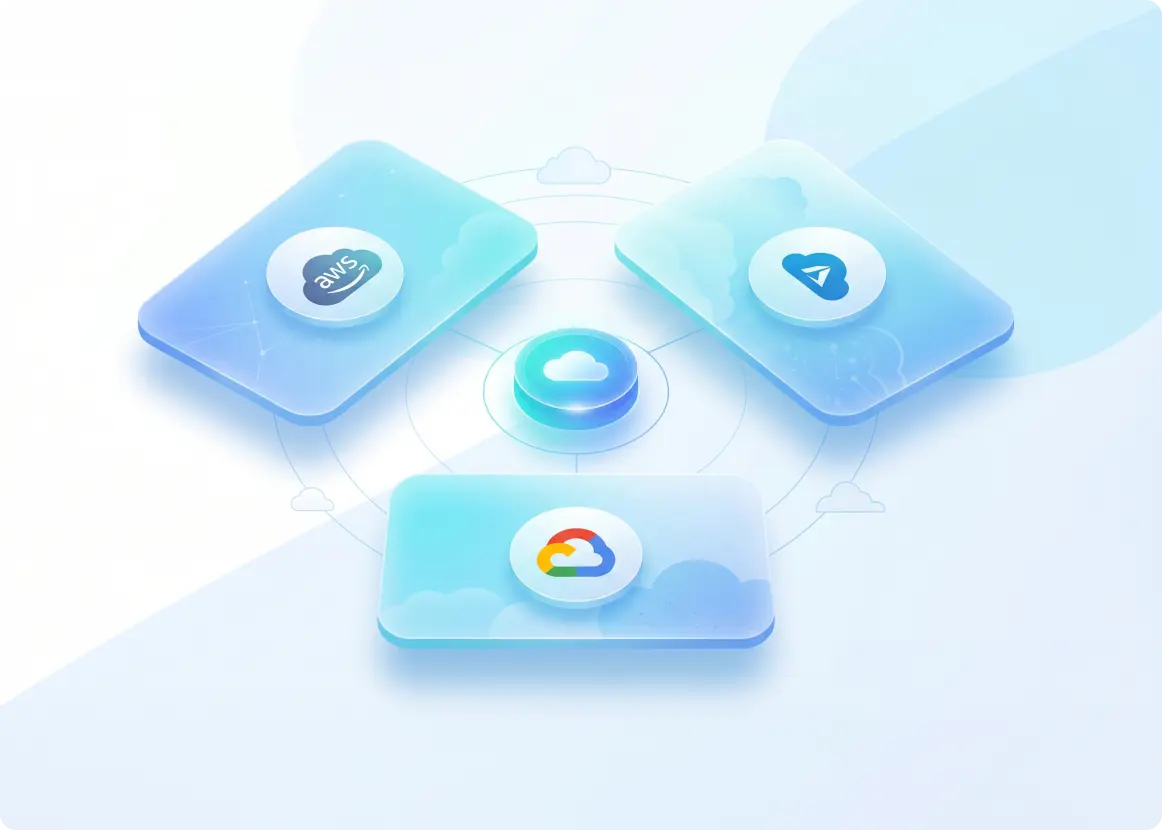
Today, three hyper-scalers dominate the global infrastructure market: Amazon Web Services (AWS), Microsoft Azure, and Google Cloud Platform (GCP). While each Cloud Platform provides exceptional scalability, global availability, and robust security parameters, they are far from identical. Each possesses a distinct architectural philosophy, specialized service strengths, and varied pricing structures that can radically impact your long-term Total Cost of Ownership (TCO).
At Kellton, we specialize in building tech-agnostic, future-proof frameworks through our Cloud Consulting services. We understand that there is no singular best provider; only the provider that aligns precisely with your specific business goals, data architectures, and engineering skill sets.
This comprehensive guide breaks down the technical capabilities, enterprise use cases, financial structures, and modern trends of AWS, Azure, and Google Cloud to help your enterprise make a definitive, data-backed choice.
AWS vs Azure vs Google Cloud: A High-Level Market Snapshot
To understand where each Cloud Platform excels, we must first look at its current standing in the enterprise ecosystem.
| Feature / Metric | Amazon Web Services (AWS) | Microsoft Azure | Google Cloud Platform (GCP) |
|---|---|---|---|
| Market Position | Established Market Leader (~31% share) | Enterprise Giant (~25% share) | Data & AI Challenger (~11% share) |
| Primary Core Strength | Deepest, most mature service catalog; massive global footprint. | Seamless Microsoft ecosystem integration; hybrid cloud supremacy. | Industry-leading data analytics, Kubernetes management, and raw AI growth. |
| Ideal For | Broad, diverse workloads; decentralized microservices; startups to large enterprises. | Existing Windows/Active Directory environments; hybrid enterprise architectures. | Data-intensive applications; cloud-native DevOps pipelines; cutting-edge AI/ML engineering. |
1. Amazon Web Services (AWS): The Mature and Ubiquitous Innovator
Launched in 2006, AWS essentially invented the modern Infrastructure-as-a-Service (IaaS) paradigm. Because it has the longest operational history, this Cloud Platform boasts the most extensive and mature service catalog in the world, featuring more than 200 fully-featured services.
- Compute and Infrastructure Maturity
AWS sets the industry standard for compute depth with its Elastic Compute Cloud (EC2), offering over 500 distinct instance types tailored for memory, compute, graphics, and storage-optimized workloads. Furthermore, Amazon’s custom ARM-based silicon, the Graviton processor series, offers an exceptional price-performance ratio for general-purpose enterprise workloads, cutting compute expenses significantly compared to standard x86 architectures.
- Enterprise App & Developer Ecosystem
For enterprises building cloud-native applications, AWS provides unparalleled developer tooling. From AWS Lambda, the pioneer of serverless compute, to robust container environments like Elastic Container Service (ECS) and Elastic Kubernetes Service (EKS), developers benefit from a deeply documented, battle-tested ecosystem.
- The AI & Machine Learning Angle
Through Amazon SageMaker, AWS provides a highly mature, industrialized MLOps pipeline for building, training, and deploying custom models. Additionally, AWS Bedrock offers enterprise-grade API access to a broad spectrum of foundational models from leading AI startups (like Anthropic’s Claude) and open-source networks, allowing organizations to pivot quickly without being locked into a single model architecture.
The Enterprise Verdict on AWS: AWS is the safest default choice for enterprises requiring maximum service breadth, extensive third-party integrations, and a massive talent pool of certified engineers. However, its expansive service catalog requires strict governance to prevent architectural sprawl and complex billing surprises.
2. Microsoft Azure: The Enterprise Powerhouse and Hybrid King
Microsoft Azure has significantly closed the gap with AWS, establishing an ironclad grip on Fortune 500 companies. Azure's entire philosophy is engineered around the realities of legacy enterprise IT, making it an incredibly natural extension for organizations already utilizing Microsoft software.
- Seamless Microsoft Ecosystem Integration
If your enterprise relies on Windows Server, SQL Server, Microsoft 365, GitHub, Visual Studio, or Active Directory, Azure is your home turf. The integration is seamless: identity management through Azure Active Directory (now Microsoft Entra ID) extends effortlessly from on-premise desktops to complex cloud infrastructures, providing a unified security perimeter that other platforms struggle to match out of the box.
- Hybrid Cloud Supremacy
Azure recognized early on that large enterprises cannot move 100% of their workloads to the public cloud overnight due to regulatory compliance or data residency laws. Azure Arc and Azure Stack allow enterprises to run native Azure services seamlessly across on-premise data centers, edge environments, and even other public clouds, providing a truly unified pane of glass for hybrid cloud management.
- The GenAI Frontier
Azure holds a monumental advantage in the enterprise Generative AI landscape through its close, strategic relationship with OpenAI. Through the Azure OpenAI Service, enterprises gain secure, compliant, private access to cutting-edge models like GPT-4o and reasoning-focused o1 models, backed by Microsoft’s enterprise security, privacy compliance, and data sovereignty guarantees.
The Enterprise Verdict on Azure: Azure is the clear, definitive winner for organizations deeply embedded in the Microsoft enterprise software ecosystem. It offers unmatched hybrid capabilities and premium access to OpenAI tools, though users occasionally note that its portal interface can feel complex to navigate during rapid scaling.
3. Google Cloud Platform (GCP): The Data, Analytics, and Open-Source Pioneer
While Google Cloud Platform entered the hyper-scaler race slightly later, it has carved out an aggressive, high-growth position in the market. GCP approaches cloud computing not as a digital landlord renting out virtual servers, but as an engineering powerhouse designed to analyze massive datasets and run highly scalable, containerized applications.
- The Gold Standard for Containerization and Kubernetes
Kubernetes was originally designed by Google before being open-sourced. Naturally, Google Kubernetes Engine (GKE) remains the most mature, feature-rich, and operationally simplified managed Kubernetes service available on any Cloud Platform. For enterprises deploying microservices-heavy, cloud-native architectures, GKE offers superior automated scaling, lower operational overhead, and simplified node management.
- Unmatched Data Analytics with BigQuery
GCP's absolute crown jewel is BigQuery, a completely serverless, highly scalable enterprise data warehouse. BigQuery allows organizations to run lightning-fast SQL queries across petabytes of data without provisioning or managing underlying database infrastructure. For enterprises aiming to transition away from rigid, legacy data warehouses into a fluid data lakehouse model, GCP’s data analytics suite is universally considered best-in-class.
- Built for Cutting-Edge AI and Infrastructur
Google’s AI pedigree is woven directly into GCP’s DNA. Via Vertex AI, Google provides a unified development platform that brings together data engineering, classic ML, and Generative AI (powered by the native Gemini model family). Additionally, GCP offers specialized hardware like Tensor Processing Units (TPUs) that provide unmatched performance and cost-efficiency for training and running massive, complex deep learning models.
The Enterprise Verdict on GCP: Google Cloud is the premier Cloud Platform for forward-looking organizations prioritizing big data analytics, complex DevOps workflows, and custom AI/ML model training. While its overall service catalog is smaller than AWS or Azure, its core services are exceptionally elegant and high-performing.
Technical Architecture & Core Services: A Side-by-Side Comparison
Choosing the right Cloud Platform requires mapping your specific IT infrastructure needs against the direct service equivalents of each provider. The table below provides an architectural cross-reference for key enterprise domains:
| Technology Domain | Amazon Web Services (AWS) | Microsoft Azure | Google Cloud Platform (GCP) |
|---|---|---|---|
| Virtual Compute | Amazon EC2 | Azure Virtual Machines | Compute Engine |
| Managed Kubernetes | Amazon EKS | Azure Kubernetes Service (AKS) | Google Kubernetes Engine (GKE) |
| Serverless Compute | AWS Lambda | Azure Functions | Cloud Run / Cloud Functions |
| Object Storage | Amazon S3 | Azure Blob Storage | Cloud Storage |
| Relational Database | Amazon RDS / Aurora | Azure SQL Database | Cloud SQL / Spanner |
| Enterprise Data Warehouse | Amazon Redshift | Azure Synapse Analytics | BigQuery |
| AI / Machine Learning | Amazon SageMaker & Bedrock | Azure OpenAI & Machine Learning | Vertex AI & Google TPUs |
| Identity & Access | AWS IAM | Microsoft Entra ID (Active Directory) | Cloud IAM |
The Enterprise AI Battleground: AWS Bedrock vs. Azure OpenAI vs. Google Vertex AI
As Generative AI shifts from pilot projects to core enterprise production, your choice of Cloud Platform determines which AI models, training chips, and compliance frameworks your developers can access. The table below outlines how each hyper-scaler approaches enterprise-grade artificial intelligence:
| Strategic Vector | Amazon Web Services (AWS) | Microsoft Azure | Google Cloud Platform (GCP) |
|---|---|---|---|
| Flagship AI Platform | AWS Bedrock & SageMaker | Azure OpenAI Service | Vertex AI |
| Core Model Strategy | Model Agnostic / Marketplace Provides unified API access to third-party foundations (Anthropic Claude, Meta Llama, Mistral, Cohere) alongside Amazon Titan. | Exclusive Premium Partnerships First-party, deeply optimized access to OpenAI’s frontier models (GPT-4o, o1 reasoning models). | Native Ecosystem Sovereignty Built around Google’s native multimodal powerhouse (Gemini) alongside wide open-source support. |
| Primary Structural Strength | Flexibility & Freedom Enterprises can swap underlying models via a single API without changing their backend application architecture. | Ecosystem Primacy & Scale Unrivaled integration with Microsoft 365 Copilot, security boundaries, and enterprise data pools. | Multimodal Data Scale Gemini’s industry-leading context window (processing millions of tokens) enables massive document analysis natively. |
| Proprietary Hardware Accelerators | AWS Trainium (for model training) and AWS Inferentia (for cost-efficient inference). | Custom Azure Maia AI Accelerator chips alongside deep NVIDIA H100/B200 clusters. | Google Tensor Processing Units (TPUs)—the industry gold standard for training massive deep-learning networks. |
| Enterprise Use Case Fit | Best for enterprises wanting to avoid single-model lock-in and preserve long-term architecture flexibility. | Best for organizations requiring immediate, high-reasoning GPT capabilities tied to existing Microsoft infrastructure. | Best for data-heavy operations, building complex, custom RAG (Retrieval-Augmented Generation) architectures over multi-format data. |
Enterprise Cost Structures: Navigating AWS, Azure, and GCP Financial Models
Pricing across all three hyper-scalers is highly competitive, but the way costs scale can vary drastically based on your architectural design and procurement strategy. To maximize cost-effectiveness on your chosen Cloud Platform, enterprise financial operations (FinOps) teams must evaluate commitment discounts and licensing benefits.
1. AWS Pricing
AWS utilizes a consumption-driven, pay-as-you-go model. It offers significant cost reductions through Savings Plans and Reserved Instances (RIs), yielding up to 72% savings if you commit to a consistent volume of compute usage over a 1-to-3-year period. However, enterprise buyers must watch out for complex data egress (transfer) fees, which can quickly inflate budgets if data flows heavily between regions or out to external systems.
2. Azure Pricing
Azure’s financial trump card is the Azure Hybrid Benefit. This program allows enterprises to repurpose their existing on-premise Windows Server and SQL Server licenses directly in the cloud, resulting in up to 40% to 50% cost savings compared to standard base rates. If your enterprise is already spending heavily on enterprise Microsoft agreements, Azure is almost always the most financially optimized choice on paper.
3. GCP Pricing
Google Cloud takes a much more flexible, customer-centric approach to cloud budgeting. It offers Sustained-Use Discounts (SUDs), which automatically apply price drops to compute instances that run for a significant portion of the billing month, requiring no upfront long-term contracts. For predictable workloads, GCP also offers Committed Use Discounts (CUDs) that rival the savings of AWS and Azure, often making its baseline infrastructure highly competitive for data and container workloads.
Multi-Cloud and Hybrid Architectures: Connecting AWS, Azure, and Google Cloud
While it is tempting to look for a single Cloud Platform to host your entire corporate footprint, modern enterprise strategy has moved firmly toward hybrid and multi-cloud architectures.
Relying entirely on a single vendor exposes an organization to vendor lock-in, localized regional downtime, and rigid pricing negotiations. By partnering with a tech-agnostic cloud engineering expert, enterprises can design an architecture that leverages the unique strengths of multiple hyperscalers simultaneously:
- An enterprise might anchor its core corporate directory and internal productivity applications on Microsoft Azure.
- Simultaneously, they might host their consumer-facing global web applications on AWS to benefit from its immense geographic reach and edge infrastructure.
- Finally, they can route their massive telemetry and operational logs into Google Cloud's BigQuery to power real-time business intelligence and advanced machine learning modeling.
Implementing this multi-cloud vision requires careful governance, standardized infrastructure-as-code (like Terraform), unified security monitoring, and an experienced partner to prevent data silos and spiraling network costs.
How to Choose: The Enterprise Decision Matrix
To finalize your direction, evaluate your organizational priorities against the following diagnostic checklist:
1. What does your current technology stack look like? If your enterprise infrastructure is dominated by Microsoft enterprise software, .NET codebases, and Active Directory, Azure provides the most frictionless path with the highest ROI.
2. What is the core focus of your engineering team? If you are a fast-moving, cloud-native DevOps engineering organization looking for the widest array of developer tools and third-party software integrations, AWS delivers the most comprehensive foundation.
3. Are data analytics, predictive intelligence, and containers core to your competitive advantage? If your strategic roadmap centers on processing massive amounts of data, deploying complex Kubernetes microservices, and utilizing cutting-edge generative AI models, Google Cloud offers an incredibly elegant, high-performance environment.
Accelerate Your Cloud Transformation with Kellton
Selecting and configuring a Cloud Platform is not just an IT infrastructure upgrade, it is a foundational business decision that shapes your organization's agility, security, and financial trajectory for years to come. Navigating the nuances of service dependencies, cloud security protocols, automated compliance, and FinOps optimization requires deep structural expertise.
At Kellton, we are a certified, tech-agnostic partner with dedicated expertise across AWS, Azure, and Google Cloud environments. Our global team of certified cloud consultants works directly with your engineering and business leaders to perform exhaustive IT landscape reviews, map out clear cloud migration roadmaps, design high-availability hybrid architectures, and provide 24/7 Cloud Managed Services.
We don't believe in forcing your enterprise into a one-size-fits-all box. Instead, we help you master the cloud ecosystem to drive true digital transformation.
Ready to find the perfect cloud fit for your enterprise operations?
Connect with Kellton’s Cloud Advisory Team today
Submit
Frequently Asked Questions: Enterprise Cloud Strategy
Q1: What is the most common hidden cost when migrating to a major Cloud Platform?
Ans. Data egress fees; the cost of moving data out of a provider’s network, frequently catch enterprises off guard. While inbound data transfers are free, heavy inter-region data processing or routing information back to on-premise systems can lead to massive monthly billing surprises.
Q2: How does an enterprise prevent single-vendor lock-in?
Ans. By building your workflows around open-source standards like Kubernetes for applications and utilizing cloud-agnostic Infrastructure-as-Code (IaC) tools like Terraform. This decoupling allows you to shift core compute components between vendors with minimal architectural rewriting.
Q3: Which Cloud Platform is best suited for regulatory compliance (e.g., HIPAA, GDPR, FedRAMP)?
Ans. All three hyperscalers maintain robust compliance certifications across major global frameworks. However, Azure often holds a slight edge for strict enterprise governance due to its dedicated national cloud deployments and deep alignment with institutional security policies.
Q4: Can we utilize AI services from Google Cloud if our primary data resides on AWS?
Ans. Yes, via multi-cloud data pipelines, though network latency and egress fees can impact performance. The best practice is to deploy an architectural framework like Google Anthos or Azure Arc to manage workflows natively across heterogeneous environment borders.
Q5: How do we determine which enterprise legacy applications are "cloud-ready"?
Ans. Perform a rigorous workload audit mapping application dependencies, database frameworks, and performance requirements. Applications built on modern microservices can move via a simple "replatform," while rigid monolithic legacy code may require significant refactoring first.
Q6: How does FinOps protect an enterprise from cloud budget overruns?
Ans. FinOps establishes real-time budget alerting, enforces precise resource-tagging strategies, and automates the shutdown of idle development instances. It converts unstructured cloud billing data into transparent, unit-economic reporting mapped directly to organizational business metrics.