For the last few years, the enterprise relationship with Artificial Intelligence was largely conversational. We asked questions; it gave us answers. We provided prompts; it provided drafts. But as we move deeper into 2026, that chatbot era is officially closing.
The catalyst? The rise of the AI Coworker, pioneered by breakthroughs like Claude Cowork.
We are shifting from Large Language Models (LLMs) that talk to Agentic Systems that do the job. This isn't just a marginal improvement in UI; it is a fundamental architectural shift. For leadership at the helm of digital transformation, understanding how an AI coworker actually works, and why it needs to be integrated into your stack, is the difference between scaling productivity and drowning in shadow AI risks.
The 2026 Context: From Passive Assistant to Active AI Coworker
In 2024, if you wanted an AI to help with a project, you had to be the middleman. You would copy data from a spreadsheet, paste it into a chat window, ask for an analysis, and then manually move that result into a slide deck.
In 2026, the Agentic Shift has removed the middleman.
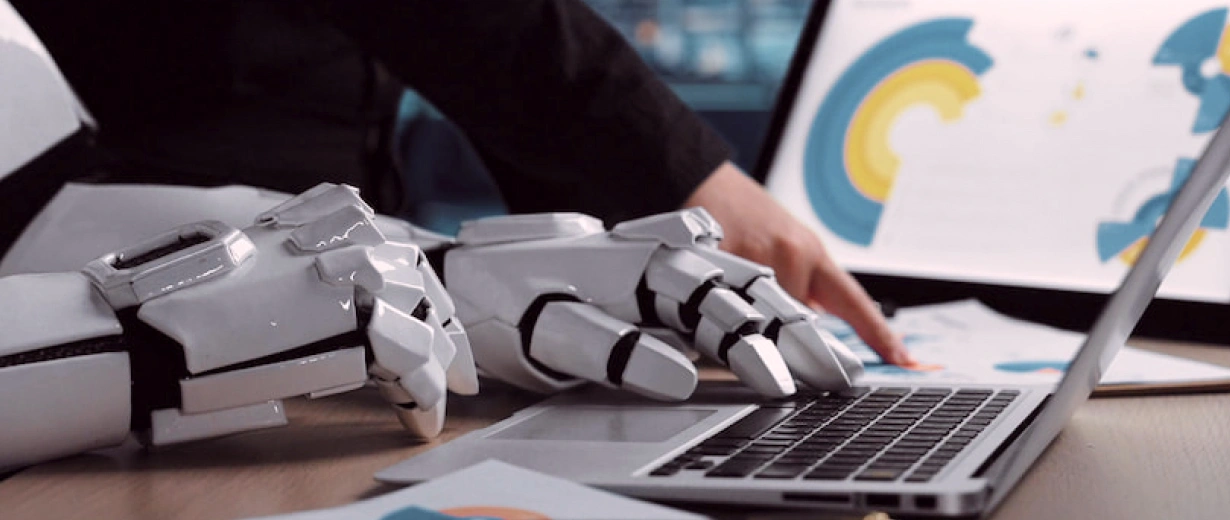
An AI Coworker like Claude doesn't wait for you to feed it data. It has agency. When assigned a goal, it navigates your environment, interacts with your software, and executes multi-step workflows autonomously. Claude Cowork has acted as a catalyst because it proved that an AI could reliably use a computer much like a human does, scrolling, clicking, and typing across different applications to achieve a finished result.
What Exactly is an AI Coworker? (It’s Not Just a Better Chatbot)
To the uninitiated, an AI Coworker might look like a very fast intern. To a technical architect, it is a sophisticated bundle of three core capabilities that 2024-era bots simply didn't possess:
1. Computer Use Capabilities
Standard AI lives in a text box. An AI Coworker lives in a virtualized desktop environment. It can see a screen, move a cursor, and click buttons. This allows it to interact with legacy software that doesn't have an API, opening a 10-year-old ERP system, navigating to the Invoices tab, and extracting data just like a human operator would.
2. Local File & Environment Interaction
Unlike cloud-only bots, a coworker agent can be granted controlled access to local directories. It can open a .py file, find a bug, fix the syntax, and then run a terminal command to test the build. It understands the context of your specific file structure, not just general internet knowledge.
3. Autonomous Browsing
While 2024 bots could search the web, 2026 agents can use the web. They can log into a portal, navigate complex menus, download a CSV, and then cross-reference that data with an internal document. This is active execution, not just passive retrieval.
The underlying magic here is the Agentic Loop. Unlike standard chatbots that halt or hallucinate when facing an unexpected error, an AI Coworker utilizes an iterative execution cycle. If a legacy ERP system throws a random timeout error, the agent doesn't crash; it reads the error, diagnoses the issue, and tries an alternative navigation path. This self-correcting resilience transforms a fragile automated script into a dependable corporate asset.
The Multi-Agent Ecosystem: Claude as an Orchestrator
One common misconception is that Claude is a single entity doing everything. In a sophisticated enterprise setup, your AI Coworker is actually an Orchestrator at the center of a Multi-Agent Ecosystem.
Think of it as a department head. You might have a "Researcher Agent," a "Writer Agent," and a "Compliance Agent." When you give a high-level command, the Orchestrator breaks that task down and delegates it to specialized sub-agents.
The Rise of MCP (Model Context Protocol)
The nervous system connecting these agents to your business is the Model Context Protocol (MCP). This is a game-changer for your tech stack.
In the past, connecting an AI to your data required custom, fragile API integrations for every single tool. MCP provides a universal plug-and-play standard. Whether your data lives in Slack, Jira, Google Workspace, or a private SQL database, MCP allows the AI Coworker to read and write across these platforms seamlessly. It creates a unified fabric of information that was previously siloed behind different logins and interfaces.
Historically, connecting a new tool to an enterprise ecosystem meant writing fragile custom middleware, managing a messy web of webhooks, and constantly fixing broken API endpoints. MCP standardizes this completely by serving as an open-source abstraction layer. By treating all enterprise repositories, from a 20-year-old on-prem SQL database to modern SaaS apps like Jira, as uniform context providers, it slashes engineering integration timelines from months to mere days, drastically lowering tech-stack maintenance costs.
The Shadow AI Risk: Why Doing Nothing is Your Biggest Security Threat
Many organizations are hesitant to deploy AI Coworkers due to security concerns. However, the irony is that not providing an enterprise-grade coworker is what creates the most risk.
The Gap Between Consumer and Enterprise
Your employees are already looking for ways to automate their grunt work. If you don’t provide a secure, Enterprise-Shielded Agent, they will use consumer-grade tools on their personal devices. This is "Shadow AI."
- Consumer Tools: Often train their models on user data, meaning your proprietary code or sensitive client info could end up in a public training set.
- Enterprise Agents: Built on private VPCs (Virtual Private Clouds) where data is encrypted, never stored by the provider, and strictly governed by SOC2/HIPAA compliance.
By building an AI Coworker layer into your stack, you bring this productivity into a managed environment. You control what the agent can see, what it can click, and where the data goes.
Furthermore, true enterprise-grade agents introduce Granular Role-Based Access Control (RBAC) explicitly designed for AI. Just as you wouldn’t give a junior employee root access to your entire financial database, you can restrict an AI Coworker’s session tokens based on its specific department. If an agent encounters an anomaly, its blast radius is strictly contained. This gives SecOps teams comprehensive audit logs, deterministic guardrails, and instant kill-switch control over automated activities.
Real-World Use Cases: Where the ROI Lives
How does this look in practice? Let’s look at three departments where agentic workflows are delivering 10x returns:
1. Marketing: From Research to Execution
Instead of a human spending four hours researching competitor prices and drafting a social campaign, the AI Coworker:
- Browses competitor sites to find current pricing.
- Accesses the internal "Brand Voice" guide.
- Generates five variations of ad copy.
- Logs into the CMS to save them as "Drafts" for human approval.
2. DevOps: The Self-Healing Pipeline
In a modern CI/CD pipeline, an AI agent can:
- Monitor container health.
- When a build fails, read the error logs and identify the faulty line of code.
- Create a Pull Request (PR) with the fix.
- Alert the lead engineer with a summary: "I found a memory leak in the billing module and drafted a fix in PR #402."
3. HR & Recruitment: High-Touch Automation
HR agents can handle the "heavy lifting" of the talent funnel:
- Parsing thousands of resumes against a specific job description.
- Cross-referencing LinkedIn profiles to verify experience.
- Checking the interviewer's calendar via the Google Workspace MCP.
- Autonomously emailing the candidate to schedule a first-round interview—all without the recruiter lifting a finger.
Future Outlook: The Competitive Edge of Proprietary AI Coworkers
As we look toward the end of 2026, a clear divide is appearing in the market.
On one side are companies waiting for "off-the-shelf" software (like Microsoft or Salesforce) to release generic AI updates. These companies will get incremental gains, but they will be using the same tools as their competitors.
On the other side are the leaders who are building their own Agentic Layer. By partnering with specialists like Kellton to build custom AI Coworkers, these companies are creating Digital Twins of their business logic. They own the workflows, they own the fine-tuned intelligence, and they own the efficiency.
In the 2020s, the stack isn't just about databases and servers anymore. It’s about Reasoning and Execution. If your stack doesn't include an AI Coworker that can "do" the work, you aren't just behind, you’re essentially running a manual business in an automated world.
Is Your Team Ready to Orchestrate?
The transition from LLMs that talk to Agents that do is the most significant productivity lever of our generation. The technology—Claude Cowork, MCP, and Agentic Loops—is here. The only question is how quickly you can integrate it into your existing infrastructure to stop "chatting" and start "executing."
Transform your tech stack from simple reasoning to active execution.
Contact Kellton’s AI Center of Excellence to deploy your first secure, autonomous AI Coworker.
Submit